Machines
Fluid Pressure Circuit Treats the Relationship as the Point
As diesel emissions mandates tighten and electric drives emerge, KYB is patenting intricate mechanical valves to keep fluid power from choking on its own waste heat.

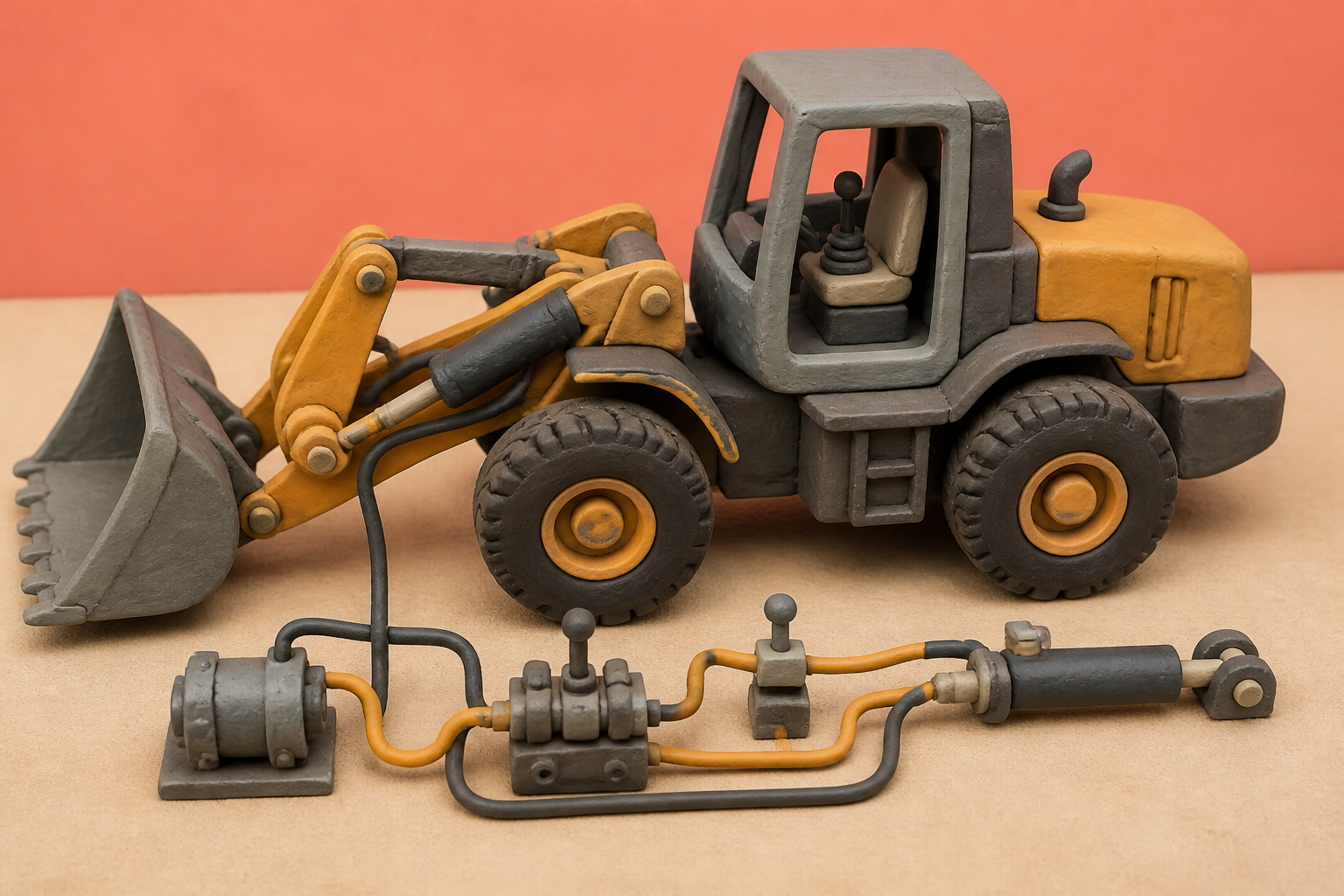
What changes in this design
A person might assume that splitting pressurized flow into two pipes is as simple as turning a tap to a fixed setting. In that everyday view, fluid simply divides evenly according to how wide the pipe is open.
The record describes a diverter valve equipped with its own pressure compensation valve. Instead of remaining at a rigid setting, this component continually alters how wide the diverted passage opens depending on the pressure difference between the main and diverted lines.
This detail shows that moving fluid cannot be controlled just by setting fixed openings when switching between pathways. Watching the live pressure gap between lines allows the hardware to respond directly to changing conditions and keep fluid delivery compensated.
The twenty-one percent machine
The number that caught my eye was twenty-one percent. According to a landmark study from Oak Ridge National Laboratory, mobile hydraulic equipment operates at an average energy efficiency of just twenty-one percent. Nearly four-fifths of the engine power fed into the pumps of a typical excavator or loader vanishes before it ever moves a bucket or turns a track. Instead, that energy bleeds off as fluid heat, requiring dedicated cooling radiators just to prevent hydraulic oil from breaking down under pressure. Across the United States alone, fluid power systems consume between 2.0 and 2.9 quadrillion BTUs every year, generating 308 to 380 million metric tons of carbon dioxide.
The primary villain behind that waste is throttling. Whenever a machine forces pressurized oil through a narrow valve orifice to meter its speed, that pressure drop converts useful work into raw heat. Under federal Tier 4 nonroad diesel rules, exhaust particulates and nitrogen oxides must drop by more than ninety percent. For heavy equipment makers racing to meet those caps, running an engine hard simply to boil hydraulic oil has gone from a tolerated compromise to a major regulatory headache.
A legacy built on oil
Few industrial suppliers understand the physics of heavy equipment like KYB Corporation. Founded in Tokyo in 1919 by Shiro Kayaba, the company grew into a dominant supplier of hydraulic pumps, cylinders, and control valves for construction machinery worldwide. In Japan, it commands an eighty-five percent share of the concrete mixer truck market. Its hardware has long formed the circulatory system of modern construction.
Yet mechanical dominance can mask institutional shortcuts. In October 2018, the company admitted that its staff had systematically falsified inspection records on oil dampers dating back to at least 2003. The altered safety tests affected roughly seventy percent of its damper output across nearly a thousand structures in Japan, triggering mandatory replacements across municipal offices, commercial hubs, and venues prepared for the 2020 Tokyo Olympics. The scandal drove home an uncomfortable lesson: when an industry depends on your valves to absorb violent physical loads, precision on paper is not the same as precision in steel.
What happens inside the diverter valve
That background frames a recent patent application, US20260258821A1, titled "Fluid Pressure Circuit." The published record outlines a system designed to divide hydraulic oil from a single supply source across multiple tasks. A switching valve directs oil through a main passage to an actuator, while a flow diverter valve channels a portion into a secondary passage. Inside the diverter sits a pressure compensation valve that variably adjusts the opening of the diverted passage based on the differential pressure between the two lines.
In traditional machinery, hydromechanical diverters rely on hydrostat spools to balance differential pressure across an orifice. But those spools operate within narrow margins. When working loads shift on an active job site, flow rates wander, pressures fluctuate, and pilot-line lags create dynamic instability. KYB's filing attempts to counter that instability mechanically, balancing the spool against changing line pressures so the secondary circuit receives a dependable flow rate.
Looking at the diagram, I could not tell whether the secondary passage was meant to tame dynamic instability or simply satisfy an equipment maker's existing pump geometry. What struck our team when going through the valve's internal balance was how much machining goes into managing fluid nobody actually wants to pump.
The shift away from throttling
The trouble is that pressure compensation is still throttling. You achieve smooth control by deliberately choking high-pressure oil and dumping the excess energy as heat.
I wondered why an engineering team would spend years refining a sliding metal plug to save a fraction of a bar of pressure when the whole premise is bleeding heat. Other manufacturers are taking a different path. Danfoss developed modular valve platforms like its PVG series, replacing standalone mechanical diverter spools with digitally calibrated proportional valves paired with CAN-bus electronic actuators. Adding electronic flow matching can cut system energy use by five percent simply by adjusting pump displacement to match demand.
Academic research points toward an even cleaner break. At a university fluid power center in Indiana, engineers backed by federal grants demonstrated that decentralized, valveless electrohydraulic actuators can eliminate throttling entirely. Connecting reversible electric drives directly to individual cylinders cut fluid system energy use by up to seventy percent, with simulated efficiencies topping seventy-five percent.
The part worth watching
The commercial stakes are huge. Market analysts value the global hydraulic valve sector at 5.89 billion dollars in 2024 and project it will reach 8.56 billion by 2034, with mid-range valves between 50 and 200 liters per minute commanding nearly forty percent of sales. North America accounts for more than a third of that demand.
When you trace the flow through the published record, what we are really watching is a mechanical patch on a century-old compromise.
My own sense is that this filing marks the twilight of an old mechanical instinct. Heavy equipment cannot afford to waste four-fifths of its fuel indefinitely, especially as battery-powered excavators arrive with strict energy budgets. Refining mechanical diverter spools buys time for equipment builders who want to keep existing diesel chassis in production without overhauling their hydraulic architecture. But as valveless electric actuators prove themselves, the cleverest mechanical valve will not save a machine that wastes energy just to regulate its own flow.
Sources
Reporting for this piece drew on the published filing and the references below.
- Fluid Pressure Circuit (US Patent Application US20260258821A1)
- Estimating the Impact (Energy, Emissions and Economics) of the U.S. Fluid Power Industry
- Japanese firm falsified earthquake safety data on 2020 Olympic venues
- Compensated proportional valves
- Individual Electro-Hydraulic Drives for Off-Road Vehicles
- Hydraulic Valve Market to Grow Over Next 10 Years
The record, briefly. US20260258821A1, “Fluid Pressure Circuit” A fluid pressure circuit includes a fluid supply source, an actuator device, a switching valve to switch flow passages, and a flow diverter valve diverting fluid from a main flow passage to a diverted flow passage. The flow diverter valve has a pressure compensation valve that variably adjusts an opening degree of the diverted passage based on a differential pressure between the passages to compensate for flow rate.
More angles on this
- CPC F15B: Systems acting by means of fluids in generalThe official classification family this record was filed into, published in the USPTO Cooperative Patent Classification scheme.
- CPC E02F: Dredging; soil-shiftingThe official classification family this record was filed into, published in the USPTO Cooperative Patent Classification scheme.
- Liquid Dispensing System With Internal Recirculation Makes a Small Case for Better TimingAnother reading from the wider F26B classification family, drying solid materials or objects by removing liquid therefrom.
- The Quiet Exit Inside a Sensor AttachmentAnother reading in the same Machines category on this site.
Read around this one:Public patent recordUSPTO published figure