Objects
How Dual Retractable Arbors Stabilize the Connection Between Watch Middle and Band
A new patent replaces the century-old spring bar with twin retractable arbors, bringing quick strap changes to an industry built on rigid cases.

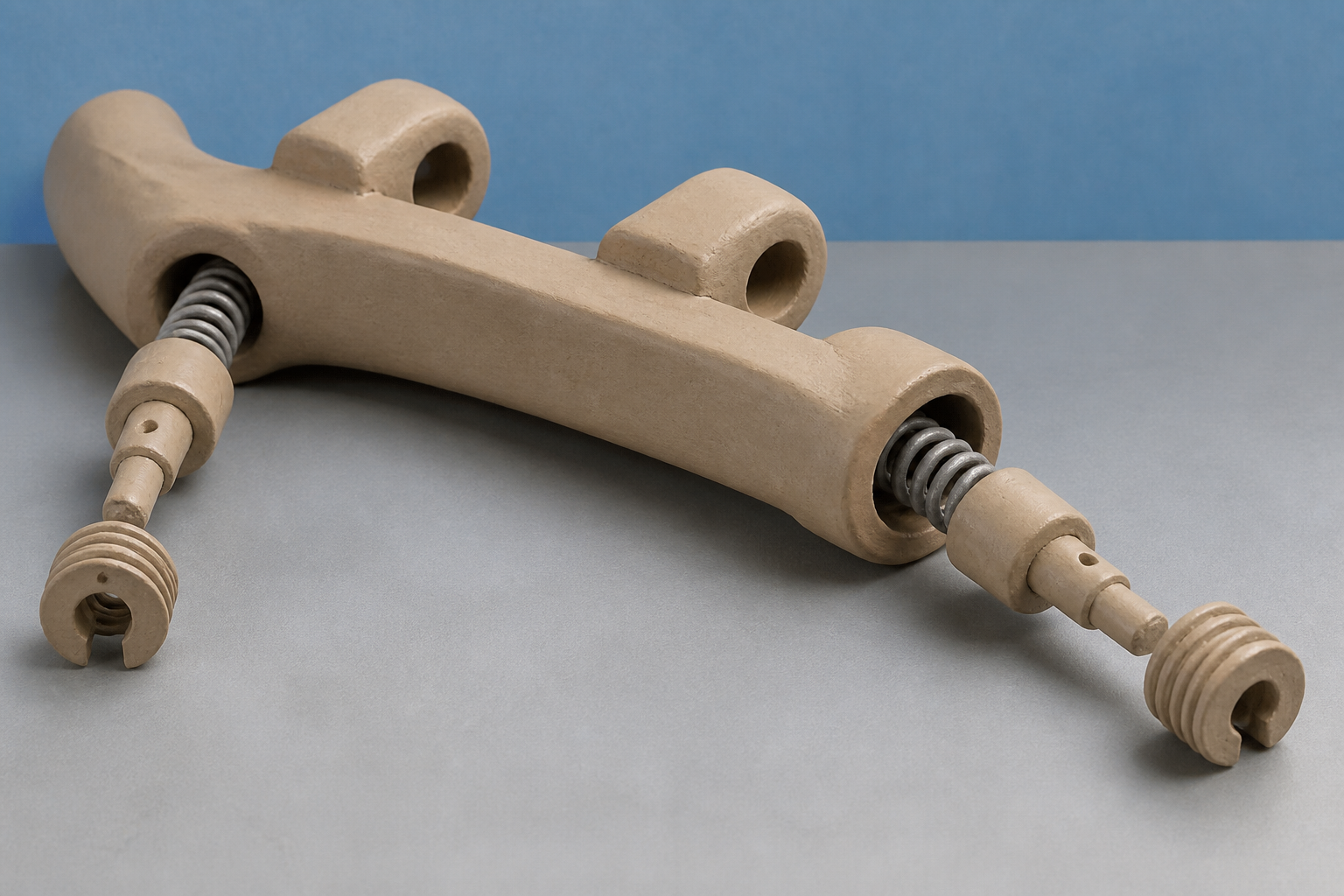
What changes in this design
People generally picture a watch strap held onto a watch body by a single bar or pin spanning the gap. Most assume one continuous piece does the entire job of linking the strap to the case.
Instead of a single bar, this record describes two distinct pins positioned inside separate housings. At least one pin moves against an elastic return element, projecting outward to fasten the middle and connecting element, and retracting for separation.
Examining how watches fit together reveals how small connection points can rely on multiple independent components. Discovering how dual pins, springs, and stop surfaces interact shows how parts are configured for mechanical attachment and release.
The ninety-year-old spring
In 1929, an inventor named Isidor Dinstmann patented a simple mechanism: a tiny metal tube with an internal coil spring pushing two pivot pins outward into holes drilled in a watch case. Before his spring bar, pocket watches converted for First World War trenches relied on soldered wire loops, or fragile screwed pins that stripped under pressure. Dinstmann gave the industry a durable, universal standard that allowed any strap to mate with any case of matching width. It survived the transition from utilitarian drilled tool-watch lugs—where a simple punch could safely compress the bar from the outside—to modern blind-hole solid cases where the pin holes hide on the inner flank. But that aesthetic refinement came at the expense of ease. I spent years swapping steel bracelets with a notched fork tool, feeling blindly for a microscopic shoulder while bracing for the slip that gouges an expensive lug.
Why quick release became mandatory
The modern luxury market no longer tolerates scratched metal. When Cartier released its redesigned Santos in 2018 with the QuickSwitch system, it changed how buyers interact with their cases. Pressing a concealed button under the end-link releases the band in seconds, letting owners switch between a steel bracelet and calfskin strap without visiting a boutique or risking damage with a sharp tool.
Other manufacturers followed, bundling multiple proprietary straps with their timepieces. The commercial stakes are enormous. When we look at Swiss export figures, the concentration is staggering: the top four brands capture 55 percent of the 25.9 billion Swiss franc market. Industry growth has tilted heavily toward ultra-premium pieces, where watches priced over 50,000 francs drive 89 percent of growth despite representing less than two percent of total volume. At the pinnacle sits Rolex, generating 10.1 billion Swiss francs across 1.24 million timepieces in 2023 alone, commanding over 30 percent of global retail market share. When an enterprise of that scale rethinks how a strap meets a case, it changes the entire horological supply chain.
Two arbors inside a watch middle
That brings us to a recent patent, US20260259529A1, titled "Assembly Of A Band Portion On A Watch Middle." Rather than relying on a single floating spring tube slipped between the lugs, the application outlines a dedicated fastening system built directly around two distinct arbors seated in specialized housings within the case middle. Where a traditional spring bar is a separate consumable compressed between opposing lug walls, this architecture integrates the retaining structure directly into the watch case. At least one arbor is movably mounted with an elastic return element that pushes it outward into a projecting position, locking the band element firmly to the case middle.
To release the strap, the arbor retracts against the internal spring. What catches our eye in the application is how strictly mechanical the solution remains. A coaxial stop element provides a stop bearing surface alongside a central opening that guides the arbor's movement without rattling or play. It avoids external push-buttons that could snag on dive gear or disrupt the clean curves of a solid case. The mechanism must also withstand rigorous engineering benchmarks, like the shock and pull requirements of ISO 6425 for mechanical dive watches and DIN 8330 for aviation instruments, ensuring that convenience does not compromise resilience under extreme conditions.
The price of leaving standard lugs behind
This engineering shift directly challenges the independent strap industry. Over the past decade, aftermarket businesses like Everest raised capital on Kickstarter and built thriving operations around curved-end rubber and leather straps priced between $200 and $350. They succeeded because they solved a real aesthetic gap: filling the awkward void between flat-ended aftermarket bands and factory cases, relying entirely on universal spring-bar geometry to achieve a tailored fit.
If proprietary dual-arbor geometries become the norm, universal twenty-millimeter straps will no longer fit. Buyers face classic vendor lock-in. Instead of picking from hundreds of third-party leather, canvas, and rubber options, owners become tied to proprietary straps that often cost hundreds of euros directly from the boutique. Independent artisans lose their canvas when the interface between strap and lug is no longer an open standard.
Where the risk actually sits
I could not find a CPC classification in the published record, which leaves the exact timeline of its commercial rollout unclear. But the strategic direction is evident. Under Swiss regulations, retaining technical development and at least 60 percent of manufacturing costs in Switzerland is required to claim the Swiss Made designation. A proprietary internal case mechanism keeps high-margin accessory production anchored firmly in-house, ensuring that replacement straps and specialized hardware contribute directly to domestic value creation.
That leaves my doubt resting not on the engineering, but on the relationship between owner and object. If you buy a high-end watch today, we expect both unyielding security and effortless versatility. A spring bar from 1929 was clumsy, but it gave the wearer freedom to customize a timepiece without gatekeepers. Replacing it with a captive, dual-arbor housing gives the manufacturer control over every millimeter of the wrist, transforming an open mechanical standard into a closed proprietary ecosystem.
Sources
Reporting for this piece drew on the published filing and the references below.
- US Patent 20260259529: Assembly Of A Band Portion On A Watch Middle
- The Domination of Rolex in the Watch Business
- Morgan Stanley Top 50 Watch Brands for 2025
- A Brief History of Spring Bars & Watches
- The ABCs of Time: Everything about Watch Lugs
- Cartier Santos QuickSwitch and SmartLink Systems
- From Real Estate to Rolex, the Story of Everest Horology
- Making a Tool Watch: ISO and DIN Standards
- Strap Width and Proprietary Lug Interfaces
- Swiss Made Legal Criteria
The record, briefly. US20260259529A1, “Assembly Of A Band Portion On A Watch Middle” A fastening device connects a band portion to a watch middle using two distinct arbors in arbor housings. At least one arbor is movably mounted with an elastic return element urging it into a projecting position to fasten the middle and connecting element, and can retract for separation. A coaxial stop element provides a stop bearing surface and a central opening for arbor movement.
More angles on this
- The Decorative Band Has Detachable ConfidenceAnother reading from the same A44C classification family, personal adornments, e.g. jewellery; coins.
- CPC G04B: Mechanically-driven clocks or watchesThe official classification family this record was filed into, published in the USPTO Cooperative Patent Classification scheme.
- CPC A44C: Personal adornments, e.g. jewellery; coinsThe official classification family this record was filed into, published in the USPTO Cooperative Patent Classification scheme.
- A zipper slider whose underside is set at two heights on purposeAnother reading from the neighbouring A44B classification family, buttons, pins, buckles, slide fasteners, or the like.
- Guiding the Cleaning Rod on an Optical Print HeadAnother reading from the wider G03G classification family, electrography; electrophotography; magnetography.
Read around this one:Public patent recordUSPTO published figure