Groundwork
Integrated Controller For Vehicle Marks a Pause Worth Noticing
A Korean thermal supplier wants to put more vehicle cooling controls on one board, just as carmakers find value in owning the board themselves.

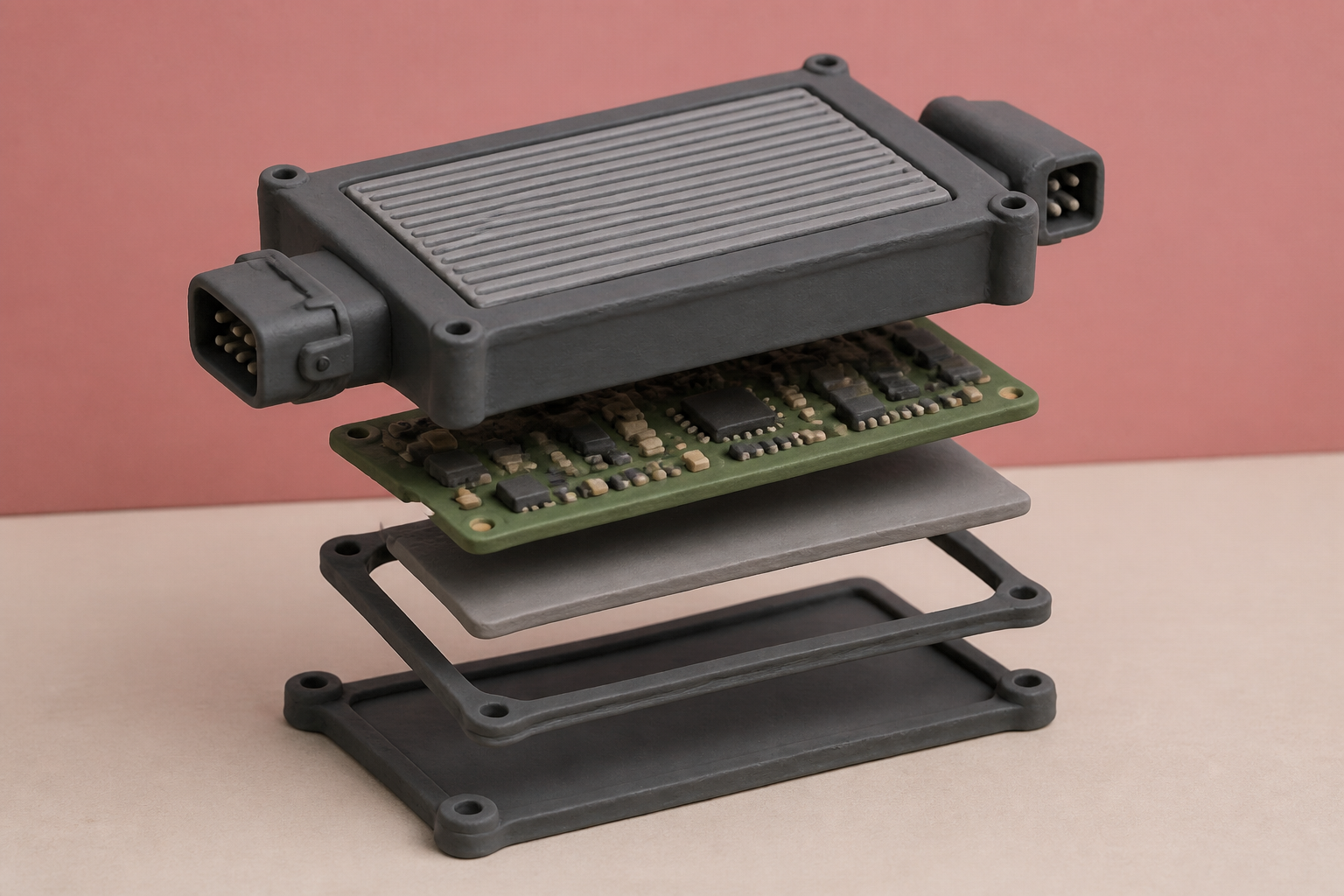
What changes in this design
Without further detail, a reader might picture each electrical part involved in vehicle temperature management being directed separately, or several control units being needed to coordinate them.
Here, one controller directs two or more electrical parts in the vehicle's temperature-management setup together.
For someone comparing vehicle designs, the key point is that a single unit directs two or more temperature-management parts. Its stated aims are cost competitiveness, easier tuning of the parts as a group, and improved reliability.
The $4,700 gap
In 2025, BYD's Seal was priced at $24,190, down from $30,198 in 2022. The number tells a sharper story than any schematic, which is why I started there: a car can get cheaper not only by buying better parts, but by deciding who gets to assemble them. A cost study put BYD's advantage over a comparable U.S. electric sedan at roughly $4,700 per vehicle, about 15% of that rival's price.
At least three quarters of the gap came from vertical integration and lower overhead, as I read it. The study estimated that BYD avoided about $2,369 in supplier markups per vehicle and made about 80% of its Tier-1 components in-house, compared with 37% for the rival. Subsidies explained only about 5% of the difference, so I don't think public aid alone explains the pressure on component suppliers. That is the pressure sitting behind a seemingly narrow patent about cooling hardware.
Hanon's 31 percent
Hanon Systems is the Korean thermal-management supplier listed as assignee on the newly published application. Its second-quarter 2026 operating profit rose 61.3% from a year earlier, and its first-half cost-of-goods ratio improved to 89.3%. Those figures don't read to me as proof that the EV transition has been won. Electrification products were 31% of its revenue, while cost-cutting and foreign-exchange effects helped support the profit improvement.
The timing makes the filing read to me as an attempt to remain useful as the vehicle's heating and cooling equipment becomes more electrically managed. Hanon is now majority-controlled by Hankook, after the 2025 acquisition. It points toward a smaller, cheaper unit that a supplier could sell into an industry where some manufacturers increasingly want the valuable integration work for themselves.
One board, two jobs
That is where I found US20260255554A1, filed on March 6, 2024 and published August 27, 2026. It proposes consolidating control of two or more thermal-management electrical components in one controller. In one claimed arrangement, a high-voltage water heater and a low-voltage cooling fan share electromagnetic-compatibility filters, a DC link, and communication circuitry.
That is more consequential than it first sounds. Instead of giving each device much of its own electronic support, the design puts shared electronics on a single- or dual-microcontroller board. The board can shed heat through the water heater's coolant loop. Hanon presents the arrangement as a route to lower cost, easier system optimization, and better reliability. The first two claims are, I think, the real commercial draw. An earlier Hanon application paired a central manifold with fewer hoses and pipes in an integrated cooling module. This board filing is, to me, a companion move: first reduce the plumbing, then reduce duplicated electronics.
The hot board problem
Yet the phrase "one board" shouldn't do too much rhetorical work, in my view. Research on centralized vehicle computing, rather than this specific design, puts processor junction limits around 80 to 90 C, interactive-surface limits around 40 to 45 C, and thermal loads in the 1 to 4 kW range. Those are constraints, not a verdict on Hanon's controller, but they explain why consolidation can force throttling.
Reliability has a second cost. When several functions live together, a failed board can take several jobs with it. Engineers studying fail-operational vehicle architectures therefore point to dual-lockstep processors and fallback zone controllers. The patent's unresolved economic test, as I read it, is this: if redundancy recreates the electronics it combined, the savings get thinner.
What the filing is really betting on
This isn't a bet that fans and heaters will disappear as separate physical devices. The filing is, I think, a bet that the software, filtering, power handling, and communications around them can be sold as a compact package before the carmaker absorbs that package in-house. The prize is real: the multi-domain controller market is estimated at $2.43 billion in 2026 and projected to reach $4.84 billion by 2031. That forecast is not a guarantee that a component maker captures the value. Asia-Pacific already has 40.34% of the market and is projected to grow fastest as Chinese automakers develop controllers domestically. That is another reason, I think, why the obvious expansion may be most hostile to outside suppliers.
The engineering direction persuades me, but I am less persuaded that integration alone protects a supplier's place. BYD's cost advantage illustrates why a carmaker may want to own it; thermal and failure limits show why it cannot be made cheaply by simply erasing boxes. Hanon's filing matters, I think, because it stakes a claim on making that difficult middle ground manufacturable.
Sources
Reporting for this piece drew on the published filing and the references below.
- Integrated Controller For Vehicle
- Hanon Systems - Wikipedia
- Hanon Systems Announces Second Quarter 2026 Financial Results
- Hanon Systems files patent for integrated cooling module for miniaturization and weight reduction of cooling system
- Centralized Vehicle Computing: Thermal Limits, Fail-Operational Design, and Cost Trade-Offs
- Why Are Chinese EVs So Cheap?
- Multi-Domain Controller Market Size, Share & 2025-30 Outlook
The record, briefly. US20260255554A1, “Integrated Controller For Vehicle” An integrated controller for a vehicle integrally controls two or more electrical components of a thermal management system using a single controller, providing cost competitiveness, easier system optimization, and improved system reliability.
Identity details. The saved title-page transcription needs review, so names are not repeated here. Check the official published title page.
More angles on this
- Duo-Pump Liquid Cooling Device Treats the Relationship as the PointAnother reading from the same H05K classification family, printed circuits.
- Liquid Crystal Polymer Dielectric Powder Or 3D Printed Material Marks a Pause Worth NoticingAnother reading from the same H05K classification family, printed circuits.
- CPC H05K: Printed circuits; casings or constructional details of electric apparatus; manufacture of assemblages of electrical componentsThe official classification family this record was filed into, published in the USPTO Cooperative Patent Classification scheme.
- CPC B60H: Arrangements of heatingThe official classification family this record was filed into, published in the USPTO Cooperative Patent Classification scheme.
- Apparatus And Method For Reorder Buffer With Sliding Window In A Treats the Relationship as the PointAnother reading from the wider H04L classification family, transmission of digital information, e.g. telegraphic communication.
Read around this one:Public patent recordUSPTO published figure