Field Notes
Look-Ahead Vsp Elastic Waveform Inversion Treats the Relationship as the Point
Oilfield patent filings promise clear soundings ahead of the drill bit, but the math under the hood still relies on algorithms from 1965.

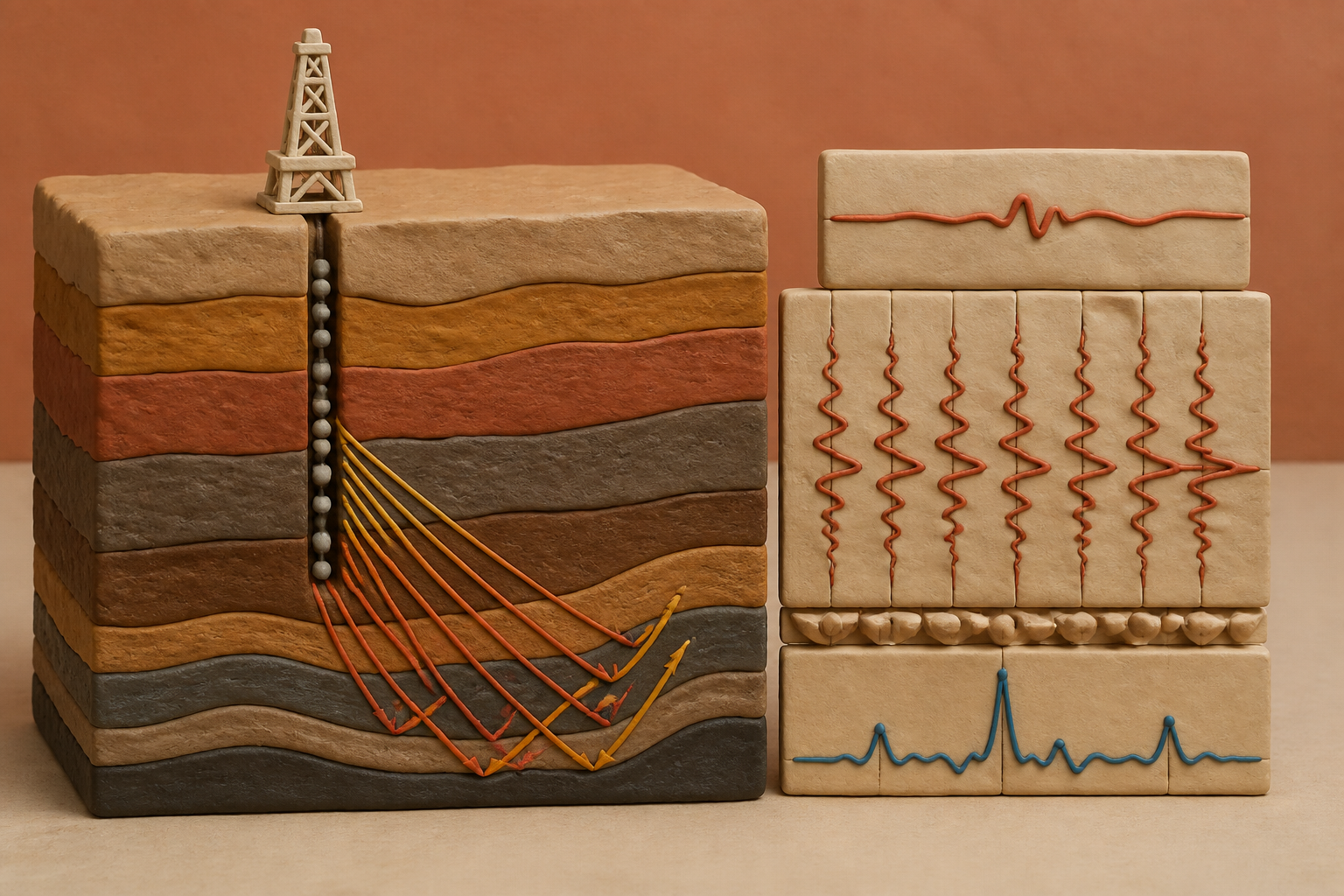
What changes in this design
Normally, once sensors reach the bottom of a well, you can only directly measure the rock surrounding the drilled path, leaving deeper formations uncertain until further drilling occurs.
Instead, this approach uses known velocity and density from the upper well to model what lies deeper. It matches reflected sound signals against a pattern, scans possible layer values across a grid, and mathematically refines the layer depth, speed, density, and attenuation.
Predicting physical properties before drilling deeper helps build an accurate picture of underground structures. Understanding wave speed and layer thickness in advance provides valuable geological insight into unseen zones below the borehole.
The thousand-foot blind spot
In an exploration well drilled into the mountains of Pakistan, the drill bit reached 14,763 feet of measured depth before anyone realized the target was gone. The crew had already set casing at 8,854 feet and continued turning the pipe toward a predicted rock boundary, only to drill 1,049 feet past it without striking the reflector they expected. They were blind in their own borehole. To find their bearings, they halted drilling, ran a vertical seismic profile tool down the hole, and listened for acoustic echoes bouncing off deeper strata to rebuild their velocity model.
That operation ended safely, but drilling into unmapped formations rarely offers second chances. With offshore drillship day rates hovering near $400,000 a day in 2026 and oil prices drifting toward the $50s amid an expected supply surplus above three million barrels a day, nobody wants to pay for blind footage. Yet conventional surface seismic data often blurs the exact boundary where one rock type ends and a dangerous pressure pocket begins.
Twelve hundred pounds of pressure
I suspect most people outside the oilfield assume that modern seismic imaging works like medical ultrasound, offering crisp, unambiguous cross-sections of the earth. The reality is much messier. In April 2010, when the Deepwater Horizon rig drilled the Macondo well in the Gulf of Mexico, pore pressure dropped roughly 1,200 pounds per square inch across just 370 feet between 17,640 and 17,740 feet subsea. That sudden plunge narrowed the safe drilling window to a razor: drilling mud had to exert roughly 14.20 pounds per gallon equivalent to stop reservoir fluids from entering, but anything above 14.3 or 14.4 would shatter the rock.
Researchers who later studied the blowout found that three-dimensional surface seismic surveys simply could not resolve the crucial sandstone layer where that pressure transition sat. That narrow margin makes me understand why drillers demand real-time velocity updates before cutting another foot. If surface soundings cannot see the trap, the only option is to turn the wellbore itself into an acoustic listening post, shooting seismic energy from the surface and recording the reflections returning to sensors placed inside the hole.
The race to see ahead of the bit
What we are looking at in the published record is not a sudden breakthrough, but one more entry in a long corporate footrace. Oilfield service companies have spent two decades trying to out-patent each other on look-ahead vertical seismic profiling. In 2017, Halliburton filed a patent arguing that conventional local gradient methods leaned far too heavily on initial assumptions, proposing a differential-evolution global inversion instead to spot high-pressure zones. In 2022, Sercel filed for an elastic full-waveform inversion method, pointing out that thirty years of acoustic-only processing had produced smeared, artificial halos around stiff salt formations.
A new patent publication, US20260259343A1, titled "Look-Ahead Vsp Elastic Waveform Inversion," stakes out another claim in this territory. The filing outlines a method that takes velocity and density logs measured above the bottom of the well, and uses elastic waveform inversion to infer a one-dimensional profile of depth, velocity, density, and seismic attenuation below the bit. Instead of relying strictly on compressional waves, it models the elastic stress and strain of the rock, cross-correlating subterranean reflections against a template to map out deeper layers.
Sixty-year-old math in modern code
The filing describes a two-step optimization process. First, it performs a grid search across candidate layer parameters to establish a baseline model. Then, it turns the mathematical tuning over to a downhill simplex algorithm to refine the solution.
I find it remarkable that an industry handling multimillion-dollar rigs still leans on a numerical heuristic published when Lyndon Johnson was president. John Nelder and Roger Mead introduced the downhill simplex method in 1965. It is a derivative-free geometric tool that crawls across an error surface by flipping, expanding, and shrinking a geometric simplex. But applied mathematicians know its flaws well: it easily gets trapped on non-stationary points, depends heavily on how variables are scaled, and works reliably only when the objective function is smooth and simple. Subsurface geology is rarely smooth.
Where the risk actually sits
To my eye, the difficulty never lived in writing another inversion formula. The real challenge is that look-ahead seismic methods are trying to solve an ill-posed mathematical problem with noisy, incomplete echoes. Shallow borehole data is notoriously contaminated by ground noise, and converted shear waves decay rapidly as they travel through fractured rock.
We cannot simply compute our way around missing physical signals. When an algorithm runs a 1965 simplex search over elastic waveforms, it produces clean, authoritative curves on a computer screen. But if the underlying wave data cannot separate a change in rock stiffness from a change in fluid pressure, the drill bit is still entering the formation on faith.
Sources
Reporting for this piece drew on the published filing and the references below.
- US20260259343A1 - Look-Ahead Vsp Elastic Waveform Inversion
- US12379514B2 - System and method for elastic full waveform inversion and imaging
- US10324212B2 - Prediction ahead of bit using vertical seismic profile data and global inversion
- Look-Ahead VSP Survey Predicted Missed Target Ahead of Bit, Enabled Successful Casing Landing
- Overpressure at the Macondo Well and its impact on the Deepwater Horizon blowout
- Nelder–Mead method - Wikipedia
- 2026 Offshore Challenge: Softening Demand Puts the Brakes on Day Rates
The record, briefly. US20260259343A1, “Look-Ahead Vsp Elastic Waveform Inversion” Systems and methods process vertical seismic profile (VSP) data using elastic waveform inversion (EWI). Using velocity and density above a well's total depth, the EWI inverts 1D depth, velocity, density, and attenuation below total depth. It searches reflections via cross-correlation with a template reflection, inverts layer parameters using grid search, and optimizes them using a downhill simplex method.
More angles on this
- CPC G01V: Geophysics; gravitational measurements; detecting masses or objects; tagsThe official classification family this record was filed into, published in the USPTO Cooperative Patent Classification scheme.
- CPC E21B: Earth or rock drilling; obtaining oil, gas, water, soluble or meltable materials or a slurry of minerals from wellsThe official classification family this record was filed into, published in the USPTO Cooperative Patent Classification scheme.
- Thermal Imaging Camera Device Makes the Next Move Easier to SeeAnother reading from the neighbouring G01J classification family, measurement of intensity.
- Inside systemAnother reading from the wider G05B classification family, control or regulating systems in general.
- Inside covid-19Another reading in the same Field Notes category on this site.
Read around this one:Public patent recordUSPTO published figure