Field Notes
Luminous Laminated Glass Panel Comprising A Functional Coating Questions the Default Arrangement
A patent about keeping a glowing car roof red-free hints at a bigger problem: the metal inside the coating is getting expensive.

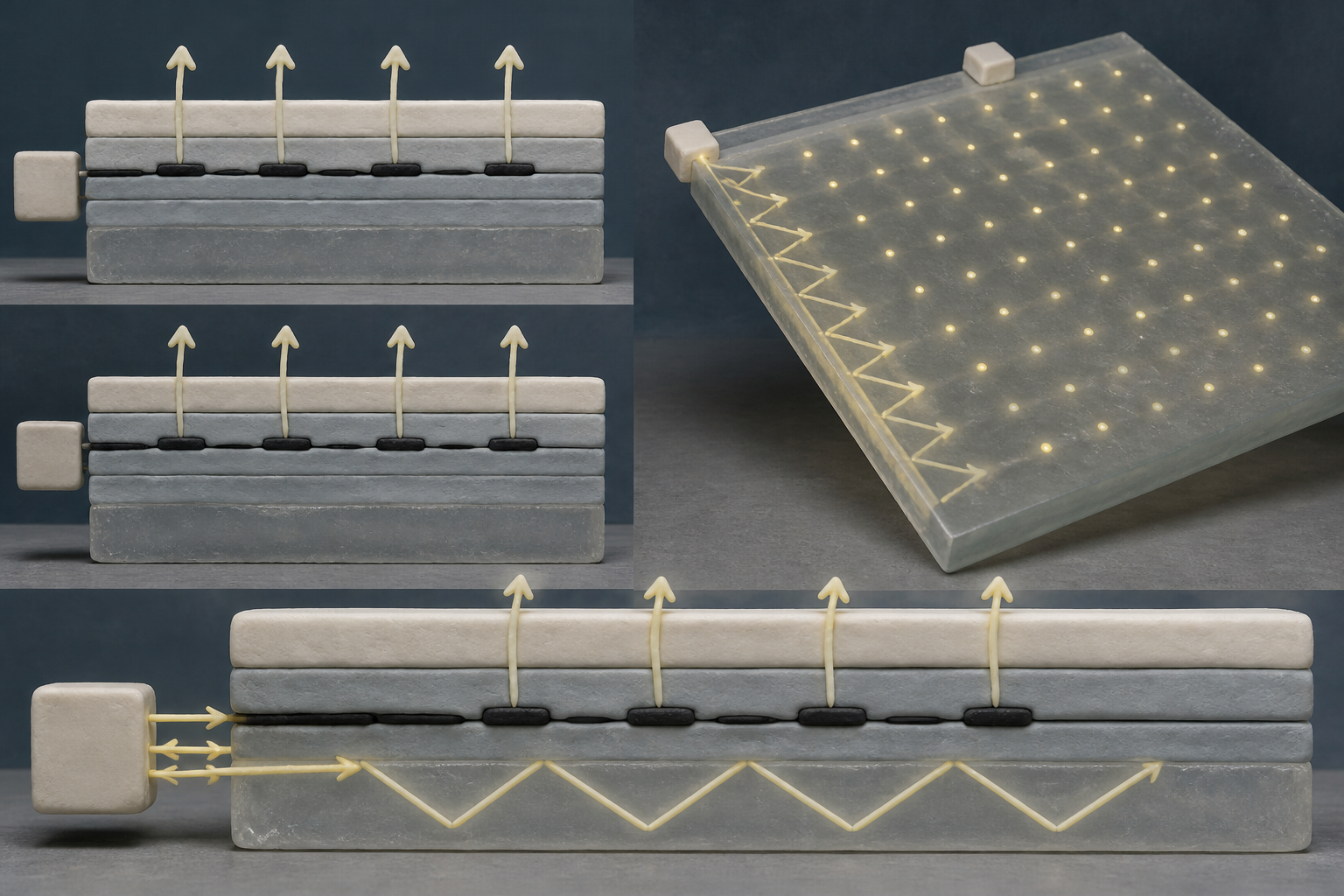
What changes in this design
Ordinarily, a piece of glass built to carry an electrically conductive coating treats that coating as a single functional layer, with whatever sits above or below it added mostly to protect the coating rather than to shape the optics deliberately.
This particular design pairs two dielectric coatings, one above and one below the conductive layer, and each coating contains both a higher-index and a lower-index layer. It also sets exact numeric limits: the gap between those two refractive indexes at 550 nanometers must exceed 0.25, and the combined optical thickness of both coatings together must exceed 200 nanometers.
Putting hard numbers on both the index gap and the combined thickness means the coating stack isn't just extra layers - it's built to a specific optical recipe, which is the kind of detail that can shape how a finished glass panel looks and behaves once it's installed.
A Roof That Glows Without Wires
Picture a panoramic car roof that glows evenly from the windshield header to the back seat, with no LED strip visible anywhere on the glass. Saint-Gobain Sekurit sells exactly that under the name AmpliSky, part of a line it calls Light in Glass. 'The lighting function is embedded within a standard laminated glazing pane, remaining invisible until activated,' the company's Fabien Geniaux has said of it. Light enters at the edge of the pane and travels sideways inside it, bouncing along by internal reflection until it needs to surface as visible light somewhere in the middle of the roof. Whether that counts as luxury or gimmick depends on the car it's fitted to, but the physics underneath turns out to be genuinely interesting, and a little more fragile than the marketing lets on.
Where Sideways Light Goes Wrong
The trouble starts with the same coating that makes ordinary window glass efficient in the first place: a low-emissivity layer that keeps heat inside in winter and outside in summer. Send light sideways through glass carrying that coating and it strikes the layer again and again on its way to wherever it's meant to surface, and the coating doesn't absorb every color equally. Red fades first and fades worst, so a pane lit from one edge drifts in color and dims the farther the light has to travel. I had to read the filing's own description of the failure twice to believe a patent would name it this plainly: erasure of the pattern, worst in the red band, growing as distance from the light source increases.
A Fix Measured In Tenths Of A Percent
The fix claimed in US20260259364A1, filed under the title Luminous Laminated Glass Panel Comprising A Functional Coating, isn't a new light source. It's a rebuilt sandwich around the existing one: the transparent conductive oxide that actually carries current sits between two dielectric coatings, each built from a higher-index layer and a lower-index one, silicon nitride and silicon oxide in the filing's own examples. Push the refractive index gap between those layers past 0.25 at the wavelength the eye reads best, and push the combined thickness of both stacks past 200 nanometers, and reflection inside the guided light climbs into a range the filing states as 91.7 to 96.0 percent. Those aren't round numbers, and if I'm honest, they read like a tenth revision of a stack, not a first one.
Fifteen Years Of The Same Problem
No assignee is listed on the filing itself. I couldn't find one stated anywhere in the public record, but the background section cites Saint-Gobain's own commercial products, Satinovo and Smoothlite, as its points of reference, and it builds directly on a chain of earlier applications running back through 2022 and 2018 to a filing from 2010. That isn't the pattern of an outside inventor solving a one-off coating problem. It's a company working through the fine print of a technology it has already been selling for years.
Whatever this filing is defending, it's defending it inside a genuinely crowded field. One industry estimate puts the automotive glass market at $55.5 billion by 2035, and several large glassmakers are chasing the same panoramic-roof and smart-glazing contracts. Laminated glazing carrying any functional coating still has to clear ECE R43, the regulatory testing regime paired with EU directives that checks impact resistance, optical distortion and light transmittance before a pane can be fitted to a vehicle at all. A patent this narrow, covering a few percentage points of reflected light, only matters if somebody else might file one first.
The Metal Behind The Coating
The material doing the electrical work inside that stack is a transparent conductive oxide, and the near-universal choice for the job is indium tin oxide. Indium isn't mined for itself anywhere; it only comes out as a byproduct of zinc smelting, so the supply can't expand quickly no matter what the price does. And the price has moved: about $265 a kilogram in January 2024, $500 to $600 in Rotterdam by early 2026, roughly a 55 percent jump since September 2025 alone, with China, which supplies about 70 percent of the world's refined indium, cutting exports along the way. Indium now sits on the critical-minerals lists in the US, the EU, and Japan. None of that shows up in the patent, and it doesn't need to, but it shaped what I went looking for once the number surprised me.
Where the risk actually sits
None of this is new territory for Saint-Gobain. Back in January 2008, its research arm and a German partner, Novaled, announced Silverduct, a metallic transparent electrode with sheet resistance under 4 ohms per square against roughly 30 for standard indium tin oxide, built explicitly to route around the limits of oxide electrodes in large-area lighting. The company has known for close to two decades that there's a way to do this job without indium, and that fact, more than anything in the coating chemistry, is what changed my read of this filing.
Saint-Gobain has, by its own account, named cost and industrialization, not remaining optical performance, as what stands between this glass and wider use in cars. A patent that shaves a few more percentage points off guided-mode reflection is a patent that assumes the material underneath it stays affordable enough to keep using. My guess, watching indium climb while a filing works out how to use it more efficiently, is that this is a company polishing a technique it may eventually need to retire, backed by research it already banked once before.
Sources
Reporting for this piece drew on the published filing and the references below.
- Luminous Laminated Glass Panel Comprising A Functional Coating - Justia Patents
- Saint Gobain and Splanemann defend smart glass patent at EPO
- Revolutionising car interiors with Saint-Gobain's Light in Glass technology
- Indium Prices Surge to Decade Highs
- Saint-Gobain and Novaled Announce a Breakthrough in Glass Substrates for OLED
- Automotive Glass Testing in Compliance with ECE R43
The record, briefly. US20260259364A1, “Luminous Laminated Glass Panel Comprising A Functional Coating” A material for luminous laminated glazings includes a substrate coated with a functional layer based on a transparent conductive oxide, sandwiched between two dielectric coatings each having a higher- and lower-refractive-index layer, where the refractive index difference at 550 nm exceeds 0.25 and the combined optical thickness of both dielectric coatings exceeds 200 nm.
More angles on this
- Inside multi-tiered semiconductor waveguideAnother reading from the same G02B classification family, optical elements, systems or apparatus.
- Waveguide For Display Panel Makes a Small Case for Better TimingAnother reading from the same G02B classification family, optical elements, systems or apparatus.
- CPC G02B: Optical elements, systems or apparatusThe official classification family this record was filed into, published in the USPTO Cooperative Patent Classification scheme.
- CPC F21V: Functional features or details of lighting devices or systems thereofThe official classification family this record was filed into, published in the USPTO Cooperative Patent Classification scheme.
- Inside road safety system including multiple roadAnother reading from the wider G01W classification family, meteorology.
Read around this one:Public patent recordUSPTO published figure