Objects
Manufacturing Method Of Electronic Device Treats the Relationship as the Point
A small vacuum-bonding patent lands as Innolux shifts away from the LCD factories whose precision it still needs to defend.

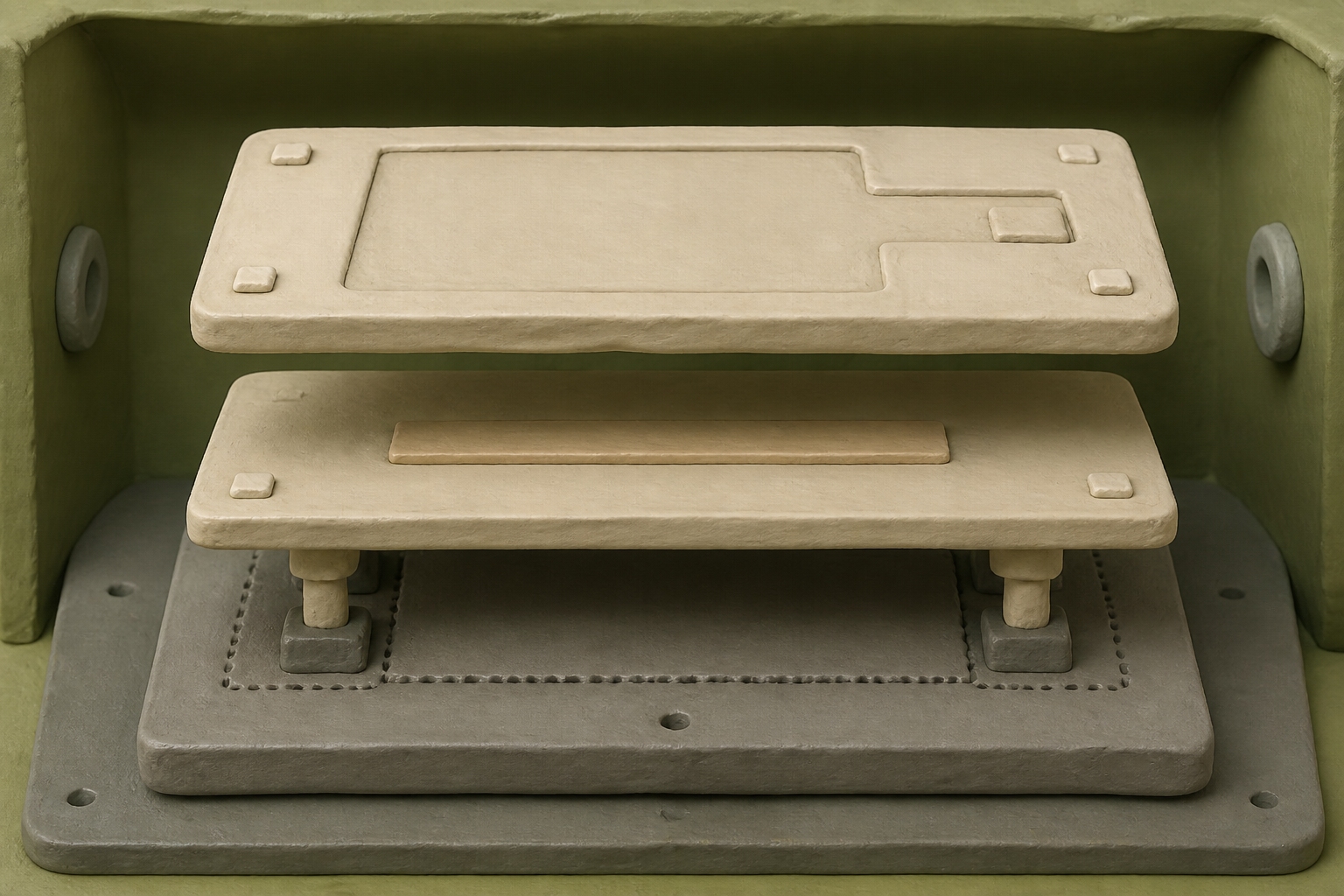
What changes in this design
Someone looking at two device panels might assume they can simply be brought together and lined up by their marks. They may not expect air pressure or the placement of joining material to be part of the alignment process.
This record calls for marks on a first panel and at least one second panel to be aligned under vacuum below 700 Pa. A first joining piece is used, and the marks and joining material must remain separated by positive first and second distances.
It shows that accurate positioning is treated as more than matching visible marks. Low air pressure and the physical spacing around the joining material are included as conditions of the manufacturing method.
Fab 3 goes quiet
In late 2027 or 2028, a Taiwanese laptop-panel line called Fab 3 is expected to stop making LCD panels. Its operator may convert the site to advanced packaging, a business far removed from the thin display stacks that once justified giant factories and ever-finer production tools.
That future makes a September patent publication feel oddly timed. Innolux is still refining how two panels are lined up and bonded, even as display making occupies a smaller place in its business. The company’s non-display packaging activities accounted for 55% of its first-half 2026 revenue, while its display unit continued to face weak consumer demand and higher component costs. I don’t read that as evidence that screens are finished. It does make each process improvement look less like expansion and more like protection for work that remains valuable while the company changes shape.
Two marks under vacuum
The filing, US20260259446A1, is concerned with a very small failure that can spoil a very large object. Two panels must be aligned, adhesive placed between them, and the assembly bonded. Do the alignment in normal air and then move it into a vacuum chamber, the application argues, and the pressure change can shift the panels before bonding is complete.
Its answer is to keep the operation together: align the marks and bond the panels under a vacuum below 700 pascals. The marks must also sit a positive distance from the adhesive. That condition sounds fussy because it is. A related parent application puts the marks 50 to 1,000 micrometers from the adhesive, with 250 to 350 micrometers presented as preferable, and calls for no more than 50 micrometers of variation between the marks. I found that scale clarifying: this is not a new screen, but an attempt to prevent a screen from becoming fractionally wrong during assembly.
A factory of tolerances
Those fractions matter across LCD, LED, and OLED panel stacks, where layers have to meet without visual defects or mechanical stress. The filing is a divisional of an application filed in February 2024, which claims priority from filings in the United States and China in 2023. Patent publication is therefore a late view of an engineering concern that has already spent years inside the system.
Innolux itself was formed in 2010 through the merger of three display businesses, described at the time as the largest flat-panel merger in history. Its scale was built for an era when building panels was the central contest. My hesitation is with treating this application as a simple sign of confidence in that old contest. A patent can be a way to reserve room to operate, preserve accumulated know-how, and make a production line worth more to the people still using it. The published application does not tell us which of those purposes matters most.
The shrinking LCD share
Taiwan’s panel makers are working in a market whose center of gravity has shifted. One 2025 account put China at 76% of the global LCD market and Taiwan at 19%, attributing a period of price stabilization partly to Chinese manufacturers holding factory utilization around 75% to 80%. Another industry account says Chinese makers took 52.1% of display-industry revenue in the first half of 2025.
Numbers from different market reports measure different things, so I would not blend them into a single verdict. They do point in the same direction. Industry researchers expect Innolux and another Taiwanese panel maker together to fall below 10% of LCD monitor-panel supply and to about 20% of notebook-panel supply by 2028. The planned Fab 3 closure belongs in that picture. So does the move toward packaging technologies such as FOPLP, TGV, and CPO, where glass handling and precision assembly may yet find a second use.
The harder half of the problem
Vacuum alignment is not Innolux’s invention alone. HKC, another panel maker, received a U.S. patent in 2023 for a laminating method that uses two rough-alignment passes and a pressure-stabilization stage at 800 to 1,000 pascals. Its stated concern is avoiding peeling or damage to the liquid-crystal layer. The contrast matters: one approach keeps alignment and bonding in a continuous lower-pressure vacuum; the other pauses to stabilize pressure. Neither turns precision into a solved problem.
That is why this filing deserves attention, though not inflated praise. The novelty claim is bounded by a specific arrangement of panels, marks, adhesive spacing, and sub-700-Pa processing. What interests me is the persistence behind it. Even while the business moves toward packaging and retires capacity, Innolux is still trying to hold two shifting surfaces exactly where they belong. The company’s harder problem is not whether it can make that move. It is deciding how much of a changing industrial future can still be built from the discipline that made its old factories work.
Sources
Reporting for this piece drew on the published filing and the references below.
- US20260259446A1 - Manufacturing Method Of Electronic Device
- US20240319529A1 - Electronic device and manufacturing method thereof
- Capacity Rationalization by Taiwan's Two Panel Giants to Reshape TV, Monitor, and Notebook Panel Supply by 2028
- Innolux Q2 2026 slides: packaging pivot amid display weakness
- AUO, Innolux forecast to make modest profits: researcher
- US11604372B2 - Method and control device for laminating display panel as well as vacuum laminator
The record, briefly. US20260259446A1, “Manufacturing Method Of Electronic Device” A manufacturing method provides first and second panels with alignment marks, aligns the first and at least one second mark under vacuum below 700 Pa using a first adhesive member, and requires positive first and second distances between the marks and adhesive member.
More angles on this
- When Angled Light Takes the HandoffAnother reading from the same G02F classification family, optical devices or arrangements for the control of light by modification of the optical properties of the media of the.
- The Routine After a Heatable Optical ChoiceAnother reading from the same G02F classification family, optical devices or arrangements for the control of light by modification of the optical properties of the media of the.
- CPC G02F: Optical devices or arrangements for the control of light by modification of the optical properties of the media of the elementsThe official classification family this record was filed into, published in the USPTO Cooperative Patent Classification scheme.
- When Vision Correction Stops Being a Separate ErrandAnother reading from the neighbouring G02B classification family, optical elements, systems or apparatus.
- Inside road safety system including multiple roadAnother reading from the wider G01W classification family, meteorology.
Read around this one:Public patent recordUSPTO published figure