Field Notes
When Angled Light Takes the Handoff
A new liquid-crystal application lands as old LCD alignment patents settle a trade fight and OLED climbs.

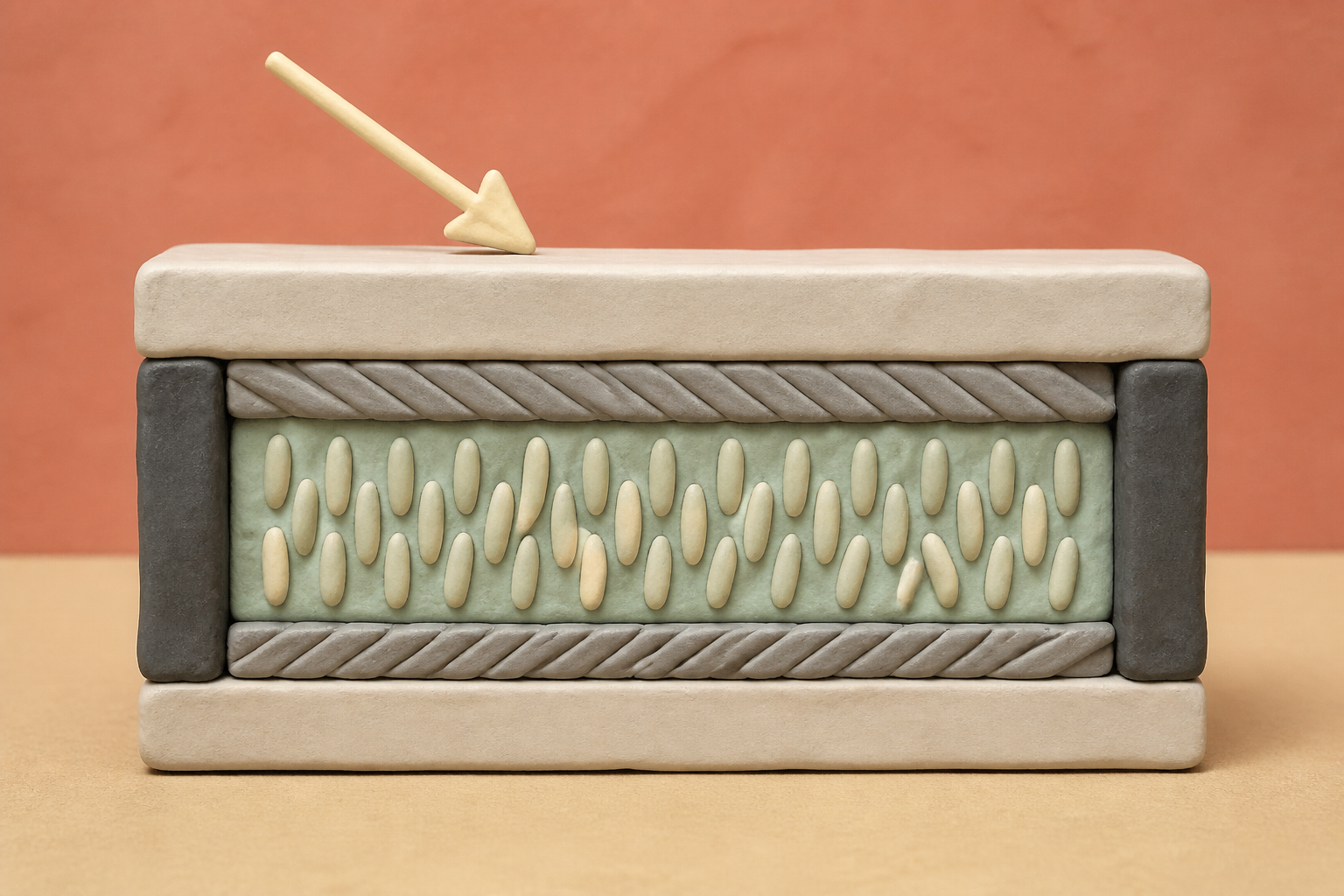
What changes in this design
A reader might assume that making a layered liquid-crystal element simply means placing the material between two supporting surfaces. The record does not state how such elements are ordinarily made.
Here, light is directed at the liquid-crystal layer from an angle rather than straight on. That treatment forms two polymer films that are set at a tilt, using material that includes a photopolymerizable monomer.
The key detail is the angle of the light. It is part of the manufacturing step and is tied to the formation of the two tilted films, rather than being presented as a separate feature.
August 21, 2026
On August 21, a U.S. trade investigation into LCD imports ended without an import ban. A complaint filed the previous August had accused 19 respondents, including major television brands and panel makers, of infringing two older LCD patents. Settlement motions arrived in June and July 2026, an administrative judge issued a termination order on July 22, and the Commission voted to end the case on August 20.
The timing made me look past the legal calendar and toward the manufacturing relationships behind it. This was a roughly nine-month licensing campaign over the familiar LCD arrangement of two glass substrates with liquid crystal between them. That construction is old enough to feel settled. It plainly is not settled enough to stop generating disputes.
Three thousand five hundred patents
One of the asserted patents was filed on October 12, 2007 by an Epson display unit and reassigned in 2018. Longitude Licensing says its Dublin-based 138 East LCD Advancements portfolio contains about 3,500 Seiko Epson LCD patents. An 18-year-old patent can therefore acquire a new commercial life long after its technical moment has passed.
This is why I resist treating patent age as a measure of present importance. The case did not produce an infringement ruling, so it cannot tell us which side would have prevailed. It does show that old alignment and electrode work can still bring current television supply chains to the negotiating table.
Light at an angle
Alignment is the practical problem beneath the glass. Liquid-crystal molecules must be persuaded to lean in controlled directions, because the direction changes how light passes through a panel. A 2012 polymer-alignment patent laid out the familiar costs: rubbing can create static electricity and contaminants; electrode slits and ribs can produce uneven brightness and response; polymer-sustained alignment can introduce process-control problems and residual monomer.
The technical history gives us a stubborn trade-off, not a finished solution. A 2015 patent described how additional ultraviolet exposure could improve voltage-holding reliability while reducing anchoring energy and worsening image sticking. Its proposed answer used heavily uneven doses on the two substrates. A 2012 photo-alignment predecessor claimed a roughly 6% transmission gain and less afterimage by steering molecules away from problems at panel edges. Polymer-sustained alignment reached mass production around 2005, and later variants were reported to improve transmission by 30% over an earlier version.
US20260259445A1 belongs in that argument. It proposes forming a liquid-crystal layer between two substrates, shining light obliquely from the surface side, and creating first and second inclined polymer layers. Its liquid-crystal material includes a photopolymerizable monomer and a trans body with a central double bond. That history is why I read this as a manufacturing problem rather than a screen-feature announcement. The public patent entry attaches no numerical performance gain to this method, so comparison with those earlier claims would be premature.
878.1 million panels
A 2026 industry forecast puts large-area LCD shipments at 878.1 million units, down 3.0% year over year. Large-area OLED shipments are forecast at 38.8 million, up 18.8%. The number that stopped me was not OLED's growth rate but LCD's scale: a shrinking category can still be vast enough for tiny yield, brightness, reliability, or licensing advantages to matter.
Demand is not falling evenly. LCD television panels below 65 inches are forecast to decline 5.9%, while panels at 65 inches and above grow 8.4%. An established liquid-crystal supplier now also lists smart-dimming films, VR, automotive, and AR among its markets. My view is that these figures describe a mature technology being worked from several directions at once, rather than a simple handoff from LCD to OLED. Nothing here proves why this applicant filed, but it helps explain why incremental alignment work continues to be filed.
The open question
The open question is whether oblique light and two inclined polymer layers become a measurable production advantage, or simply another option in a crowded family of alignment methods. I cannot determine that from a published application alone, and the quiet settlement of the trade case offers no technical verdict either.
What we can see is a field in which chemical formulation, light dose, substrate treatment, and panel geometry remain economically active long after the basic LCD has become ordinary. This filing matters less as a promise of a new screen than as evidence that the old screen still has unfinished business.
Sources
Reporting for this piece drew on the published filing and the references below.
- Liquid Crystal Element, Production Method Of Liquid Crystal Element
- Certain Liquid Crystal Display Devices, Components Thereof, and Products Containing the Same - Notice of Institution of Investigation
- Certain Liquid Crystal Display Devices - Termination of the Investigation
- Longitude Licensing - About Us
- US7705948B2 - Liquid crystal display device
- Large-area OLED shipments to increase 18.8% YoY in 2026
- CN105037617B - Liquid crystal alignment layer polymer
- US9810950B2 - Method for producing liquid crystal display device with reduced image sticking
- US9063378B2 - Photo alignment method and exposure system
- Liquid Crystals - JNC Corporation
- Panel Technologies - TFTCentral
The record, briefly. US20260259445A1, “Liquid Crystal Element, Production Method Of Liquid Crystal Element” A production method forms an LC layer between first and second substrates, irradiates it with light obliquely from a surface-facing direction, and forms first and second inclined polymer layers. The LC material contains a photopolymerizable monomer and a trans body having a central double bond.
More angles on this
- The Routine After a Heatable Optical ChoiceAnother reading from the same G02F classification family, optical devices or arrangements for the control of light by modification of the optical properties of the media of the.
- Inside multi-tiered semiconductor waveguideAnother reading from the same G02F classification family, optical devices or arrangements for the control of light by modification of the optical properties of the media of the.
- CPC G02F: Optical devices or arrangements for the control of light by modification of the optical properties of the media of the elementsThe official classification family this record was filed into, published in the USPTO Cooperative Patent Classification scheme.
- When Vision Correction Stops Being a Separate ErrandAnother reading from the neighbouring G02B classification family, optical elements, systems or apparatus.
- Inside road safety system including multiple roadAnother reading from the wider G01W classification family, meteorology.
Read around this one:Public patent recordUSPTO published figure