Objects
Selective Variable Relocation In Constrained Calculation Systems
As corporate dreams of physical quantum chips fade into supercomputer simulations, a new patent reveals the stubborn math trap holding simulated annealing back.

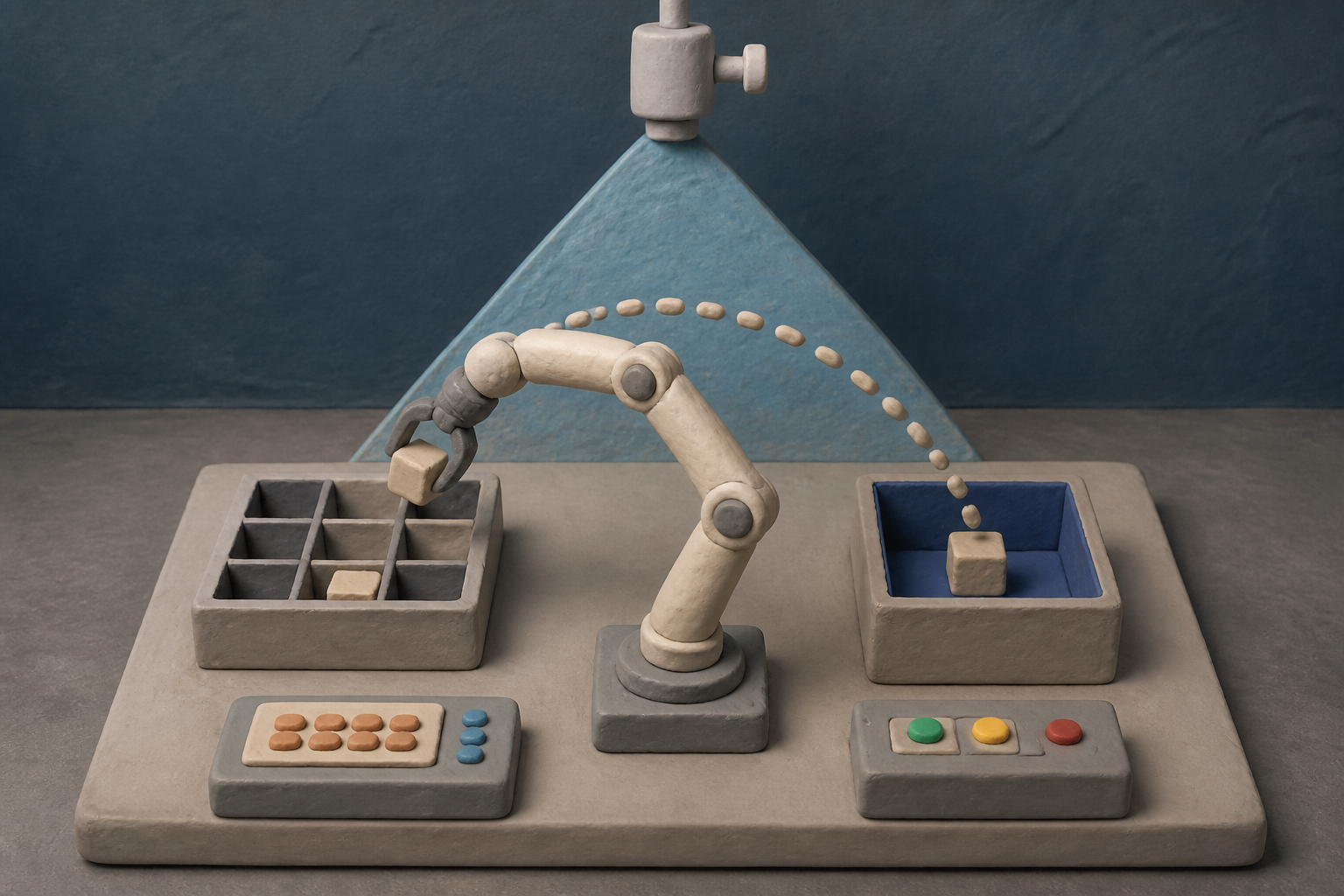
What changes in this design
When a math process hits an invalid answer, a person might expect the program to scrap everything and restart from scratch, or simply make tiny, gradual adjustments near the failed point.
Instead of discarding the whole attempt, this approach targets only the variable tied to the unmet requirement. It switches that single figure to a random value or to an entry from an entirely different, non-overlapping zone, and then continues looking for an answer.
The record details a specific strategy for breaking out of dead ends during complex problem-solving. Knowing how computational systems handle failed rules shows the logic behind searching through complicated mathematical possibilities.
Assembly lines at the Tsutsumi plant
In October 2022, assembly line managers at Toyota's Tsutsumi plant switched on an 8,192-bit CMOS processor called the Digital Annealer. Built by Fujitsu, the specialized silicon was designed to tackle combinatorial scheduling: arranging vehicles on the line so that paint booths, parts bins, and worker shifts never tripped over one another. For years, quantum-inspired hardware promised to sweep past traditional computing by treating complex schedules as physics problems. If you map every constraint to an energy penalty, the system naturally settles into the lowest, cheapest valley.
I spent an afternoon looking through benchmark tables from late 2025 to see where that dream stalled. When we look at how physical factories actually work, clean binary choices disappear. Real factory floors run on hard, unforgiving boundaries. A robotic arm cannot collide with a frame. A custom wiring harness cannot arrive ten seconds late. Turning those hard physical boundaries into smooth physics equations turns out to be an exhausting mathematical trap.
The penalty inflation trap
The mathematical engine behind this class of machines is quadratic unconstrained binary optimization. It treats variables as digital switches that flip on or off. In telecommunications optical routing benchmarks, that approach looked miraculous: a dedicated annealing system matched or beat the solution quality of a standard classical solver in two minutes rather than two hours of heavy computation.
The catch is the word unconstrained. Real industrial operations are packed with rigid, non-negotiable rules. To feed a hard constraint into an annealer, engineers have to convert each requirement into an artificial mathematical penalty. Research analyzing these formulations alongside evolutionary algorithms demonstrated what happens next: artificially converting non-binary and constrained problems into unconstrained quadratic forms drastically inflates the search space. Instead of searching a small, structured space of valid schedules, the machine wanders through a vast, artificial swamp where nearly every path violates the rules.
Shaking the broken switches
In my view, the patent published this year under application US20260259532A1 shows the quiet reality of that compromise. Japanese electronics giant NEC commercialized its Vector Annealing Service in November 2021, deploying SX-Aurora TSUBASA vector supercomputers to scale proprietary simulated annealing algorithms up to 300,000 fully connected bits for enterprise optimization. By 2026, as hardware developers quietly retreated from building physical superconducting quantum processors, corporate focus shifted to squeezing competitive performance out of classical vector hardware through software heuristics.
The patent, which lists researcher Kei Takaya among its inventors, tackles the exact moment an annealing search gets trapped by an illegal solution. When a solution candidate fails to satisfy a constraint condition, the processor steps in. Rather than restarting the entire computation or wandering fruitlessly through penalty space, the processor identifies a variable value related to the broken constraint. It then forcibly changes that value to a random number or shifts it into a non-overlapping second region before searching for a candidate again.
What I find striking about the filing is how candidly it admits the underlying flaw. Simulated annealing is exceptional at sliding down smooth gradients, but it is fundamentally blind to logical walls. Takaya and his colleagues had previously demonstrated in robotic pick-and-place research that resolving complex collision routes required reformulating binary variables into continuous ones and applying soft guidance constraints to shallow branch-and-bound trees in classical solvers. This patent is another emergency exit: when the physics simulation gets stuck against a hard constraint, kick the offending variable into a completely different room.
The harder half of the problem
The fundamental trouble is that classical algorithms have not stood still. In late 2025, a 56-page benchmarking study evaluated digital annealers and hybrid quantum systems against classical mixed-integer programming and constraint programming solvers across chemical reaction pathways and mRNA codon design. The classical solvers delivered faster time-to-solution across every single problem scale tested, solving the problems in their natural representation without forcing them into bloated binary penalty equations.
I cannot tell whether this heuristic will save vector annealing in enterprise production. Forcing variables to jump across non-overlapping regions is a clever practical patch, but it remains a workaround for an architecture that struggles with basic logic rules. Standard mathematical branch-and-bound solvers quietly ate our lunch while the marketing teams were talking about energy valleys. If quantum-inspired vector computing wants to hold its ground in modern factories, it needs more than random variable kicks. It needs to prove that unconstrained physics can beat plain, rigid logic at its own game.
Sources
Reporting for this piece drew on the published filing and the references below.
- Patent US20260259532A1: Calculation Device, Control Device, Processing System, Searching Method, And Recording Medium
- NEC launches simulated annealing service utilizing vector supercomputers
- Fast MILP-based Task and Motion Planning for Pick-and-Place with Hard/Soft Constraints of Collision-Free Route
- Fujitsu, Toyota Systems leverage Fujitsu’s Quantum-Inspired Digital Annealer to streamline automobile production sequence
- Routing and Wavelength Assignment with Protection: A Quadratic Unconstrained Binary Optimization Approach
- Comparing the Digital Annealer with Classical Evolutionary Algorithm
- Comparative Studies of Quantum Annealing, Digital Annealing, and Classical Solvers for Reaction Network Pathway Analysis and mRNA Codon Selection
The record, briefly. US20260259532A1, “Calculation Device, Control Device, Processing System, Searching Method, And Recording Medium” A calculation device includes a memory storing instructions and a processor configured to solve an optimization problem with constraint conditions. When a constraint is not satisfied for a solution candidate, the processor changes a variable value related to the constraint to a random variable value or to a value from a non-overlapping second region, and then finds a solution candidate again.
More angles on this
- Inside systemAnother reading from the same G05B classification family, control or regulating systems in general.
- A Coffee Basket's Quiet Second ActAnother reading from the same G05B classification family, control or regulating systems in general.
- CPC G05B: Control or regulating systems in generalThe official classification family this record was filed into, published in the USPTO Cooperative Patent Classification scheme.
- CPC B25J: Manipulators; chambers provided with manipulation devicesThe official classification family this record was filed into, published in the USPTO Cooperative Patent Classification scheme.
- Strut Channel Ratchet And Method Therefor Marks a Pause Worth NoticingAnother reading from the neighbouring B25B classification family, tools or bench devices not otherwise provided for, for fastening, connecting, disengaging, or holding.
Read around this one:Public patent recordUSPTO published figure