Machines
The cleaning part that sits beside the chamber, never quite against it
Residue inside a heated-tobacco device has become a quiet engineering race in a vast market still shadowed by patent and health disputes.

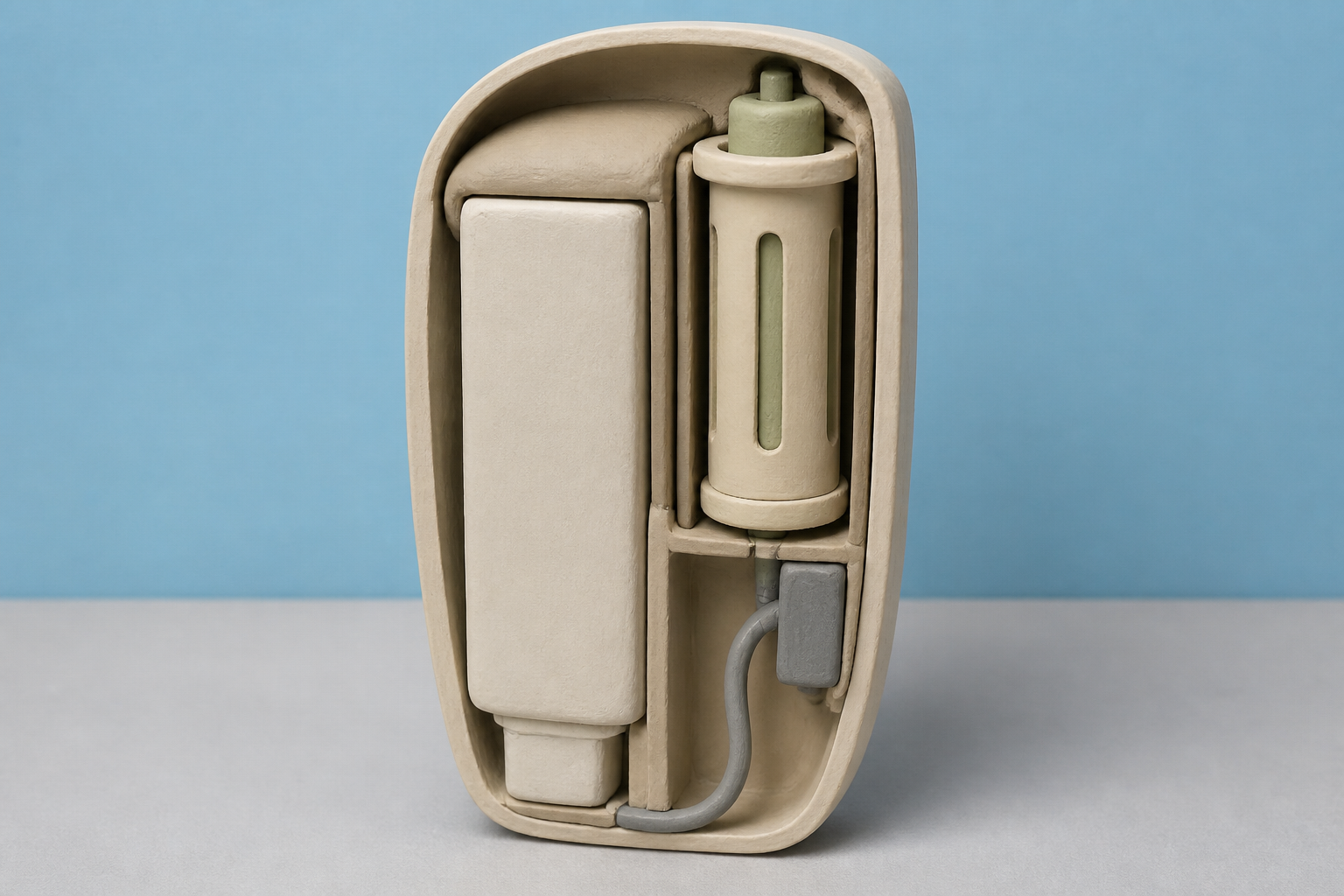
What changes in this design
Without that placement detail, a reader might expect the vibrating cleaning piece to touch the chamber directly.
Instead, the vibrating cleaning element is mechanically coupled to the chamber exterior while remaining spaced from the chamber. The unit also has a heating element and a controller for initiating heating.
It makes the physical layout easier to understand: a linked cleaner is outside and apart from the chamber, while the heating element and controller initiate heating.
The caked heater blade
A tobacco-heating device can fail for a small, grubby reason: its heater blade becomes caked in residue. Consumer troubleshooting advice for IQOS identifies that buildup as a leading reason a device may not heat properly. The proposed remedy is manual cleaning, accompanied by a warning that rough use of the cleaning stick might damage the device.
That awkward bargain - clean the part that provides the heat, but do not hurt it - is, I think, where US20260256217A1 enters the story. Published as Aerosol Generating Devices, it describes a heating assembly with a chamber that receives part of an aerosol-generating consumable. Its vibrational cleaning element is mechanically coupled to the chamber exterior while spaced from it; a heating element and controller initiate heating. It reads as an attempt to send cleaning motion to the chamber without adding another object that directly rubs against it.
Residue at 300 to 380 C
The new arrangement belongs to a cluster of patents aimed at the same unglamorous maintenance problem. A Philip Morris filing from 2019 describes coating heating surfaces with pyrocatalytic material that chemically breaks down residue at 300 to 380 degrees C, rather than scraping or shaking it off. A separate Philip Morris patent, granted in 2024, keeps the person in the loop: a flexible wiping sleeve, a rigid scraper, and a telescoping stick make up a physical cleaning kit.
A patent filing does not, by itself, show how a retail device performs over months of ordinary use. Taken together, these documents suggest a move from cleaning after the fact toward having the device manage residue itself. I kept coming back to the consumer question left outside the claims: how many careful maintenance steps will anyone accept before a convenient alternative stops feeling convenient?
Vibration at the right moment
A patent granted in January 2026 lays out a third route. Its heating element itself can move vertically, horizontally, or with a twist at insertion, preheating, each puff, and the end of a session. The stated aim is to create a fine gap so tobacco residue does not fix to the heater blade in the first place.
That approach moves the surface that gets dirty. US20260256217A1 instead places its vibrational cleaning element outside the chamber, mechanically coupled to it while remaining spaced away. The difference could vanish in a product demonstration, but it is exactly the sort of detail patent claims turn on. To my eye, it exposes a reasonable design preference: if rough cleaning might damage a heater, transmitting motion may be more appealing than pressing a tool against it.
178 billion sticks
The industry publication behind the 2024 market estimates puts global heated-tobacco retail sales at $38.85 billion, up 12.7% year-on-year, with 45.3 million devices sold and 178 billion sticks consumed. Those figures are market estimates rather than a regulator's count, but I found that the number that stopped me was 178 billion. It gives an inward-facing cleaning problem an unexpectedly large scale.
That scale helps explain why small differences inside a heater chamber have also travelled through courts. Philip Morris and BAT settled their heat-not-burn patent clash on February 2, 2024, ending a dispute that began in Japan in 2018 and spread across the United States, Europe, and other jurisdictions. The non-monetary agreement runs for eight years and lifted the US import ban on IQOS. A cleaning mechanism did not cause that dispute, and this filing establishes no link to it. It does sit in the same commercial field, where details of heating, maintenance, and importability have mattered enough to fight over.
The open question
Cleanliness and health impact are different questions. In 2019, the US regulator authorized standard, non-modified-risk sale of IQOS through its premarket tobacco application pathway, citing acrolein levels 89 to 95% lower and formaldehyde levels 66 to 91% lower than combustible cigarette smoke. The regulator also said the product was not safe and did not authorize it as a reduced-risk product.
The World Health Organization challenged the idea that those comparisons settle a harm-reduction case. Its 2020 statement says some toxins occur at higher levels in heated-tobacco aerosol than in cigarette smoke, and some appear in the aerosol but not cigarette smoke at all. The filing describes a maintenance mechanism, not an emissions or health-outcomes study. I do not read a cleaner chamber as health evidence. The useful question raised by US20260256217A1 is narrower: can a device keep working without asking its owner to use a cleaning stick near its heater, and what does that convenience actually buy?
Sources
Reporting for this piece drew on the published filing and the references below.
- US20260256217A1 - Aerosol Generating Devices
- Troubleshooting Common IQOS Device Issues
- US20210251290A1 - Aerosol-generating device with pyrocatalytic material
- US12048333B2 - Cleaning tool with additional cleaning elements for an aerosol-generating device
- US12527360B2 - Aerosol generation device having vibration part and control method thereof
- Heated Tobacco: Markets
- Philip Morris and BAT end global patent clash over heat-not-burn cigarettes
- FDA permits sale of IQOS Tobacco Heating System through premarket tobacco product application pathway
- WHO statement on heated tobacco products and the US FDA decision regarding IQOS
The record, briefly. US20260256217A1, “Aerosol Generating Devices” A heating assembly has a chamber for part of an aerosol-generating consumable and a vibrational cleaning element mechanically coupled to the chamber exterior but spaced from it, with a heating element and controller to initiate heating.
More angles on this
- CPC A24F: Smokers' requisites; match boxes; simulated smoking devicesThe official classification family this record was filed into, published in the USPTO Cooperative Patent Classification scheme.
- A Baseplate's Signal: From Guess to Defined ResponseAnother reading from the neighbouring A24B classification family, manufacture or preparation of tobacco for smoking or chewing; tobacco; snuff.
- Degassing a bottle: a chamber, a pump, and the judgment left to whoever holds itAnother reading from the wider A23L classification family, foods, foodstuffs or non-alcoholic beverages, not otherwise provided for; preparation or treatment thereof.
- A cooling plate broader than it is deep, and the quiet difference between a setting and a promiseAnother reading in the same Machines category on this site.
Read around this one:Public patent recordUSPTO published figure