Machines
The Hinge Between a Winning Card and the Next Choice
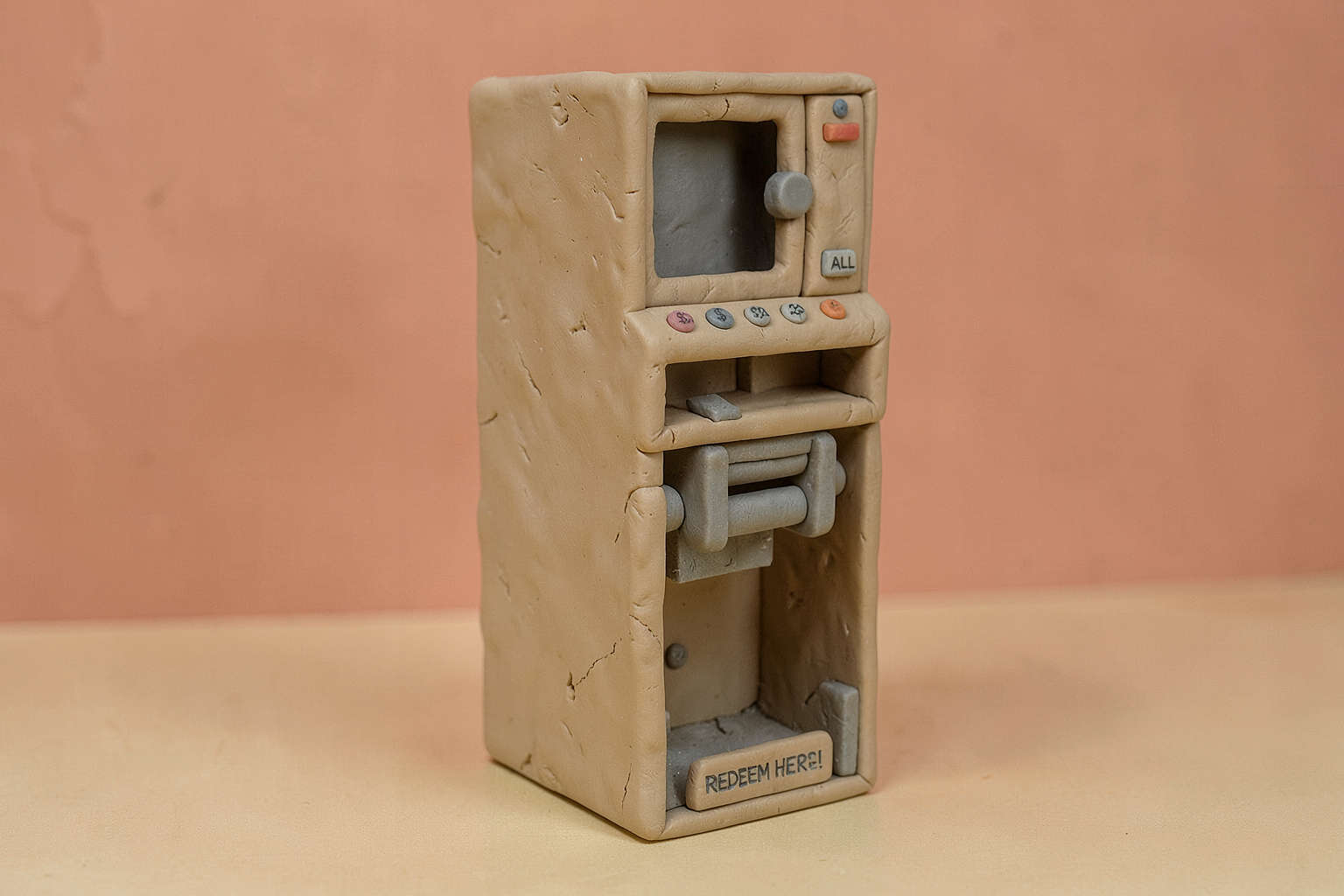
Pulltab-Card Collector-And-Scanner Device is a named source detail in the stated arrangement. It keeps the central design choice visible.

First, the setting
Community gathering places often offer simple paper games alongside food, conversation, and local events. A person opens a small card to see whether it reveals a prize, while staff must keep play orderly and handle used cards. People work on these routines because busy counters benefit from clear, familiar steps.
At a counter in a social venue, a player holds a pull-tab card, opens its covered areas, and then brings the finished card to a nearby machine. The card is fed into a slot, taken from the player's hand, and checked as the screen and machine guide the next step.
What changes in this design
Without the built-in function, a player has a winning card, but how its value would be redeemed is not stated.
This machine includes a collector and scanner that automatically redeems winning cards as credit toward buying additional pulltab cards from that machine.
A winning card can become credit toward another purchase at the same machine. What the scanner reads or how it decides the credit is not stated.
The Integrated Collection Hinge
At the vending machine, a winning pulltab card - the named card handled in this vending arrangement - is automatically redeemed for credit toward purchasing additional pulltab cards, and the next choice is whether you want to continue. That cause, effect, and next choice form the opening scene I notice in US20260263909A1, published September 10, 2026, titled Pulltab-Card Collector-And-Scanner. The filing describes the mechanism as an integrated pulltab-card collector-and-scanner device in a pulltab-card vending machine. "Integrated" means built into the vending-machine arrangement. A collector-and-scanner, in everyday language, is a device for collecting and scanning the card. The arrangement is less like a grand finale than a quiet stage manager moving the next cue into place.
That compact scene separates a setting from a promise. A setting is the physical arrangement: the vending machine and the device built into it. A promise is the defined response that the arrangement says follows when the relevant condition is met. I keep returning to that distinction because it stops a familiar-looking machine from becoming a vague story. The machine has the air of a restrained committee clerk, accepting one card and forwarding a credit toward the next choice. Here, credit means credit toward purchasing additional pulltab cards, and "automatically" keeps attention on the stated redemption result rather than an imagined sequence of unseen gestures.
Once setting and promise are apart, the small hinge becomes easier to spot. The winning card is the stated cause; credit toward purchasing additional cards is the stated effect; the opportunity to purchase is the next choice. A hinge here means the narrow handoff that lets one moment lead into another, not a claim about the machine's physical parts. It is less like a detached receipt and more like a label-maker fastening an outcome to the next decision. The distinction deserves your attention because an arrangement can look complete simply by containing familiar parts, while its promise becomes clear only when those parts are tied to a response. That is the first beat of a practical test: identify the handoff before treating the scene as the point.
Credits Toward Another Pulltab Card
With the hinge identified, the purpose can be followed in order. The filing describes an integrated collector-and-scanner device that enables players to automatically redeem winning cards. It connects that redemption to credits toward purchasing additional pulltab cards from the vending machine. Cause, effect, choice: the card is the condition, the credit is the stated result, and an additional purchase is the available next move. The sequence does not require an invented backstage story about speed, approval, or any other unmentioned detail. A practical test follows from that restraint: can you point to the condition, stated response, and next choice without adding an unwritten bridge? If so, you are reading a promise rather than merely a setting. If not, the setting may still be visible, but its practical role remains a guess.
Defined Redemption, Not Guesswork
That test makes the comparison sharper. A broad picture of a vending machine can leave a collector, a scanner, a winning card, and a future purchase as separate objects in a reader's mind. The filing instead describes a defined response: winning cards are automatically redeemed for credits toward purchasing additional pulltab cards from that vending machine. This is not a claim that one arrangement outranks another; it is a bounded contrast between nearby objects and an expressly connected sequence. The contrast is less like finding more equipment on a counter and more like seeing the instruction card that tells the counter what to do. By replacing a guess about what comes next with a stated response, the arrangement gives the scene its direction.
From there, the consequence travels beyond this particular machine without pretending the filing says more than it does. When you encounter any compact system, look first for the setting - the components that are present - then for the promise - the response the arrangement says follows. Ask whether an outcome is merely displayed, or whether it becomes the condition for a clear next choice. That is a transferable observation about continuity: a system feels intentional when the prior result changes what can happen next. The second is about restraint: define the bridge in ordinary language before decorating it with labels. For you, the usable consequence is simple: wherever a process risks becoming a row of static things, look for the small hinge that converts an outcome into a next step.
The record, briefly. US20260263909A1, “Pulltab-Card Collector-And-Scanner” A pulltab-card vending machine includes an integrated pulltab-card collector-and-scanner device that enables players to automatically redeem winning cards for credits toward purchasing additional pulltab cards from the vending machine.
More angles on this
- The Small Rearrangement Behind a Skin-Tone ScanAnother reading from the same G06Q classification family, information and communication technology [ict] specially adapted for administrative.
- The Signal Behind a Disappearing Lottery CodeAnother reading from the same A63F classification family, card, board, or roulette games.
- CPC G06Q: Information and communication technology [ict] specially adapted for administrativeThe official classification family this record was filed into, published in the USPTO Cooperative Patent Classification scheme.
- CPC G07F: Coin-freed or like apparatusThe official classification family this record was filed into, published in the USPTO Cooperative Patent Classification scheme.
- A Weightlifting Machine’s Setting Is Not Yet a PromiseAnother reading from the neighbouring A63B classification family, apparatus for physical training, gymnastics, swimming, climbing, or fencing; ball games; training equipment.
Read around this one:Public patent recordUSPTO published figure