Machines
The Quiet Handoff Inside a Pull Pump Motor
Pull Pump Motor and Same Direction form one stated connection: A pull pump motor for fitness equipment has a motor shell.

First, the setting
Exercise equipment helps people move their bodies indoors when weather, schedules, or space make other activity less convenient. Many machines guide repeated pushing, pulling, stepping, or turning motions so a workout can feel steady and controlled.
In a gym or home workout corner, someone grips handles or settles onto a machine and begins moving. Parts inside the housing turn while the person exercises, creating the familiar motion and low mechanical sound of powered fitness equipment nearby.
What changes in this design
A reader might normally picture fitness equipment as having a motor hidden inside a housing to provide powered movement. How other motors manage rotation direction or route their shafts is not stated.
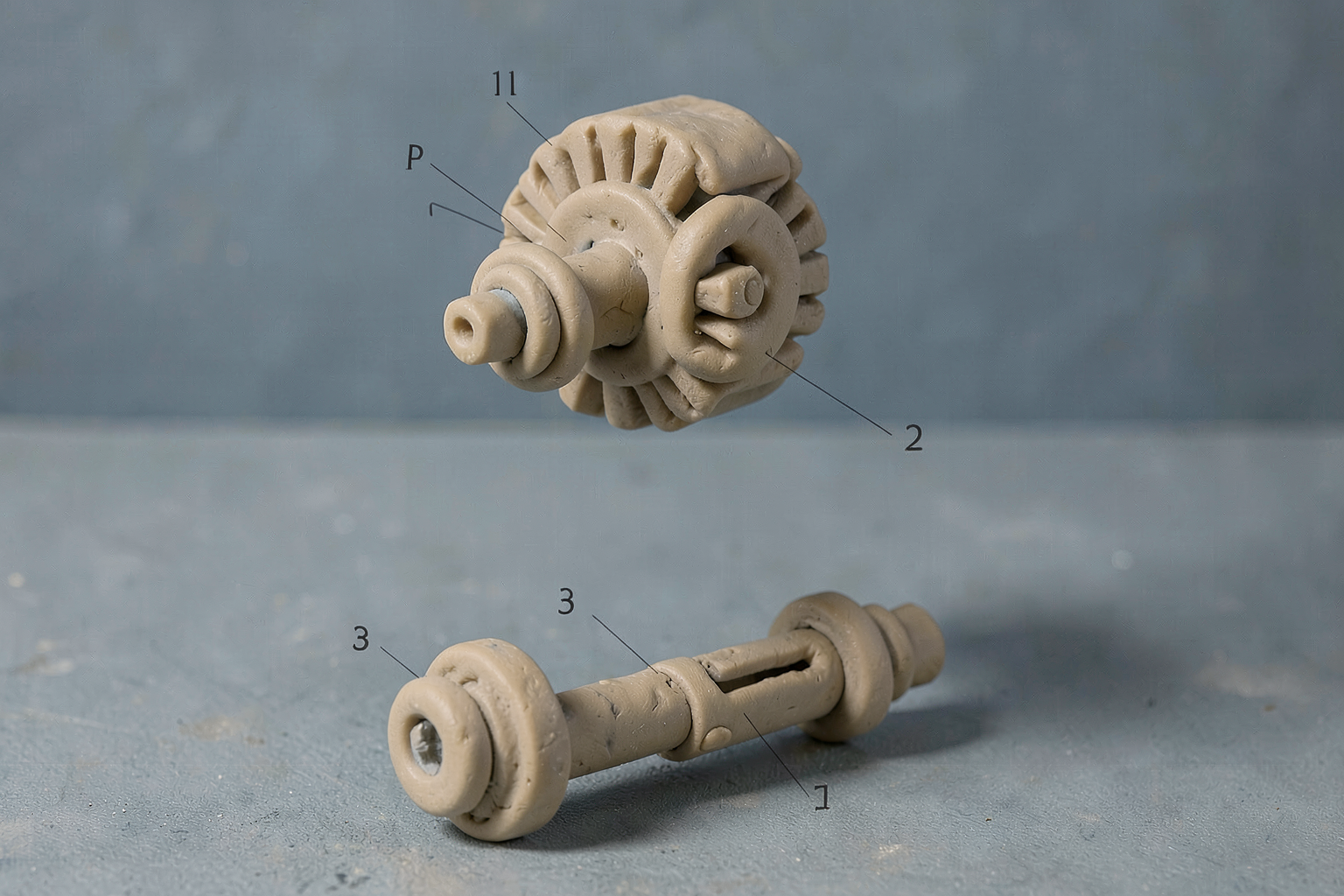
Here, the rotating shaft is formed in the rotor and extends through the motor shell. A clamping slot and protrusion cooperate with that shaft, while the motor shell, stator core, and rotor are configured to rotate in the same direction.
It directs attention to the small connection around the shaft rather than to an entire exercise machine. The record identifies the parts involved, but it does not state a performance result or the effect on a user.
Motor Shell Boundaries
Could you tell where a motor stops being an enclosed arrangement and becomes a responsibility for whatever comes next? The obvious headline is a pull pump motor for fitness equipment; the more useful question is where its described motion crosses a boundary. Published as US20260263860A1 on September 10, 2026, the application invites that narrower question because a rotating shaft is said to extend through a motor shell. Here, ownership does not mean legal title. It means the practical moment at which your attention should move from the parts named inside the assembly to the connection that lets the arrangement continue. That is what made me look twice: the title points toward a machine category, while the application details point toward a crossing. That is a more manageable question, and it does not require pretending the rest of the machine has been explained. The motor shell begins to read less like a lunchbox and more like a border with a job to do.
Rotor Parts in View
That border is easier to inspect once the terms are kept modest. A motor shell is the named shell in the described motor assembly; a stator core and rotor are likewise named components, and the filing says the motor shell, stator core, and rotor are configured to rotate in the same direction. A rotor is also the part in which the filing forms the rotating shaft, so the wording ties the shaft directly to that component. A clamping slot is a slot identified for clamping, and a protrusion is a projecting feature; the filing says those two cooperate with the rotating shaft. An ordinary version of this story might stop at a motor turns. This one does not ask you to accept that broad blur. It asks you to hold onto particular nouns and one relation among them, which is an unglamorous discipline but a useful one. The method is almost librarian-like: retain the labels before trying to supply a story they do not contain.
With those names in hand, the picture can stay deliberately small. You do not need to imagine a whole exercise machine, a user, or a result, because none is needed to notice the described arrangement. Picture the motor shell as the named boundary, the rotor as the place from which the rotating shaft is formed, and that shaft extending through the shell. The clamping slot and protrusion enter that picture only through their stated cooperation with the shaft. No more placement detail is needed to keep this question bounded. The arrangement has the air of a quiet stage manager, keeping the passage legible without claiming to direct the entire show.
The Handoff in Practice
That restraint brings the mechanism into focus. In practical order, the filing describes a rotating shaft formed in the rotor; it says that shaft extends through the motor shell; and it says a clamping slot and protrusion cooperate with that shaft. The same description also states that the motor shell, stator core, and rotor are configured to rotate in the same direction. Nothing in those sentences tells us more than that, so the sensible editorial move is to stop there. Yet the sequence gives you a real point to watch: the shaft is the named element that extends through the shell. At that crossing, the system changes ownership in the nonlegal sense used here: your attention moves from components named with the shaft to the shell passage. The arrangement is as if a small clerk has stamped continue at the shell, then returned to the quiet work of being a motor.
Once you watch that crossing, the contrast is observable before and after. Before, the ordinary shorthand that a motor turns leaves the enclosure and connection as a single blur. After, you can point in the wording to a rotating shaft formed in the rotor, its extension through the motor shell, and the clamping slot and protrusion said to cooperate with it. The contrast does not establish superiority, novelty, durability, or a particular use beyond fitness equipment. It simply changes the question you ask of the description. The handoff feels less like a mystery relay and more like a labeled doorway. That is worth your attention because broad labels make systems sound complete, while named relationships show where their explanation actually becomes specific.
Because that specificity is bounded, the takeaway should be practical rather than grand. Whenever an arrangement includes a part that extends through a shell or other stated boundary, pause at the crossing instead of treating the boundary as scenery. When a description says features cooperate, keep the relationship separate from a guess about their shape, position, or outcome. For this filing, those habits preserve the small but meaningful distinction between an overall motor label and the stated shaft, shell, slot, and protrusion relationship. I think that distinction matters because systems are often explained most honestly at the point where one named responsibility meets another. On your next diagram or product description, try a small experiment: cover the headline, circle only the words that mark a part crossing a boundary or cooperating with another, and see whether the system still has a clear handoff.
The record, briefly. US20260263860A1, “Pull Pump Motor For Fitness Equipment” A pull pump motor for fitness equipment has a motor shell, stator core, and rotor configured to rotate in the same direction. A clamping slot and protrusion cooperate with a rotating shaft formed in the rotor, which extends through the motor shell.
More angles on this
- Under 55 mm, a Handoff Gets Its PlaceAnother reading from the same H02K classification family, dynamo-electric machines.
- CPC H02K: Dynamo-electric machinesThe official classification family this record was filed into, published in the USPTO Cooperative Patent Classification scheme.
- The Fuse That Gets Told When to Blow: A Fire Prevention Filing for Electronic Control UnitsAnother reading from the neighbouring H02H classification family, emergency protective circuit arrangements.
- Before the OLED, a Precisely Set Molecular RoomAnother reading from the wider H10K classification family, organic electric solid-state devices.
- A Wearable Heater That Waits for Two Switches Before It Warms Your SkinAnother reading in the same Machines category on this site.
Read around this one:Public patent recordUSPTO published figure