Objects
The Quiet Work of Alignment Around a Target
One Wisconsin isotope maker's magnet patent is, I think, a sign that cancer-drug supply is being rebuilt around beams, not just aging reactors.

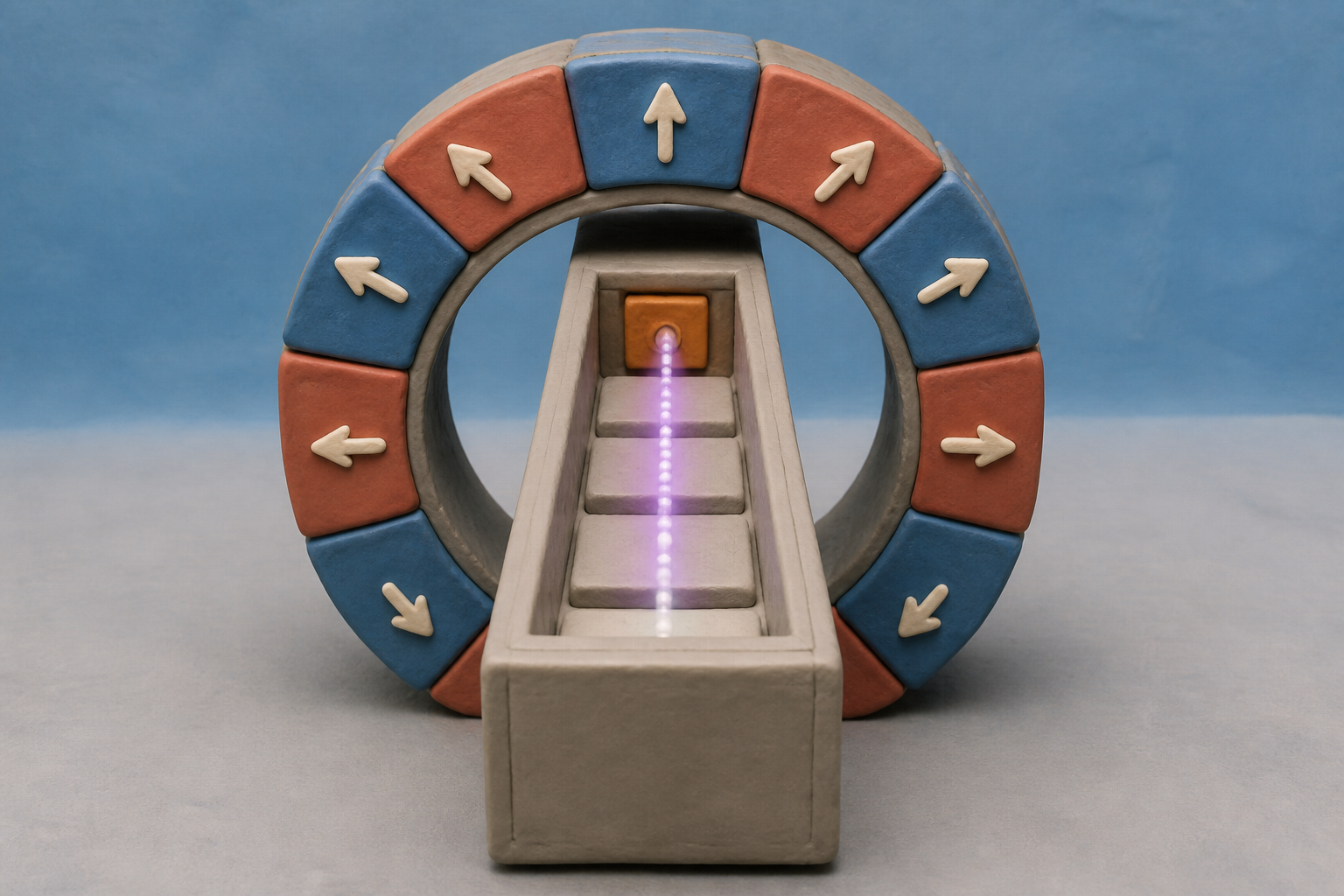
What changes in this design
Without this record, a reader might simply picture a target that receives an ion beam and gathers ions from it. The abstract does not describe a standard setup, so this is only a plain starting picture, not a claim about ordinary practice.
In this record, a collection target comes with a target housing, and a suppression magnet is arranged in a Halbach array around that housing. The record therefore identifies both ion collection from the impinging beam and the magnetic layout surrounding the housing.
That matters for understanding the page because the target is not the only item named: the surrounding magnet and its Halbach-array layout are also part of the assembly. The abstract does not say what outcome the magnetic layout produces.
August 8, 2023
On August 8, 2023, I found a Wisconsin isotope maker telling the state it would lay off 59 people. Its notice cited cash-flow trouble after a shortage of financing and investment. Five days earlier, the company had announced visible Cherenkov radiation from a fusion experiment. The contrast matters to me: large nuclear ambitions do not erase the immediate need to make and sell something useful.
That product was lutetium-177, a radioisotope used in radioligand therapy. This turn is, I think, the useful frame for a patent published three years later. It is not a broad claim about fusion. It is a tightly bounded effort to keep scarce, expensive atoms under control.
A drug that needs more atoms
By May 2026, SHINE Technologies had received European marketing authorization for Ilumira, its non-carrier-added Lu-177. The company says it makes the material in Janesville, with at least 99.9 percent radionuclidic purity. That authorization reads to me less as a finish line than as evidence that isotope production had become its near-term work.
Demand gives that work urgency. Novartis's Pluvicto launched in 2022, outgrew capacity at a single site, and appeared on the US shortage list in early 2023. Lu-177 production needs enriched targets, high-flux neutron sources, and weeks of irradiation. This patent does not, I think, solve that whole chain. The patent is, as I see it, trying to improve one costly handoff within it.
Bruce 7 and a different route
Bruce 7 was what I kept coming back to. Bruce Power began commercial Lu-177 production inside that CANDU unit in October 2022, irradiating ytterbium-176 targets. The targets are shipped to Germany for processing into pharmaceutical-grade non-carrier-added Lu-177, and a second production line arrived in 2024. This is not a laboratory prospectus. The working supply chain I see is built around reactor time.
The gap is not merely geographic. The reactor route depends on enriched targets, high-flux neutron sources, weeks of irradiation, shipping and processing. Recent Mo-99 shortages show why that dependence gets attention: an outage at Petten coincided with maintenance elsewhere, producing reported shortages above 50 percent in some regions. Mo-99 and Lu-177 are, I am careful to say, not interchangeable. Still, both cases make, I think, the same operational point: a medical isotope is most valuable only when it arrives in time.
A ring of permanent magnets
That is where US20260253761A1 enters the story. SHINE's application, filed February 24 and published August 27, 2026, describes an ion collection assembly with a target housing and a suppression magnet arranged around it in a Halbach array. Rather than treating an ion beam only as a tool for altering a surface, the device is meant to collect beam ions in solid material. Its examples include ytterbium-176 for later Lu-177 production and gadolinium isotopes for terbium radionuclides. A very specific manufacturing problem is what I read here.
The engineering problem is basic. When ions hit the target, they can release secondary electrons. If those electrons escape, the current reading can misstate how many ions arrived. The filing proposes at least 0.5 kilogauss inside the housing, returning electrons toward the target so beam current can be measured accurately in real time. The filing reads to me as a yield-control proposal, not proof of a finished production line.
What the filing is really betting on
The geometry appeals to me because it connects this compact part to a long accelerator history. A Halbach array is a one-sided-flux magnet arrangement. Klaus Halbach independently developed a version for focusing particle accelerator beams in the 1980s. In this filing, that geometry is being used to steer unwanted electrons, not to make a new kind of therapy.
SHINE's public milestones make the filing more than a curious magnet arrangement. The company announced a $240 million Series E in February 2026 and a $263 million conditional federal loan commitment in April for a planned Mo-99 facility, with technical, legal, environmental and financial conditions still outstanding. It also says its Cassiopeia site is producing non-carrier-added Lu-177 weekly and shipping it worldwide. Those statements serve as context for me, not confirmation that this device is already deployed.
The real bet, as I see it, is that an accelerator-based isotope business can recover valuable input instead of losing it. If it can collect ytterbium-176 efficiently, measure the incoming beam honestly, and recycle the starter material, it may ease one pressure point in Lu-177 supply without waiting for another reactor slot. That is, I think, the right scale for this filing: not a cure for isotope scarcity, but an attempt to make every costly atom count.
Sources
Reporting for this piece drew on the published filing and the references below.
- Ion Collection Assembly With A Halbach Array Suppression Magnet
- SHINE Secures European Marketing Authorization for Ilumira
- Partners mark two years of Lu-177 production at Bruce 7
- Radiopharmaceutical Supply Chain Under Pressure
- SHINE Receives Conditional Commitment for $263 Million DOE Loan
- Hot Cell Lines for SHINE's Cassiopeia
- Janesville-based SHINE announces layoffs, days after announcing nuclear fusion breakthrough
- Halbach array
The record, briefly. US20260253761A1, “Ion Collection Assembly With A Halbach Array Suppression Magnet” An ion collection assembly includes a target housing with a collection target configured to collect ions of an ion beam impinging on it, and a suppression magnet arranged in a Halbach array around the target housing.
Identity details. The saved title-page transcription needs review, so names are not repeated here. Check the official published title page.
More angles on this
- CPC G21K: Handling of particles or ionising radiation not otherwise provided for; irradiation devices; gamma ray or x-ray microscopesThe official classification family this record was filed into, published in the USPTO Cooperative Patent Classification scheme.
- Shift Register Unit, Driving Method Thereof, Display Substrate And Display Marks a Pause Worth NoticingAnother reading from the wider G11C classification family, static stores.
- When a Buffer Stops WaitingAnother reading in the same Objects category on this site.
Read around this one:Public patent recordUSPTO published figure