Machines
The Small Correction Inside a Roller-Brush Cleaning Routine
Handle Latch plus Key detail carry the practical point: A cleaner body connects to a standard water hose and uses a stabilizer.

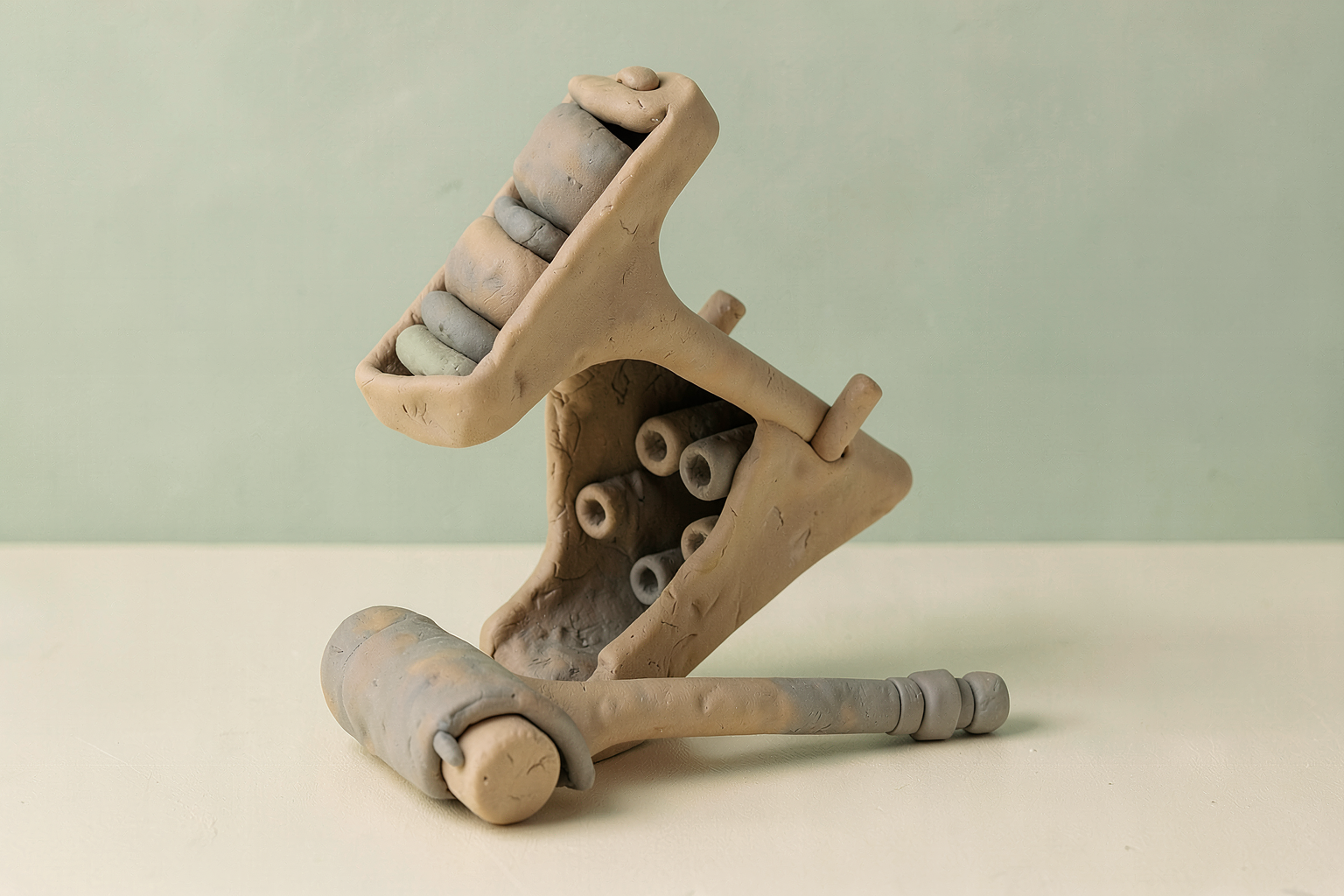
First, the setting
After painting a room or refreshing trim, a roller brush holds wet paint deep in its soft covering. Leaving it that way makes the next job messier and can waste a useful tool. People therefore rinse and care for painting tools before putting the drop cloth away.
In a garage, yard, or wash area, someone steadies a paint roller over a basin or drain while water runs through the fuzzy cover. The roller may turn in a holder as colored water flows away. Nearby, the task feels like the closing cleanup after a painting day.
What changes in this design
A reader may expect roller cleaning to mean rinsing it with water, perhaps from a hose or a stronger water source.
Here, a cleaner body attaches to a standard hose and uses a stabilizer, a fastening piece for the handle, and sprayers to send water into the roller's nap. Options include rotating support, detergent feed, drainage, strainers, and portable pressurized reservoirs.
It explains the focus of the device: guiding hose water through the roller's nap while avoiding reliance on a high-pressure water source.
Water Meets the Roller Nap
A standard hose coupling sits at the cleaner body where you might expect a high-pressure source, while water sprayers face directly into the roller nap, the brush's fibrous working surface. That is a small scene, but it changes the mood of the task from force arriving from elsewhere to direction being arranged at the point of contact. The published application, US20260262824A1, appeared September 10, 2026 under the title Apparatus For Efficient Cleaning Of Roller Brushes Without High-Pressure Water Sources. You can picture the ordinary assumption first: cleaning a roller brush means more pressure, more apparatus, or a more dramatic answer. The filing describes a different starting point, in which a cleaner body connects to a standard water hose and directs water inward. I noticed how deliberately that contrast refuses to make the hose sound grand.
That contrast brings the picture closer rather than making it larger. The water sprayers have the air of a small stage manager, directing attention into the roller nap rather than toward a grander water source. The comparison matters because it makes one relationship visible: the water source is present, but the direction of water is the detail being organized. What made me look twice was not a promise of spectacle, but the placement of supporting parts around that direction. A stabilizer, a part that steadies the cleaner body, and a handle latch, a fastening that holds a handle in position, sit beside the hose connection and sprayers. The arrangement asks you to notice what a routine usually hides: a familiar input can look different when its route is made specific.
Direction Instead of Drama
That quieter picture gives the design its correction: rather than treating the water source as the entire answer, it arranges connection, steadiness, and spray direction around the roller nap. Together, the hose connection, stabilizer, handle latch, and sprayers describe a mechanism in everyday language: water comes through a familiar hose, the body is supported, and the spray is aimed where the brush surface needs attention. The stabilizer reads less like an accessory than like a quiet hand on the clipboard, keeping the arrangement from dissolving into a collection of parts. This is not a contest against some other cleaner. It is a design lesson in assigning each small part a visible job.
Routine Made Legible
Once that mechanism is visible, the purpose narrows into something worth carrying beyond this object: let an ordinary input do its work only after the path has been clarified. The published design concerns cleaning roller brushes without high-pressure water sources, while its alternative embodiments mention rotating support, detergent feed, drainage, strainers, and portable pressurized reservoirs. A rotating support is a support arrangement described as turning; detergent feed is a way to introduce cleaning solution; drainage is a route for water to leave; strainers are screens that catch material; portable pressurized reservoirs are movable containers that hold water under pressure. Those additions widen the picture without changing the central contrast.
Because those alternatives sit beside the basic hose arrangement, the correction is not about shrinking a system until it has nothing left to say. It is about making relationships legible: what enters, what is held steady, where water is directed, and where water may leave. The handle latch has the air of a modest librarian, making one connection easier to notice before the next motion. One transferable observation is that water through a standard hose becomes easier to understand when its route is explicit. Another is that supporting and guiding parts deserve attention when they determine whether the main action can be aimed at all. No grand promise is needed for either observation. Their value is in revealing the pieces that routinely disappear behind a broader assumption.
That is why the final image stays small: a hose connection, a body, and sprayers facing into a fibrous roller surface. The standard hose has the air of a patient stagehand, present before the scene begins and not asking to become the scene. The consequence is not a verdict on every cleaning setup. It is the clearer question this design places in front of you: what routine are you trying to improve by enlarging the input when the smaller correction may be in how the input is held, directed, and allowed to leave? What I think is worth your attention is that modest reversal. Return to the pictured coupling and inward-facing sprayers, and the ordinary task looks less like a demand for more force than a request to make the relationship visible.
The record, briefly. US20260262824A1, “Apparatus For Efficient Cleaning Of Roller Brushes Without High-Pressure Water Sources” A cleaner body connects to a standard water hose and uses a stabilizer, handle latch, and water sprayers to direct water into a roller nap; alternative embodiments provide rotating support, detergent feed, drainage, strainers, and portable pressurized reservoirs.
More angles on this
- A Valve's Small Handoff: What a Polishing Apparatus Asks Its Parts to CarryAnother reading from the same A46B classification family, brushes.
- A Sink That Assigns the CleanupAnother reading from the same A46B classification family, brushes.
- CPC A46B: BrushesThe official classification family this record was filed into, published in the USPTO Cooperative Patent Classification scheme.
- CPC B01D: SeparationThe official classification family this record was filed into, published in the USPTO Cooperative Patent Classification scheme.
- Exhaust Gas Purification Catalyst Device Treats the Relationship as the PointAnother reading from the neighbouring B01J classification family, chemical or physical processes, e.g. catalysis or colloid chemistry; their relevant apparatus.
Read around this one:Public patent recordUSPTO published figure