Machines
A Sink That Assigns the Cleanup
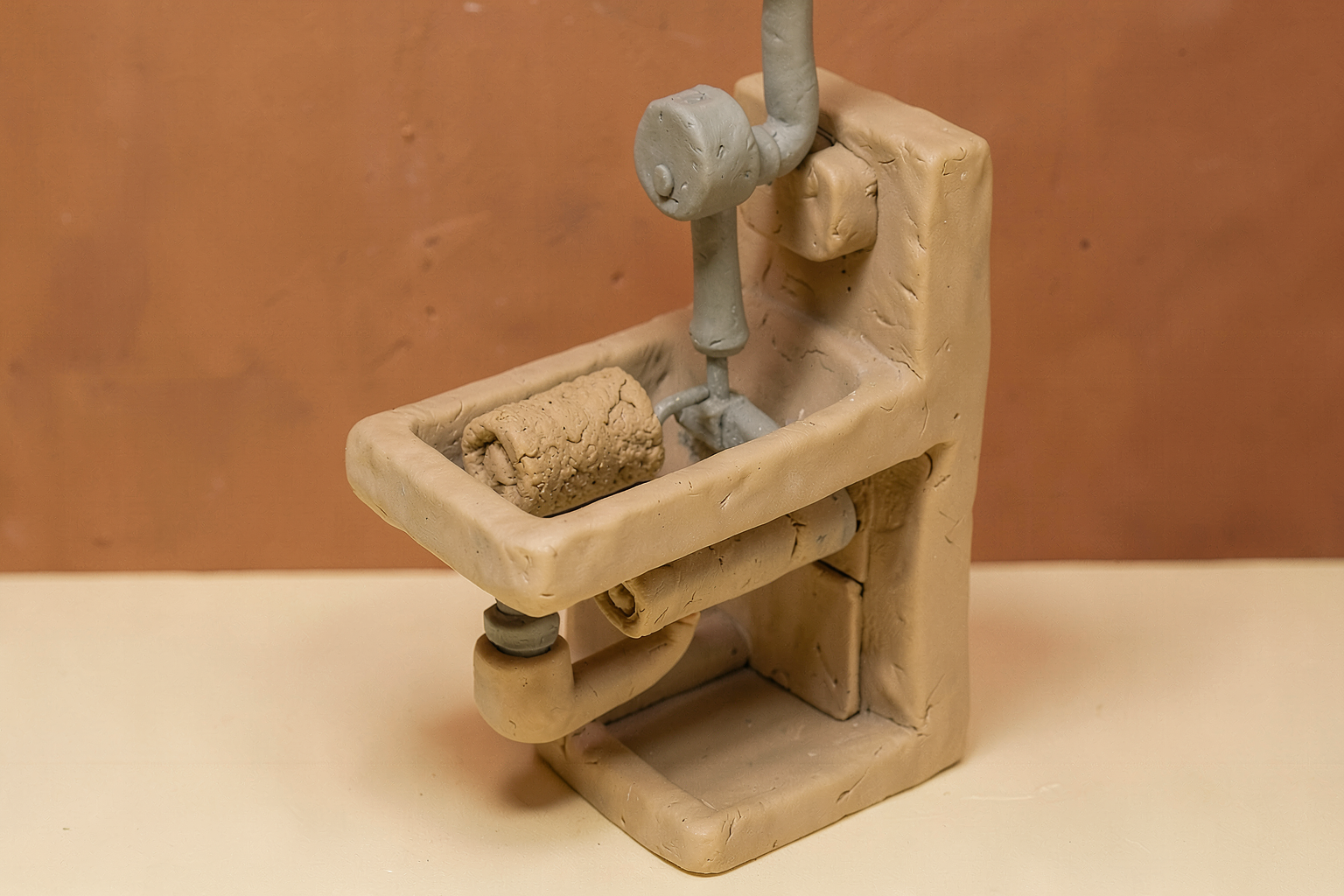
The central pairing is Motor-Driven Brush Wheel with Wheel: A sink for cleaning paint brushes and rollers soiled with water-based paints has a motor-driven brush wheel.

First, the setting
After painting walls, trim, or furniture, people need to deal with tools still coated in color. Brushes and roller covers cannot simply be left to dry if they may be used again. Cleaning them also creates cloudy rinse water that needs careful handling.
In a workshop, paint store, or home project area, someone brings a wet brush or roller to a utility sink. Bristles move against a spinning cleaning surface while water carries loosened paint downward. A nearby person sees the tools becoming clearer and the rinse water being directed away.
What changes in this design
Without the extra features named here, a reader might picture washing brushes and roller covers at a plain sink and letting the water run to its drain.
Here, brushes meet a motor-powered rotating cleaning part. A roller cover is secured by a hanger beneath an overhang, and a drain hose collects paint-water runoff for disposal.
Cleanup involves both painting tools and leftover paint-water. This sink brings brush cleaning, roller-cover holding, and runoff collection into the same place.
Cleaning Duties in the Sink
The arrangement gives brush-and-roller washing a place to perform its separate jobs. Published on September 10, 2026 as US20260262823A1, the patent titled Sink For Cleaning Paint Brushes And Roller Covers describes a sink for cleaning paint brushes and rollers soiled with water-based paints. That purpose sounds familiar, which is why the arrangement deserves a second look rather than a grand introduction. The setup sounds less like a basin waiting patiently and more like a small stage manager assigning the brush, the roller, and the runoff their places. You can picture the proposed scene before deciding whether it answers your own question: a brush-cleaning wheel, a place to secure a roller, and a route for water that has picked up paint. The point is not that a sink becomes remarkable by acquiring parts; it is that the filing makes the parts visible as a sequence of responsibility.
That picture makes the terms worth slowing down for. A motor-driven brush wheel is a wheel turned by a motor, described here as part of the cleaning arrangement. A hanger is a support; it sits beneath an overhang, which is a portion that projects above it, so the roller can be secured there. The drain hose is the route named for collecting paint-water effluent, meaning wash water carrying paint, for disposal. None of those labels asks you to imagine an unseen feature. They give you three concrete things to locate: motion for the brush, a holding point for the roller, and a channel for what leaves the cleaning work. That plain vocabulary matters because a design can only be judged at the scale at which its duties can be seen.
Wheel, Hanger, and Drain
With those duties named, the mechanism is easier to inspect without pretending it does more than the published description says. The patent places a motor-driven brush wheel in the arrangement and pairs it with a hanger beneath an overhang to secure a roller. It also specifies a drain hose that collects the paint-water effluent for disposal. The motor-driven brush wheel has the air of a modest committee with one member willing to keep moving. The available description does not supply a speed, a cleaning sequence, or a result measurement, and that limit is useful evidence too. Before acting, you can tell what jobs have been assigned while leaving unassigned details unclaimed. This is the practical diagnostic: identify the object, the support, and the exit path, then ask whether that division matches the mess you expect.
That diagnostic leads to the comparison that interests me most: not a contest between named products, but a change in who carries the burden. In the broad, ordinary picture of cleaning paint tools, the brush, roller, and used water can feel like three separate decisions. This filing instead describes an arrangement that assigns a brush to the wheel, a roller to its hanger, and the paint-water effluent to a drain hose. That division has the air of a restrained clipboard: each item is asked to wait in the place intended for it. The contrast is not proof that every cleanup is easier, faster, or better; no such result appears in the facts provided here. It is a narrower contrast between asking the person to keep reconciling objects and giving the arrangement a stated job for each one. You get evidence of intention before acting, rather than a promise about what will happen afterward.
Because that burden shift is stated rather than merely implied, two observations travel beyond this sink. First, a support placed where an object must pause can turn an improvised balancing act into a visible step; the hanger under the overhang is the record's specific example. Second, a route for residue can make disposal part of the arrangement instead of an afterthought; the drain hose is the specific example here. The drain hose makes the leftover water less like an afterthought and more like a guest escorted toward the exit. These are not instructions for another device or a verdict on this one. They are questions you can carry to any system that mixes objects, motion, and leftover material: Where does each item wait, what keeps it from drifting into someone else's task, and where does the remainder go? The evidence arrives as placement, not applause.
What the Arrangement Shows
That final point keeps the takeaway modest. I think the published patent is worth attention because it lets you inspect a cleanup routine as an arrangement of responsibilities before you grant it any larger reputation. The brush wheel, roller hanger, overhang, and drain hose do not establish an outcome beyond the stated cleaning and collection roles. They do, however, make a small systems question unusually legible: when a task gets messy, should the person coordinate every handoff, or should the layout carry some of that attention? The answer offered here is partial and specific, limited to water-based-paint brushes and rollers and the components named in the filing. Still, the image stays with me: a sink can be less like a blank container and more like a quiet host that knows where the brush, roller, and painted water are meant to go. That is a bounded reason to look twice, and no more than the published description can support.
The record, briefly. US20260262823A1, “Sink For Cleaning Paint Brushes And Roller Covers” A sink for cleaning paint brushes and rollers soiled with water-based paints has a motor-driven brush wheel, a hanger beneath an overhang to secure a roller, and a drain hose for collecting paint-water effluent for disposal.
More angles on this
- Two Rolling Brushes, Mirrored: A Cleaning Module That Says Which Way Its Bristles FaceAnother reading from the same A46B classification family, brushes.
- The Light Loop Inside an Oral-Care RoutineAnother reading from the same A46B classification family, brushes.
- CPC E03C: Domestic plumbing installations for fresh water or waste water ; sinksThe official classification family this record was filed into, published in the USPTO Cooperative Patent Classification scheme.
- CPC A46B: BrushesThe official classification family this record was filed into, published in the USPTO Cooperative Patent Classification scheme.
- Inside brush, methodAnother reading from the neighbouring A46D classification family, manufacture of brushes.
Read around this one:Public patent recordUSPTO published figure