Objects
The Useful Quiet Room Beside Memory
An obscure capacitor patent exposes how NAND makers are fighting for power, die area, and position during a blistering memory boom.

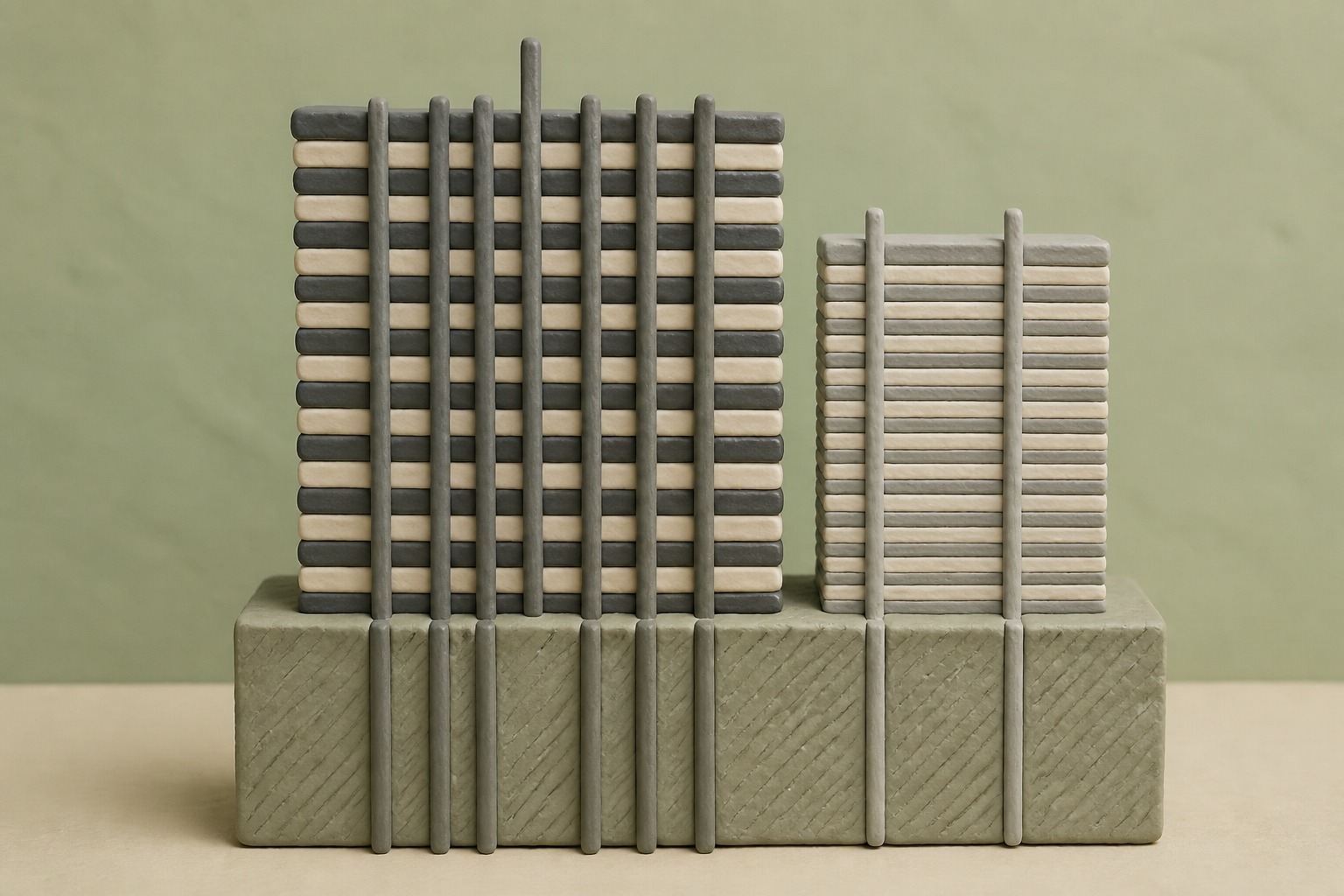
What changes in this design
The record does not say how capacitors are ordinarily placed in similar devices, so no usual layout is established.
This device puts the capacitors in a laterally separate block beside the memory block. Within that block, dummy word lines are electrodes and insulating layers are dielectrics, meaning nonconducting capacitor material.
This placement is worth noticing because it separates the memory block from the capacitor block in the physical layout. The record does not state what effect that separation has on performance, size, or use.
May 6, 2026
On May 6, 2026, SanDisk reported $5.95 billion in quarterly revenue, up 251 percent from a year earlier. That number stayed with me while I read a patent application published that August. A boom can make unused silicon valuable. US20260253624A1 belongs here, I think, not as a sudden breakthrough, but as evidence of an old engineering squeeze.
That revenue line does not prove why the application was filed. That revenue line is one I use only to set the scale: five leading NAND brands brought in $68.87 billion in the second quarter of 2026, up 77 percent from the prior quarter. A capacitor patent reads differently to me in a business moving that fast.
Three days after separation
SanDisk's filing, dated February 24, 2025, came three days after it completed its separation from Western Digital. It was published on August 27, 2026. The design places a capacitor block laterally beside a memory block. Inside the dummy block, alternating dummy word lines function as electrical plates, and the insulating layers between them as the capacitor's insulating separator.
This doesn't look to me like a magic new kind of memory here. The proposal puts capacitance, as I see it, into a dummy region instead of taking fresh die area. The application is, to me, a physical arrangement, not a demonstrated performance result. That distinction matters when an ambitious title tempts us to mistake an application for a finished product.
The 2019 patent
US11282849B2 was the next patent I found. YMTC's patent has a 2019 priority date and was granted in March 2022. It uses a dummy memory block as a pool capacitor, with conductive layers as plates and the layers between them as dielectric. Writing about the newer filing as though it discovered the broad move of mining dummy silicon for capacitance wouldn't be honest.
That does not decide the newer application's legal fate. Patent claims can turn on layer shapes, contacts, process order, and wording that a broad comparison hides. Still, the central proposition had appeared in a granted patent nearly three years before SanDisk filed. That cuts, I think, against any sweeping claim of novelty, even if a narrower manufacturing detail might yet matter.
375 layers
YMTC was not alone in treating capacitance as a geometry problem. The search turned up a 2014-priority patent that puts tall capacitor electrodes in a peripheral region, parallel to memory-channel holes, and a 2015-priority application that turns existing memory-cell transistor strings into decoupling capacitors. Both seek capacitance without simply giving up a conventional planar slice of the die.
The pressure is becoming physical. A memory maker revised a planned 400-layer-class NAND stack down to 375 layers because channel-hole etching had grown difficult, and it plans to replace tungsten word lines with molybdenum as dimensions shrink and resistance becomes more troublesome. SanDisk's dummy-block proposal is, to me, one answer among several to that constraint, not an isolated invention.
July 29, 2026
The older patent's owner has not remained a footnote. In December 2025, YMTC sued two U.S. departments over its Chinese-military-company and Entity List designations, saying it has no military ties and has never been accused of violating U.S. export controls. The lawsuit reporting can't resolve those assertions for me, but the dispute makes this technology story more than a private contest over circuit layout.
The market supplied another sign of pressure. A July report tied concern over a Chinese memory maker's Shanghai IPO to a sharp SanDisk share decline: $1,096.10 on July 29, more than 53 percent below the $2,354.39 high reported for June 25. That account is, to me, a picture of investor anxiety, not proof that one IPO caused the fall. Yet it shows why power, capacity, and die area are being read together.
The open question
US20260253624A1 is a published application, not a verdict. Whether its individual claims will be allowed, narrowed, or rejected remains unknown to me, and neither the boom nor an older patent can settle that. What I do know is that the grander claim needs restraint. The filing documents a way to harvest capacitance from dummy regions, but the public trail shows that engineers had been pursuing the same basic economy from more than one direction for years.
That is why I will watch the claims rather than the title. Can this particular arrangement show a real technical distinction from YMTC's older pool-capacitor design, or is the more revealing fact that NAND makers have been running out of easy places to put capacitance? The patent may prove consequential. Its broad idea does not, I think, seem new.
Sources
Reporting for this piece drew on the published filing and the references below.
- US20260253624A1 - Three-Dimensional Memory Device Including Capacitors Located In Dummy Memory Block And Methods For Forming The Same
- US11282849B2 - Non-volatile memory device utilizing dummy memory block as pool capacitor
- Sandisk: Fiscal 3Q26 Financial Results
- Combined Revenue of Top Five NAND Flash Brands Rises 77% QoQ in 2Q26
- US10014315B2 - Non-volatile memory devices with vertically integrated capacitor electrodes
- US 2017/0053932 A1 - Semiconductor Memory Device
- SK hynix to Mass Produce 375-Layer NAND by Year-End, Introduce Molybdenum
- Chinese chipmaker YMTC challenges US Defense Dept in suit
- SanDisk Stock Crashes Over 50% as China Chip Threat and Earnings Loom Large
The record, briefly. US20260253624A1, “Three-Dimensional Memory Device Including Capacitors Located In Dummy Memory Block And Methods For Forming The Same” A semiconductor structure includes a memory block with alternating word lines and insulating layers, vertical NAND strings, and a laterally separate capacitor block whose dummy word lines and insulating layers function as capacitor electrodes and dielectrics.
More angles on this
- A Sideways Reading of Split StaircasesAnother reading from the same G11C classification family, static stores.
- CPC G11C: Static storesThe official classification family this record was filed into, published in the USPTO Cooperative Patent Classification scheme.
- CPC H10B: Electronic memory devicesThe official classification family this record was filed into, published in the USPTO Cooperative Patent Classification scheme.
- Liquid Cooling Heat Dissipation Device For Multi-Disk Drive System Marks a Pause Worth NoticingAnother reading from the neighbouring G11B classification family, information storage based on relative movement between record carrier and transducer.
- The Clip Needs Its ContextAnother reading from the wider H04N classification family, pictorial communication, e.g. television.
Read around this one:Public patent recordUSPTO published figure