Machines
Uniform Flux and Parallel Striplines: The Quiet Mechanics of Sensor Alignment
With banknote counterfeiting at historic lows, security printers are turning to quantum spin resonance sensors to inspect physical cash before it disappears.

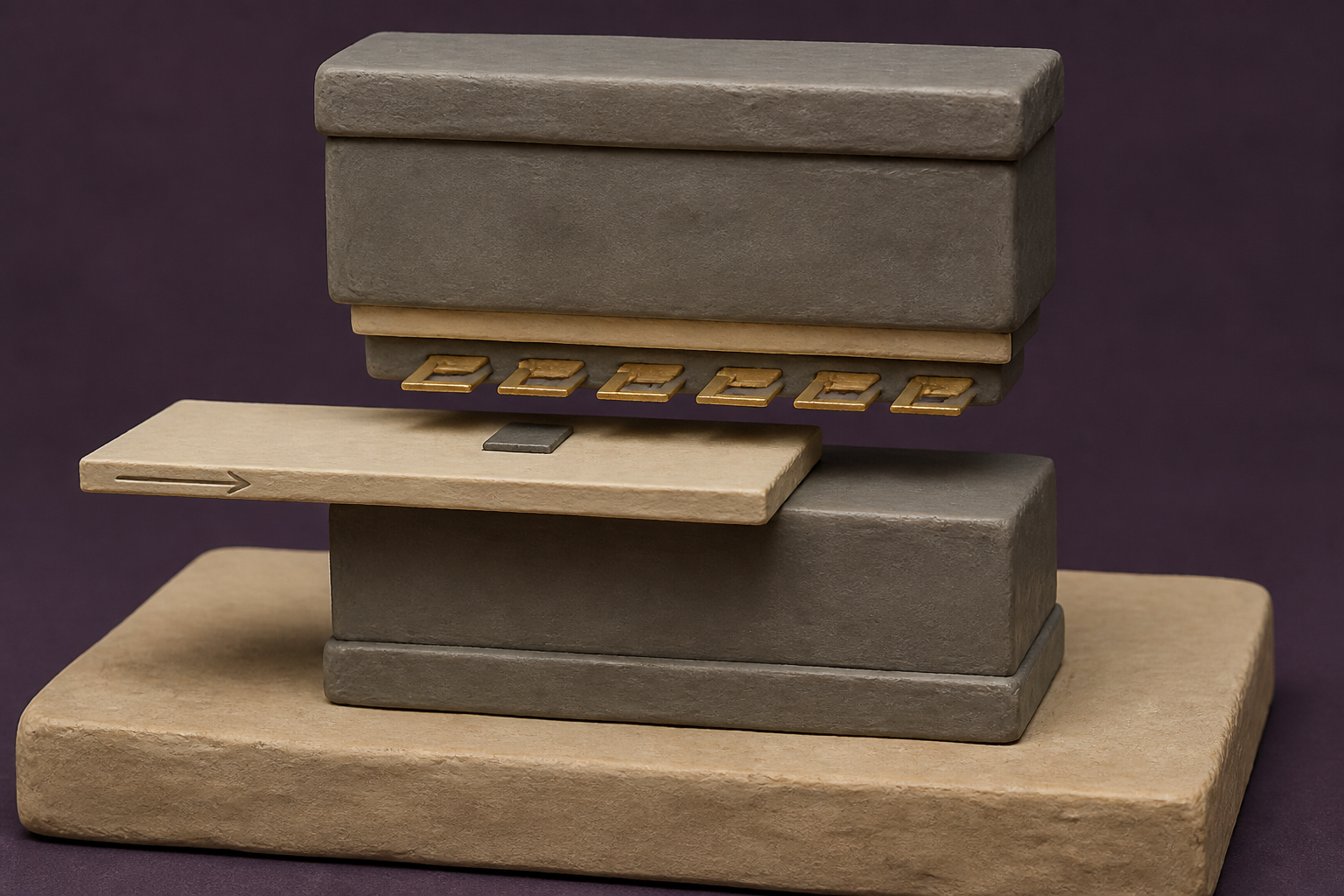
What changes in this design
A reader might expect testing equipment to check one point at a time or require distinct frequencies for separate channels. Gathering signals across an area can be difficult if the surrounding magnetic field varies between test locations.
Instead, this record describes multiple strip-like resonators operating independently while sharing the exact same excitation frequency. A polarization unit maintains a uniform magnetic field across all resonator positions inside an air-gapped magnetic core.
This approach allows several readings to happen side by side under identical magnetic conditions. Because the magnetic flux is uniform, measurements from each separate strip remain directly comparable without altering the operating frequency.
The vanishing counterfeit
In 2025, the Bank of England seized roughly 200,000 counterfeit banknotes. That sounds like a tidy stack of illicit cash until you look at the denominator. Counterfeits made up less than 0.0041% of all circulating currency in the United Kingdom, or fewer than one fake note in every 24,390. Across the Atlantic, the Federal Reserve tracked 56.6 billion genuine notes in active circulation at the close of 2025, dominated by 19.9 billion hundred-dollar bills. Criminals still try their luck with desktop printers, but the broader war over forged cash was largely won years ago by polymer substrates and microscopic optical features.
I had assumed that banknote inspection was a settled craft where minor refinements were all that remained. When we look at central bank reports, paper and polymer money appears safer from forgery than at any point in modern history. Yet inside the specialized security printing industry, researchers are not coasting on their victory. They are preparing for an entirely different kind of physical verification, borrowing techniques directly from experimental quantum physics.
The secret third level
Currency security has always run on a strict caste system. Level I features are public markers that anyone can check with a thumb or an eye: watermarks, raised ink, metallic threads, and colour-shifting patches. Level II features protect retail cashiers, relying on compact desktop scanners to spot ultraviolet fluorescence or basic magnetic ink.
The real engineering lives at Level III. These machine-readable markers are kept secret from the public and reserved exclusively for central bank sorting vaults. Back in 1975, German printing giant Giesecke+Devrient introduced the "M-Feature," a covert chemical taggant built from rare-earth compounds. Over the following decades, more than seventy central banks put it onto over 100 billion circulating banknotes. But after fifty years of service, chemical phosphors face the inevitable passage of time. If a sovereign currency wants a marker that cannot be reverse-engineered or simulated by chemical mimics, it needs something deeper than conventional optics.
A microwave lab on a strip
That replacement is taking shape in patent US20260260531A1, filed by Giesecke+Devrient. The application outlines a sensor designed to authenticate data carriers using electron spin resonance, the same spectroscopic phenomenon researchers use to map unpaired electron spins in molecular physics.
What struck our attention in the published record was the physical density of the hardware. Traditional electron spin resonance requires bulky electromagnets and resonant cavities the size of coffee cans. The patent instead flattens the apparatus into a compact sensor element. An air-gapped magnetic core paired with a polarization device generates a steady, highly homogeneous magnetic flux across a narrow inspection slot. Suspended right beside the gap is an array of planar stripline resonators, all tuned to operate independently at the exact same excitation frequency in the microwave band.
Forty notes every second
Building a planar microwave resonator is tricky enough on a laboratory bench, where half-wavelength microstrip lines in the 9 to 10 gigahertz X-band must maintain quality factors above 200 to spot dilute spin markers. Doing it inside an automated cash sorter is an operational nightmare. High-speed central bank sorting systems process banknotes at blistering speeds of up to forty notes per second. At that pace, each note flashes past the sensor head in twenty-five milliseconds.
The filing lists Stephan Huber as its inventor, a physicist who developed banknote sensors at Giesecke+Devrient before moving into academia in 2021. His design solves the speed bottleneck by splitting the excitation field across parallel stripline channels. By establishing a uniform magnetic field across every resonator location, the sensor can trigger and detect non-linear spin induction signals across the full width of the passing bill without overheating the paper or requiring slow mechanical adjustments.
The open question
I cannot say for certain whether these microwave resonators will ever reach widespread commercial deployment. Building quantum spin detectors into currency sorters represents an extraordinary technical leap, yet it arrives at an awkward historical moment. The same security printer that filed this patent is expanding rapidly into digital currencies and software platforms, even as central banks test sovereign digital cash and consumers shift to phone taps.
To my mind, that contrast highlights the central puzzle of modern currency defense. Why engineer an atomic-scale magnetic sensor to protect physical paper when physical paper is used less with every passing year? Perhaps the answer is that as cash becomes rarer, the notes that remain in circulation must be impossible to dispute. Our sense is that this filing captures an industry pushing its physical craft to its absolute technological peak, building an unforgeable lock for a door that society might eventually stop opening.
Sources
Reporting for this piece drew on the published filing and the references below.
- Sensor Element, Test Device, And Method For Testing A Data Carrier Having A Spin Resonance Feature - Justia Patents
- Counterfeit Banknotes - Bank of England
- Currency in Circulation: Volume - Federal Reserve Board
- Banknote Authentication Security Features - Spectra Systems
- Security Printing - Wikipedia
- A continuous-wave and pulsed X-band electron spin resonance spectrometer operating in ultra-high vacuum for the study of low dimensional spin ensembles - arXiv
The record, briefly. US20260260531A1, “Sensor Element, Test Device, And Method For Testing A Data Carrier Having A Spin Resonance Feature” A sensor element for testing a flat-surface data carrier having a spin resonance feature includes an air-gapped magnetic core, a polarization device, and a resonator device with multiple stripline resonators operable independently at the same excitation frequency. The polarization device generates a homogeneous magnetic flux across the resonator positions.
More angles on this
- CPC G07D: Handling of coins or valuable papers, e.g. testing, sorting by denominations, counting, dispensing, changing or depositingThe official classification family this record was filed into, published in the USPTO Cooperative Patent Classification scheme.
- Splitting the Doorway: What Happens When Physical Access Queries a Health RuleAnother reading from the neighbouring G07C classification family, time or attendance registers.
- Selective Variable Relocation In Constrained Calculation SystemsAnother reading from the wider G05B classification family, control or regulating systems in general.
- Targeting the X-Ray Opening Where Recognition Takes OverAnother reading in the same Machines category on this site.
Read around this one:Public patent recordUSPTO published figure