Objects
When a Moving Path Gets Its Bearings
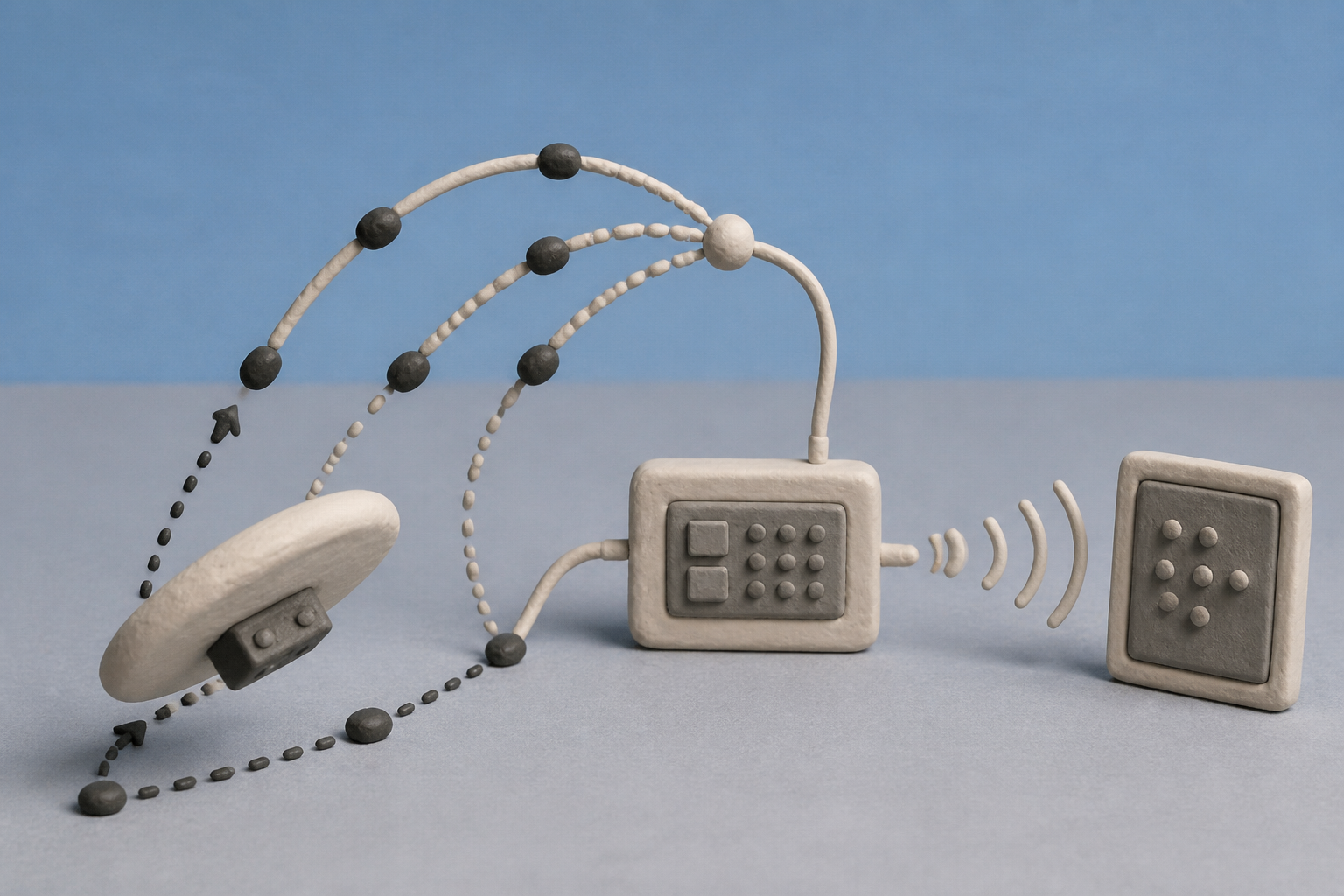
Device plus Into Trajectory State carry the practical point: A device tracks gyroscope and accelerometer outputs of recreational equipment during an activity cycle.

First, the setting
Many recreational activities involve repeated movements with equipment, such as swinging, throwing, rolling, or striking. People often want a clearer sense of how those movements unfold, whether they are practicing alone, learning from someone else, or simply comparing one attempt with another.
A participant holds or wears a piece of recreational equipment while moving through an activity. A small sensor may travel with the equipment, while a nearby phone, watch, or display shows a path-like view of the motion. Someone standing nearby might watch the activity, then look over the recorded movement afterward.
What changes in this design
A reader might otherwise expect the equipment's path to be observed directly. How paths are ordinarily measured is not stated.
Here, gyroscope and accelerometer outputs during an activity cycle are transformed into path-related state parameters. Motion parameters are associated with them, and the state parameters are shared wirelessly for partial path reconstruction.
This matters because the page is about using movement readings to recover only part of where the equipment traveled. How complete or accurate that reconstruction is not stated.
Motion Cues in One Frame
During an activity cycle, a piece of recreational equipment moves while the device tracks its gyroscope and accelerometer outputs. You can picture a small, orderly trail of readings rather than one grand announcement about where it went. The arrangement has the air of a small stage manager, keeping the motion cues from wandering off. Published September 3, 2026 as US20260257105A1, the filing called Trajectory Measurement Device, System, And A Method Thereof begins with a modest condition: motion produces signals, and signals need company.
From Sensor Outputs to Path
That picture needs a few terms. A gyroscope output concerns rotational motion, while an accelerometer output concerns acceleration; the patent tracks both during the cycle. A trajectory state parameter is a value describing where a path stands, and a motion parameter is a value connected with movement. The names are technical, but their role is less like a box of loose receipts and more like tags that keep related bits together.
With those names in view, the filing describes transforming the sensor outputs into trajectory state parameters and associating motion parameters with them. That sequence made me look twice: the quiet work is not merely collecting readings, but placing values in relation before they travel. The arrangement has the air of a restrained committee, asking each number to take the correct seat.
Once the values have that relationship, the state parameters are shared wirelessly for partial trajectory reconstruction. Partial reconstruction means recreating only part of a path from shared state information, not a complete account of every moment. That boundary is worth your attention because the described handoff preserves organized path information for a portion of the reconstruction, leaving the remainder outside the exchange.
Wireless Handoff With Shape
Against a vague handoff, the contrast becomes clear. A vague handoff would pass along motion without showing how its pieces belong; the filing instead describes state parameters formed from the outputs, associated with motion parameters, then shared wirelessly. It is less like tossing a recollection across a room and more like passing labeled pieces across a table. That is not a promise about performance. It is a design distinction that makes the transfer intelligible as part of measurement.
That distinction carries to an everyday systems question you may recognize: when information moves, what alignment should move with it? One transferable observation is that collection and organization are different chores, even within one device. Another is that a partial reconstruction can matter when shared material preserves the relationships the next step needs. Context has the air of a librarian with labels, though it requires no brass band. For that reason, I leave the published record thinking less about a device announcing a path and more about a system keeping a path's pieces aligned as they move. You might ask one calm question of the next sensor-based process you meet: can its receiver reconstruct the part that matters without guessing how the pieces fit?
The record, briefly. US20260257105A1, “Trajectory Measurement Device, System, And A Method Thereof” A device tracks gyroscope and accelerometer outputs of recreational equipment during an activity cycle, transforms them into trajectory state parameters, associates motion parameters, and shares the state parameters wirelessly for partial trajectory reconstruction.
More angles on this
- A Flywheel's Answer From Two Moving MembersAnother reading from the same A63B classification family, apparatus for physical training, gymnastics, swimming, climbing, or fencing; ball games; training equipment.
- A Glove With a PortfolioAnother reading from the same A63B classification family, apparatus for physical training, gymnastics, swimming, climbing, or fencing; ball games; training equipment.
- CPC A63B: Apparatus for physical training, gymnastics, swimming, climbing, or fencing; ball games; training equipmentThe official classification family this record was filed into, published in the USPTO Cooperative Patent Classification scheme.
- An Inflatable Costume Prepares for Lift-OffAnother reading from the neighbouring A63H classification family, toys, e.g. tops, dolls, hoops or building blocks.
- A Sleeve's Context HandoffAnother reading from the wider A62C classification family, fire-fighting.
Read around this one:Public patent recordUSPTO published figure