Objects
When the Fit Decision Moves Inside the Short
Assembly plus Short Member carry the practical point: A protective athletic padding assembly in one garment includes a short member.

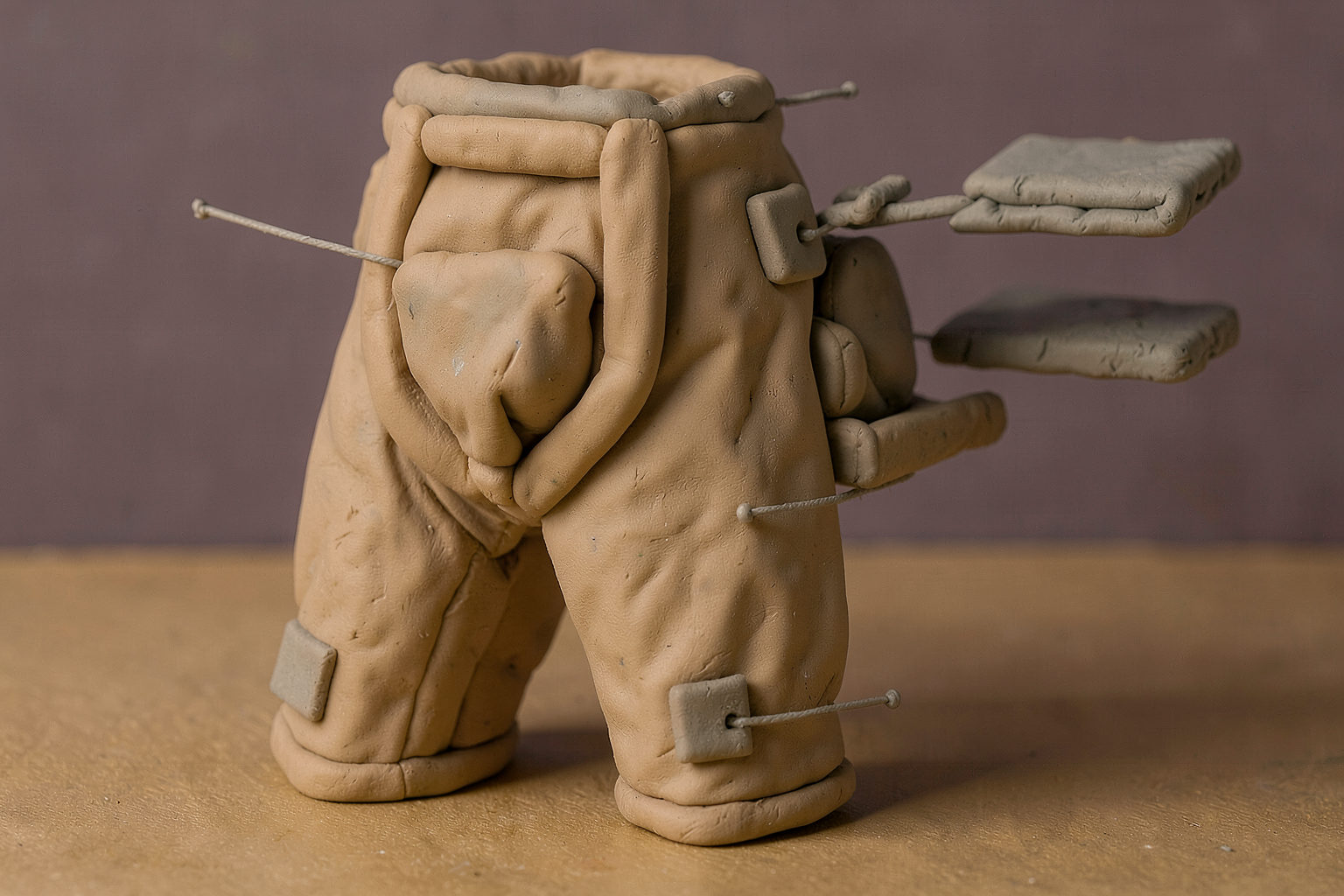
First, the setting
Sports and active play can bring sudden contact, falls, and awkward movements. People often choose clothing that feels secure and lets them focus on the activity rather than constantly adjusting what they wear. Gear worn close to the body needs to move with the person through running, bending, and sitting.
In a locker room, an athlete pulls on close-fitting shorts before practice or a game. The fabric sits beneath other clothing while the person runs, turns, and changes position. A supporter and front protective piece are held inside the garment, so the setup stays close to the body during activity.
What changes in this design
Without further detail, a reader might picture protective padding as separate from the shorts or fixed in one fit.
Here, the shorts, a hook-and-loop supporter, and a triangular shield inside the front are combined in one garment. The supporter allows the wearer to adjust the compression fit.
The central idea is easy to miss in the illustration: the fit adjustment is part of the garment itself, alongside the protective padding.
Garment Fit and Decision Ownership
You may assume the fit decision ends in the familiar moment when athletic shorts are pulled on: the garment arrives with its answer already sewn in. The published record for US20260262755A1, titled Protective Athletic Padded Shorts and published September 10, 2026, complicates that ordinary script by describing one garment with a short member, a hook-and-loop supporter, and a triangular shield inside the front short. Who, in that small arrangement, is meant to supply the missing context: the garment, or the individual wearing it? Not quite. The filing points toward an adjustable compression garment tailored to an individual's needs, and that is where I looked twice: not at a grand promise, but at a decision about fit being invited back into the garment. The scene is small, yet the front of the short is no longer asked to carry one silent assumption.
That question needs ordinary names before it can bear any interpretation. A short member is simply the shorts portion of the garment. A hook-and-loop supporter is the component identified by hook-and-loop fastening, paired gripping surfaces that meet and separate, rather than by a fixed technical label the published record does not provide. The triangular shield is a three-sided shield identified as being inside the front short. The filing describes the result as an adjustable compression garment, meaning a garment meant to fit closely with room for adjustment; it does not let us infer a material, measurement, or outcome. These definitions draw a useful line between what has been described and what has not. The vocabulary is modest, which is why it matters: each named part tells you where to look without pretending to answer everything.
With those terms in place, the arrangement becomes easier to picture without pretending to see beyond the page. One garment gathers the shorts portion, the fastening supporter, and the triangular shield; the shield is placed inside the front short, and the combined assembly is described as adjustable and tailored to individual needs. The triangular shield sits there as if a particularly polite label-maker had been asked to make a shape do some explaining. That image is deliberately small. It asks you to notice a design choice in which context is not treated as an inconvenience outside the garment, but as something the garment is organized to accommodate. The published record does not supply a user's story, and it need not. Its arrangement already raises the more interesting editorial question of where a system expects individual variation to enter.
Publication Facts, Parts, Boundaries
That question shifts from picture to mechanism. The precise claim available here is narrow: the filing describes a protective athletic padding assembly in one garment, including a short member, a hook-and-loop supporter, and a triangular shield inside the front short, to provide an adjustable compression garment tailored to an individual's needs. No broader scorecard follows. The mechanism worth attending to is organizational: the adjustment is part of the garment's stated arrangement rather than an afterthought around a presumed fixed fit. That arrangement is less like a uniform issuing orders and more like a considerate stage manager waiting for a cue. The point is not that the garment vanishes as an authority; the point is that the published description makes room for the individual as a participant in the fit decision.
The comparison can now stay modest and specific. A broad default imagines a garment as a finished answer: a size, a shape, and a decision delivered together. This filing instead describes a short member, a hook-and-loop supporter, and a triangular shield in one garment whose stated purpose is adjustable compression tailored to individual needs. Hook-and-loop has the air of a tiny committee that can reconvene without making a speech. That image should not be mistaken for a claim about results. The public anchors are limited and clear: US20260262755A1, the title Protective Athletic Padded Shorts, and a publication date of September 10, 2026. Together they support this narrow contrast, not a broader conclusion about results or how the arrangement is received.
Your Fit-Ownership Field Test
That bounded contrast leaves you with a field test for systems far beyond this garment, while keeping the patent at the center. First, ask who owns the adjustment when an individual need appears: does the system make the decision in advance, or does its arrangement allow a response within the system? Then ask whether the relevant parts make that response legible, as the named short member, hook-and-loop supporter, and triangular shield make the arrangement traceable here. A third observation follows: placing adjustment where context matters can be more meaningful than adding a generic option elsewhere. I think that is worth your attention because it is not a sweeping claim. It is a restrained revision of the old default, and a useful prompt to stop treating the garment as the only owner of the fit.
The record, briefly. US20260262755A1, “Protective Athletic Padded Shorts” A protective athletic padding assembly in one garment includes a short member, a hook-and-loop supporter, and a triangular shield inside the front short to provide an adjustable compression garment tailored to an individual's needs.
More angles on this
- A Nursing Cover With Named Openings, and the Moment Coverage Changes HandsAnother reading from the same A41D classification family, outerwear; protective garments; accessories.
- Seeing the Elastic Pattern Before You Decide What It MeansAnother reading from the same A41B classification family, shirts; underwear; baby linen; handkerchiefs.
- CPC A41B: Shirts; underwear; baby linen; handkerchiefsThe official classification family this record was filed into, published in the USPTO Cooperative Patent Classification scheme.
- CPC A41D: Outerwear; protective garments; accessoriesThe official classification family this record was filed into, published in the USPTO Cooperative Patent Classification scheme.
- An Apparel Pattern Wants To Be Noticed Before It Is WornAnother reading from the neighbouring A41C classification family, corsets; brassieres.
Read around this one:Public patent recordUSPTO published figure