Objects
Where a Core Drill Support Meets Its Edge
A new core-drill patent points back 23 years, to a small maker's repeated claim that less steel at the rim can mean a truer hole.

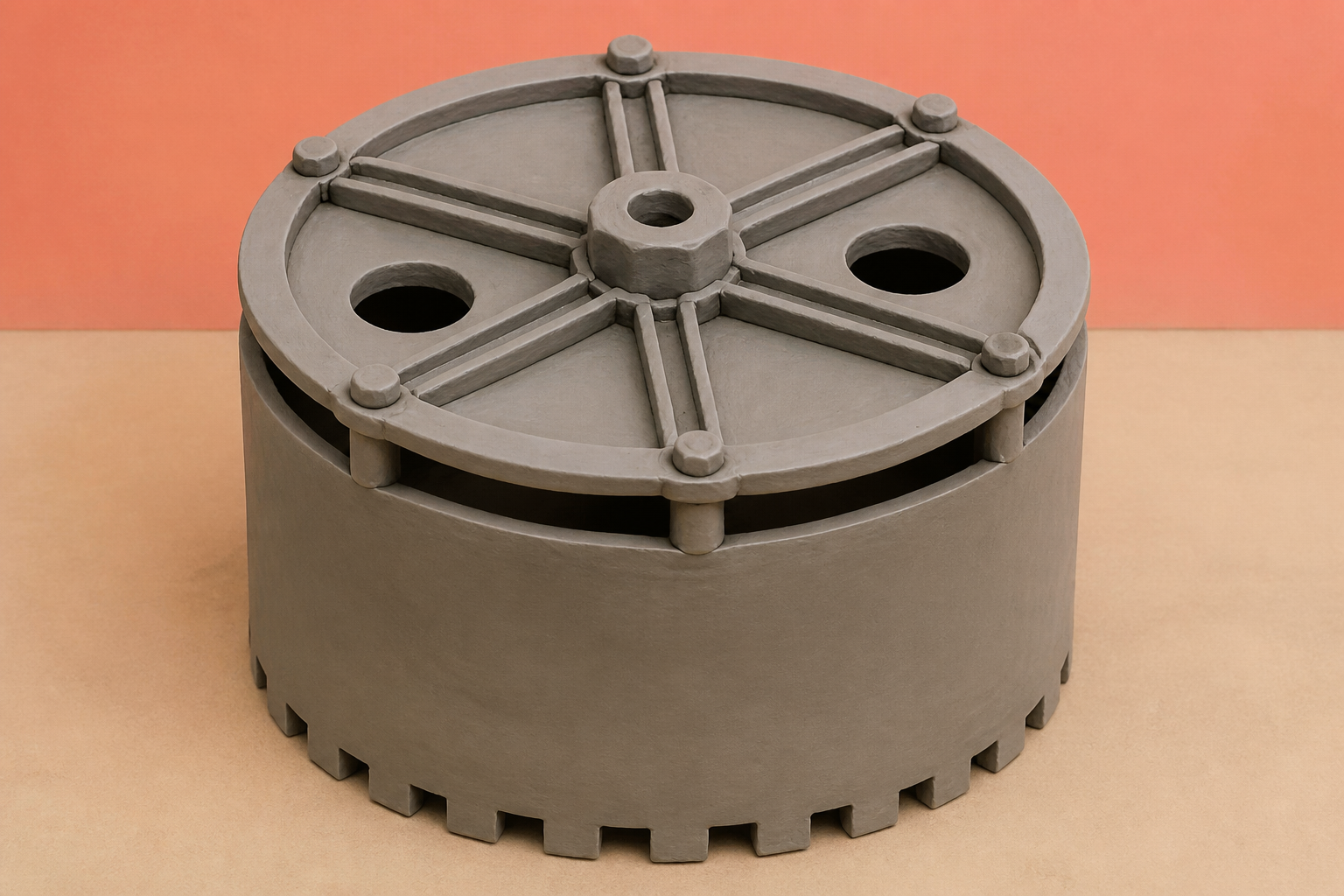
What changes in this design
The record does not say how other core drill supports are usually made or reinforced.
Here, reinforcement includes an extension between the tool center and perimeter. That extension can be non-flat, contain a channel, use slanted elements, and include a top plate.
It gives a reader a clear picture of where the extra structure sits: it reaches from the tool center toward the outer edge.
Fifteen pounds at the rim
A 16-inch core drill has an awkward problem: its cutting tube needs support, but a solid steel end plate adds substantial weight exactly where the tool is already under strain. An early Western Saw patent put a number on the trade-off, describing a spoked reinforcer that made that plate fifteen pounds lighter. It also identified the costs of the heavier approach: deflection under load and debris trapped inside the drum.
That is a very physical kind of invention. The ribs are not decorative. They are meant to keep a large circular cutter from wandering out of shape while removing steel that the operator must carry, spin, and control. What interests me is how persistently this one piece of shop-floor geometry has been pursued.
The 2003 starting point
The documented trail begins with a 2003 filing by Western Saw Corp. Its inventors were Kevin F. Baron, Kraig M. Baron, and Leon D. Jones, and its central proposal was a bolt-on drive assembly with a spoked reinforcer. A later 2010 filing describes the same broad weight-and-deflection problem, now through a high-strength spoked design.
The number I keep returning to is 23: twenty-three years from that initial filing to US20260257285A1. The 2026 application is not presenting a solid plate as its answer. It claims a reinforcement extending between a tool center and perimeter, with possible non-planar shaping, a channel, slanted elements, and a top plate to add strength. Those details may matter in claim drafting, but they sit atop an old proposition: ribs can do work that a heavy disc once did.
Six refilings and new names
The family history is unusually revealing. A later granted patent lays out a chain running from the 2010 U.S. application through granted patents, international filings, an abandoned U.S. application, and further U.S. continuations before reaching the current line. It amounts to at least six refilings around the underlying idea, all tied back to the 2010 priority date.
The named inventors changed along the way, with Anthony Baratta listed on later patents. That change alone proves nothing improper. Still, the fact that I cannot tell from the published documents how the underlying design work moved between people is part of the story: patent families preserve legal relationships more clearly than they preserve a workshop's human history. Western Saw, a family and independent diamond-tool maker in Oxnard, also markets patented lightweight tubes and anchor-slot cores, so these rights serve as a public selling claim as well as a legal asset.
An external frame disappears
A separate inventor, Lee C. Thornton, took a different route. His 2019 application for a heavy-equipment concrete core-drill stabilizer proposed an external stabilizing frame for the same basic concern: keeping a core drill from going out of round. The patent granted in 2020, then expired on July 14, 2024 after maintenance fees were not paid.
That contrast matters to me more than the difference between a channel and a top plate. One approach has kept returning to the Patent Office through a long family. The other obtained a grant and then vanished from force within four years. I don't see evidence here that either design was categorically better, only evidence that persistence in the system can matter as much as the location of the reinforcing steel.
Water changed the job
The larger change in core drilling during this period came from outside these patent drawings. OSHA's respirable crystalline silica construction standard took effect in 2017, setting a permissible exposure limit of 50 micrograms per cubic meter over an eight-hour time-weighted average and an action level of 25. Guidance for compliant wet core drilling describes water flow of roughly two to six litres per minute, depending on bit diameter.
That requirement turns water delivery, slurry control, and operator exposure into engineering facts alongside weight and stiffness. For my money, it is the more consequential pressure on modern core-drilling equipment because it changes how the work is performed, not merely how the reinforcement is shaped.
Where the risk actually sits
A continuation chain is not proof of an improper extension, and a 23-year story is not the same thing as a single 23-year patent term. Continuation applications can seek new claims, and each application still faces examination. The Congressional Research Service has described how repeated continuations can nevertheless extend practical exclusivity around a product, with legal checks intended to limit abuse.
The risk is that a familiar industrial improvement becomes fenced in not by one decisive breakthrough but by repeated attempts to define its edges. This filing deserves attention less as a startling new drill part than as evidence of that long effort. Whether its particular non-planar, channeled, slanted reinforcement earns a distinct boundary is for examination to decide. Readers should keep an eye on that question while remembering that the operator's immediate hazards may be dust, water, torque, and a heavy tool overhead.
Sources
Reporting for this piece drew on the published filing and the references below.
- US20260257285A1 - Support Assembly For A Core Drill
- US6890132B1 - Bolt on drive assembly for a core drill
- US8790052B2 - Bolt on drive assembly for a core drill with high strength spoked reinforcer
- US11883889B2 - Support Assembly for a Core Drill
- US10711525B2 - Heavy Equipment Concrete Core Drill Bit Stabilizer
- Western Saw Inc.
- OSHA Table 1 Compliance for Diamond Core Drilling
- Patent Evergreening: Issues in Innovation and Competition
The record, briefly. US20260257285A1, “Support Assembly For A Core Drill” A support assembly for a core drill uses a reinforcement with an extension between the tool center and perimeter. The extension can be non-planar, have a channel, include slanted elements, and use a top plate to strengthen the reinforcement.
More angles on this
- Cutting Tool, And Method For Manufacturing Machined Product Treats the Relationship as the PointAnother reading from the same B23B classification family, turning; boring.
- The Tilted Rim: An Editor's Reading of an Asymmetrical SiC SubstrateAnother reading from the same B28D classification family, working stone or stone-like materials.
- CPC B23B: Turning; boringThe official classification family this record was filed into, published in the USPTO Cooperative Patent Classification scheme.
- CPC B27B: Saws for wood or similar material; components or accessories thereforThe official classification family this record was filed into, published in the USPTO Cooperative Patent Classification scheme.
- Welding-Type Systems Using Fluid Sensors With Bond Resisting Substances Makes the Next Move Easier to SeeAnother reading from the neighbouring B23K classification family, soldering or unsoldering.
Read around this one:Public patent recordUSPTO published figure