Objects
Who Owns the Edge? A Susceptor Ring, an Injector Tube and the Rim of a Substrate
Assembly and Obtaining Desired Composition are the useful handles: Methods, systems, and assemblies for gas-phase processes are disclosed.

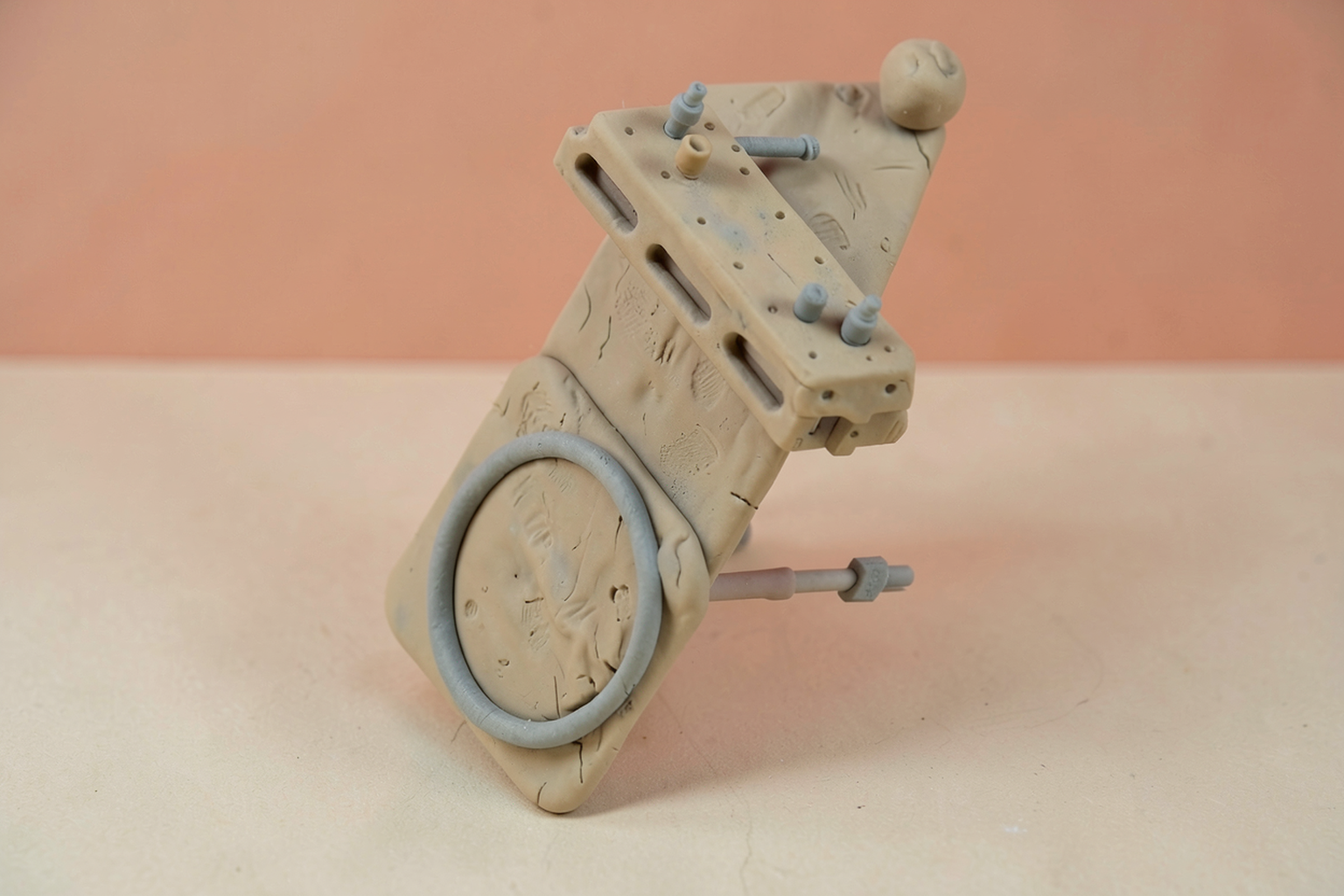
First, the setting
Many everyday devices rely on tiny electronic parts made in carefully controlled factory settings. Creating those parts often involves placing very thin layers of material onto flat surfaces. Workers care about keeping those layers even and consistent because small differences can affect how the finished parts behave.
Inside a clean manufacturing room, a technician monitors enclosed equipment holding a flat disk of material. Tubes guide gases around the disk while the equipment controls heat and flow. The activity is mostly hidden from nearby workers, but it is part of making components later found inside familiar electronic devices.
What changes in this design
The record does not state an ordinary method. A reader might picture gas being supplied to a material without special attention to its outer rim.
Here, a part called a susceptor ring and an injector tube supply gas to the substrate's periphery, meaning its outer edge.
That focus is worth noticing because gas delivery at the rim is connected with the intended material makeup or thickness pattern.
Where the substrate ends and the ring begins
Gas arrives at a surface, a layer forms from it, and then somebody has to decide what happens at the rim: that is the cause, the effect, and the next choice in US20260262477A1, published on September 3, 2026 under the title Method, Assembly And System For Gas Injection And Control. The filing describes methods, systems, and assemblies for gas-phase processes, meaning processes in which the working material shows up as a gas instead of a liquid or a solid. Its example assembly pairs two parts, a susceptor ring and an injector tube, and gives them one job: supply gas to the periphery of a substrate. The question that made me look twice is a plain one. Who is responsible for the edge, and what context around that edge does the published record leave you to supply yourself?
Answering that needs a few terms sorted first, so take them in order. A substrate is the workpiece, the thing a layer is being formed on. Its periphery is the outer margin, the band nearest the rim. A susceptor, as the word is ordinarily used for this sort of equipment, is the support a substrate rests on during processing, and a susceptor ring is a ring-shaped part belonging to that support; the published record names the ring without spelling out its exact shape, so it would be wrong of me to draw it for you in more detail than that. An injector tube is what it sounds like, a tube that delivers gas to a chosen place. The last term is profile, which here means how something varies from one location on the substrate to another. The filing mentions two of them: composition, or what the layer is made of, and thickness, or how much of it there is.
With the vocabulary settled, the picture is easier to hold. Imagine the substrate as a table being laid, with the middle well within reach and the far edge slightly awkward. Things at a boundary tend to behave differently from things in the middle, simply because a boundary has a neighbour on one side only; that is a general observation on my part, not something the filing states. What the filing does say is that gas is supplied to that margin, by those two named parts, in order to obtain desired composition and thickness profiles, either one or both. The ring comes across as if it had been handed a clipboard and told the outermost strip was now its department.
How gas reaches the rim
Walk through the sequence in order and the handover becomes visible. First, gas is wanted at the periphery. Second, an injector tube carries it there, which means the delivery has a route instead of a hope. Third, a susceptor ring belongs to the same assembly, so a piece of the support hardware is involved in feeding the rim instead of merely standing next to it. Fourth, the result being aimed at is a profile, a pattern across the substrate, not a single number read off one spot. I cannot tell you from the published record how the tube and the ring are joined, how the flow is set, or what the gas is, and guessing would be unfair to you. What can be said is where the ownership changes hands. Up to the edge, the substrate is the subject of the process; at the edge, the surrounding parts take a share of the work. The injector tube has the air of a stage manager who walks one prop to one mark and then steps back into the wings.
Testing an edge in your own work
Set that against the broad version of the same task, which is simply getting gas to a substrate. In the broad version the edge receives whatever happens to reach it, and the outcome there is a guess that someone checks afterwards. In the arrangement this filing describes, the edge has a named supplier and a stated purpose, so a defined response replaces the guess. Nothing in the record tells me that this works better than any alternative, and no such comparison is offered here. The distinction worth standing behind is narrower and, to my mind, more useful: the periphery is treated as a place with its own supply, not as the leftover part of the middle. It is less like watering a lawn and hoping the borders cope, more like giving the borders their own tap.
Two things travel well from this, and neither requires a process chamber. The first is that edges deserve an owner. In a shared spreadsheet, a relay between shifts, or a kitchen where one cook plates and another garnishes, the trouble collects where one party's attention ends and the next has not yet begun; naming who supplies that strip is half the repair. The second is to state the target as a pattern across the whole piece. A team that asks only for an average will get an average with ragged margins, while a team that asks for an even result from centre to rim has to say what happens at the rim. So the practical test is three beats long: find the boundary, ask who feeds it, and ask what result that feeding is supposed to produce. If any beat draws a shrug, you have found the place where your system is still guessing, and that is worth knowing before the edge tells you itself.
The record, briefly. US20260262477A1, “Method, Assembly And System For Gas Injection And Control” Methods, systems, and assemblies for gas-phase processes are disclosed. An exemplary assembly uses a susceptor ring and injector tube to supply gas to a substrate periphery, obtaining desired composition and/or thickness profiles.
More angles on this
- A Slanted Beam in the Routine of Making Superconducting WireAnother reading from the same C23C classification family, coating metallic material.
- The Oblong Carrier and the Mechanical Signal of AlignmentAnother reading from the same H10P classification family, generic processes or apparatus for the manufacture or treatment of devices covered by class H10.
- CPC H10P: Generic processes or apparatus for the manufacture or treatment of devices covered by class H10The official classification family this record was filed into, published in the USPTO Cooperative Patent Classification scheme.
- CPC C23C: Coating metallic materialThe official classification family this record was filed into, published in the USPTO Cooperative Patent Classification scheme.
- Inside waveguide photodetectorsAnother reading from the neighbouring H10F classification family, inorganic semiconductor devices sensitive to infrared radiation.
Read around this one:Public patent recordUSPTO published figure