Objects
A Chair Rest Begins With a Place
Positioning Base and Supporting Member: A rest assembly for a chair with a seat portion comprises a positioning base unit adapted to be arranged to the chair.

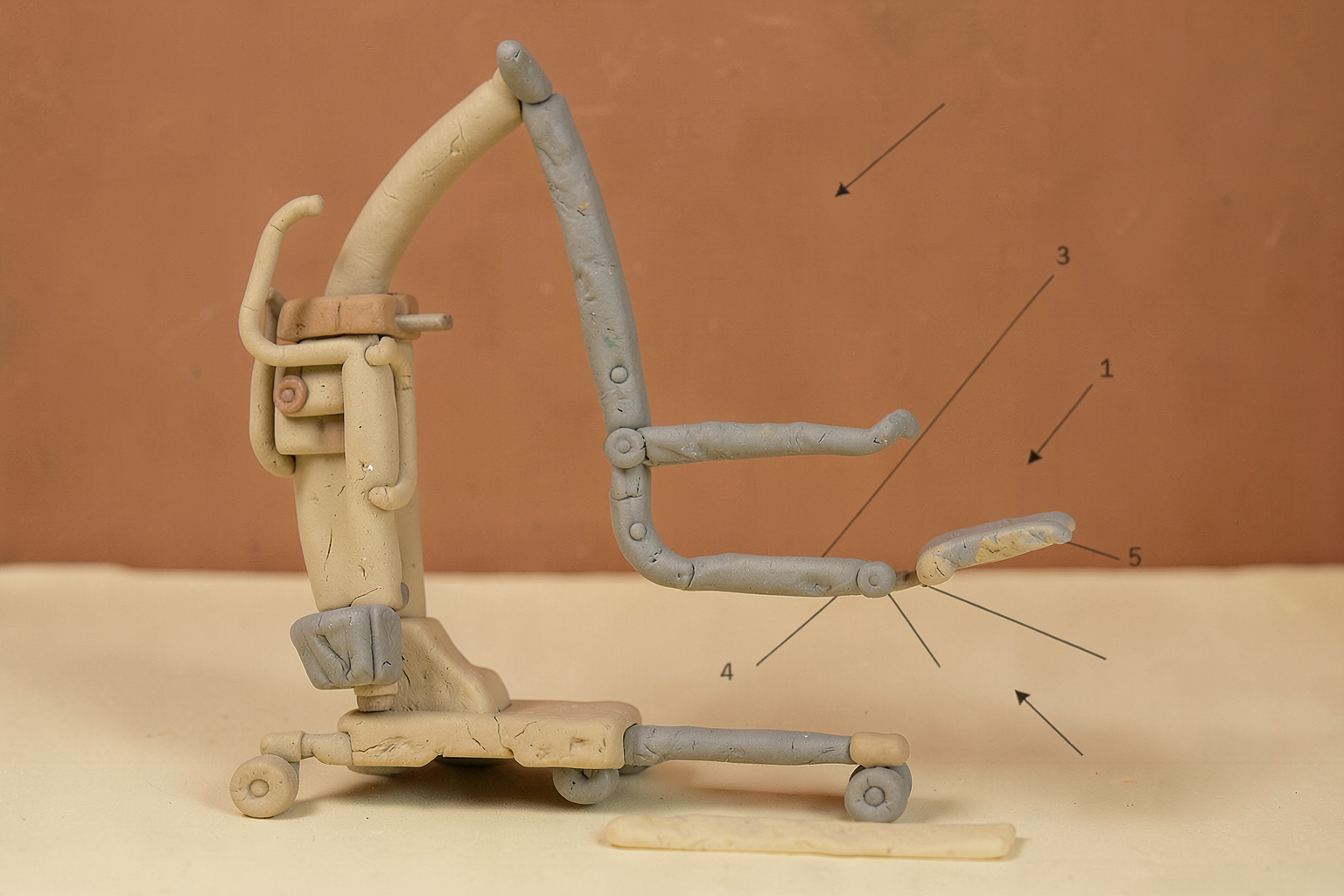
First, the setting
People spend long stretches sitting at desks, tables, waiting areas, and shared rooms. A chair becomes part of the rhythm of reading, talking, resting, or getting work done. As bodies shift position, parts of the chair may need to move with them while staying out of the way.
In a home office or lounge, someone seated in a chair reaches beside the seat and moves a hinged or sliding rest into place. The rest sits near their body while they read or pause. When it is no longer wanted, it folds or tucks beside the chair, changing the space around the seat.
What changes in this design
A reader might imagine a chair rest as one simple piece. That idea alone does not show where it goes on the chair, whether another piece is involved, or whether there is space inside its base.
Here, the chair rest is presented with three parts: a positioning base, a rest portion, and a supporting member. The base has an upper wall and two opposing side walls, with a receiving compartment between them.
This helps a reader look beyond the rest part itself and notice the base's bounded interior space. It also sets a clear limit on what is known: operation, measurements, and the compartment's contents are not stated.
Receiving Space at the Chair
The arrangement is a small argument that a chair rest should begin with a place, not an expectation. Ordinary objects tend to disappear into routines: you sit, shift, pause, and assume the furniture has already settled its questions. What made me look twice at US20260262847A1, published September 10, 2026 as Rest Assembly For Chairs And Method For Operating Such Rest Assembly, was its willingness to pause before that assumption. The filing describes a chair with a seat portion and a rest assembly made of a base adapted to be arranged to the chair, a part identified as a rest, and another part called a supporting member. That is a picture of components and position, not a promise about what the chair will deliver. It lets the arrangement stand in the doorway for a moment, with its coat still on.
That doorway matters because the picture becomes precise without becoming theatrical. The filing calls the base a "positioning base unit": in everyday language, it is the base component intended to be placed with the chair. It also names a "rest portion" and a "supporting member," but the facts available here do not tell a larger story about their operation. The positioning base unit has an upper sidewall and first and second sidewalls opposite one another; a sidewall is simply a wall-like boundary around the base. Between the first and second sidewalls sits a "receiving compartment," a designated space between those boundaries. On the page, the receiving compartment is less like a proclamation and more like a small coat check for an as-yet-unspecified part. The upper sidewall remains part of the described base, a reminder that the scene is an arrangement rather than an illustrated outcome.
Named Parts, Quiet Burden
Once the walls and space are in view, the terms themselves deserve a little inspection. "Positioning" points your attention to where the base belongs in relation to the chair, not to some broad verdict about the entire assembly. "Receiving compartment" is likewise a deliberately ordinary phrase: it names a bounded place in the base, between the opposing sidewalls, before it explains anything beyond that. The title also refers to a method for operating such a rest assembly, while the supplied published facts confine the visible description to the components and compartment just described. That restraint is worth keeping, because it separates what the filing expressly puts on the page from the future you might be tempted to supply. A good systems question begins there: what has been set, and what has merely been hoped for?
With that distinction in hand, the difference between a setting and a promise comes into focus. A setting is the arrangement that carries the burden of being understood: the positioning base unit, the rest portion, the supporting member, the upper sidewall, the opposing first and second sidewalls, and the compartment between them. A promise would be a statement about what follows from that arrangement, and the facts supplied here do not provide one. The first and second sidewalls read less like a command and more like two quiet ushers indicating where the space begins. That is not a deficiency in the picture; it is the reason the picture can be inspected without asking it to impersonate a conclusion. Instead of carrying the burden in your imagination, you are asked to notice where the burden sits: in the described placement of parts.
That change in who carries the burden is the article's small hinge. In the ordinary version of this task, someone may look at a chair rest and skip straight to an expected result, treating the words "rest" and "supporting" as a finished answer. Here, the public description makes the base, walls, and receiving compartment do the visible work of orientation, while the reader has no stated outcome to fill in. The supporting member appears as if it has been given a clipboard: present in the list, identified, and not asked to make a grand speech. Two transferable observations follow without pretending to know more than the filing supplies. First, a system is easier to discuss when it assigns a place and boundary before it advertises a result. Second, names can be useful handles, but they should not be forced to carry details the description has not given them.
Setting Before Promise
For that reason, the durable takeaway is modest: the chair rest described in US20260262847A1 rewards attention to its setting before anyone turns it into a promise. I find that useful because everyday design often hides its most consequential choice in the unglamorous question of where a thing is allowed to be. The base is adapted to be arranged to a chair; its receiving compartment is between two opposite sidewalls; a rest portion and supporting member are named alongside it. Those are not a full story of operation, and they do not need to be. They are enough to show a method of looking: locate the part, identify the boundary, and resist lending it an ending it has not stated. A setting does not guarantee a promise, but it tells you where the promise would have to stand.
The record, briefly. US20260262847A1, “Rest Assembly For Chairs And Method For Operating Such Rest Assembly” A rest assembly for a chair with a seat portion comprises a positioning base unit adapted to be arranged to the chair, a rest portion, and a supporting member. The positioning base unit has upper and first and second sidewalls opposite each other, with a receiving compartment between them.
More angles on this
- A Seat Where the Setting Meets the PromiseAnother reading from the same A47C classification family, chairs; sofas; beds.
- A chair with a battery, a column, and a pedal that never touches itAnother reading from the same A47C classification family, chairs; sofas; beds.
- CPC A47C: Chairs; sofas; bedsThe official classification family this record was filed into, published in the USPTO Cooperative Patent Classification scheme.
- The Closet That Borrows Nearby Floor Only While You Need ItAnother reading from the neighbouring A47B classification family, tables; desks; office furniture; cabinets; drawers; general details of furniture.
- Rethinking the Guard That Fits Across LimbsAnother reading from the wider A41D classification family, outerwear; protective garments; accessories.
Read around this one:Public patent recordUSPTO published figure