Objects
A Seat Where the Setting Meets the Promise
Assembly plus Key detail carry the practical point: A branded modular seat has a base with at least one side and a cushion secured to the base.

First, the setting
Seating appears wherever people wait, gather, study, eat, or watch an event. These spaces need furniture that feels welcoming, fits the room, and can reflect the identity of the place, whether it is a school lounge, a shop, or a community venue.
In a lobby or fan area, a visitor sees low seats arranged in a row or around a corner. Cushions make up the sitting surface, while the visible sides carry bold artwork or a familiar visual theme. Staff shift the pieces as the room is set up for different activities.
What changes in this design
A reader might expect a seat to stand alone, without a stated graphic panel on the base or a plan for combining it with matching seats.
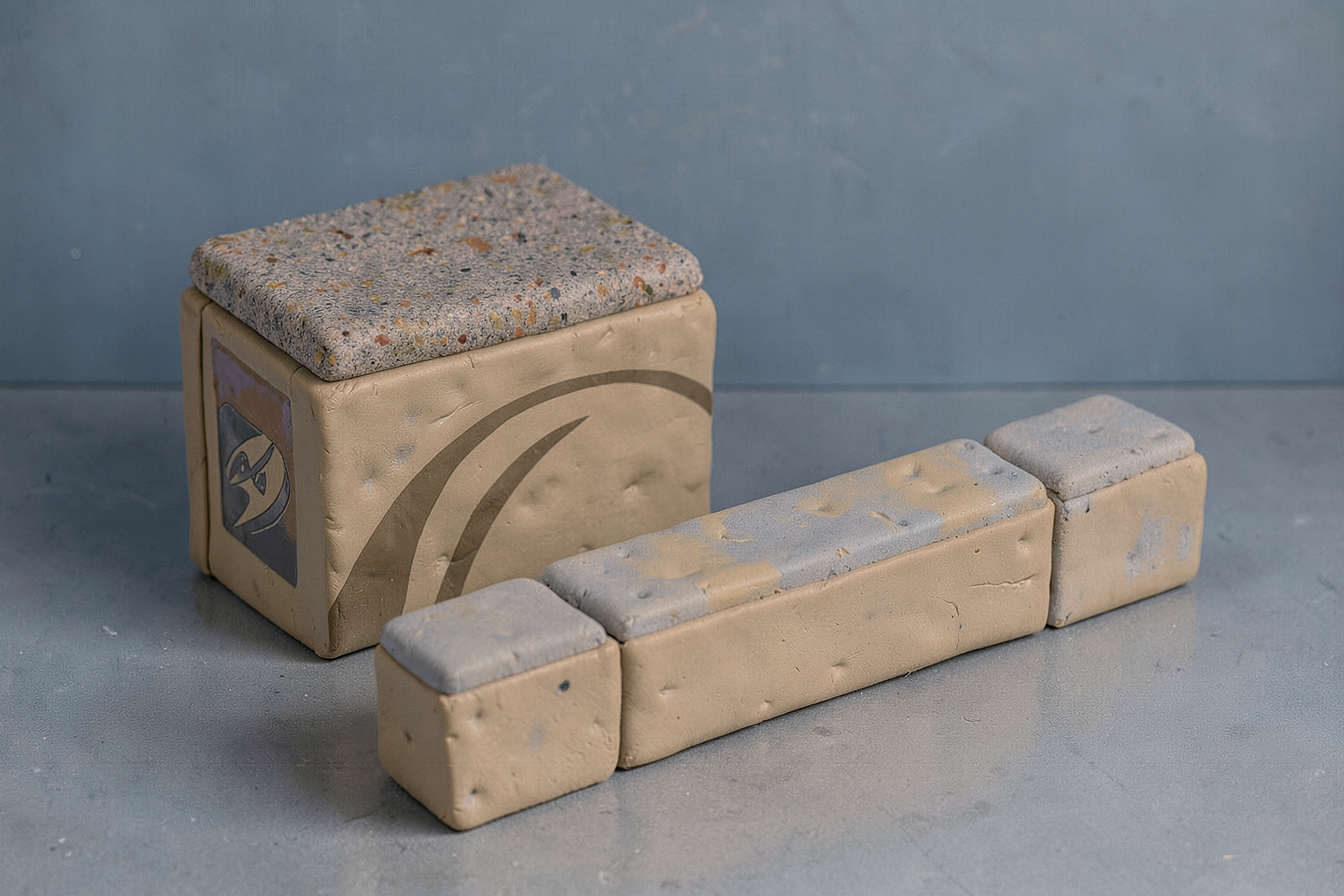
Each unit includes a base, a cushion secured to it, and a graphic panel secured to at least one side of the base. Two or more units make up a seating group.
It helps explain that this is not only one chair-like object. Each seat is also intended to be part of a larger group, with its side graphic panel remaining part of the individual unit.
Cushion, Base, and Panel
A cushion rests on a base, and a graphic panel is secured to one side. Ordinary objects matter in human routines when they are asked to hold both a body and an idea at once; that is the compact tension I notice in this published record. You can picture the cushion first, then the side of the base carrying the panel, before any special vocabulary arrives. The physical arrangement made me look twice because it treats a seat not as a mute object placed in a setting, but as part of what makes the setting legible. A single seat can already organize a small pause in a routine. At the same time, the attached panel gives that pause a visible companion. The detail stays modest, which is precisely why it lingers.
That modesty has a consequence: the graphic panel and the cushion are not described as unrelated props. The filing describes a base with at least one side, a cushion secured to the base, and a graphic panel secured to at least one side of that base. Here, secured simply means attached, a plain word that emphasizes location rather than decoration. What made me look twice is the shared anchor: the panel does not float beside the seat in this arrangement, while the cushion does not leave the base to do its own quiet work. The arrangement is less like a silent chair and more like a small stage manager keeping the furniture and its message in the same scene. That relationship becomes visible before any larger collection appears, and it prepares the terms that follow.
Two or More Seats
That shared anchor gives the terms their useful scale. The published application is US20260262844A1, dated September 10, 2026, and its record title is Branded Modular Seat. A base is, for this arrangement, the seat portion with at least one side; a cushion is the seat element attached to it; and a graphic panel is an attached panel that carries the visual part of the arrangement. Modular matters only in the narrow sense supplied here: two or more of these seat units make a seat assembly, meaning a grouped arrangement of seats. The phrase two or more is the hinge from object to system. This is not an argument that the words promise a particular experience. It is a way of noticing that the filing joins the vocabulary of sitting to the vocabulary of visible identification.
Setting Beside Promise
That join points toward purpose, but with a necessary limit. Nothing in the supplied facts identifies an audience, setting, or result, so no assertion about why a person or organization would choose it belongs here. Still, the arrangement makes a smaller editorial question available: what changes when a place to sit carries a visible sign as part of the same unit? A lone panel has the air of a label-maker that has learned to sit down. The question is not whether the seat becomes more effective than an ordinary seat; nothing supplied establishes that. It is whether the physical setting and the public-facing signal cease to be separate pieces of attention. That is a question about how a routine is framed, not about a result the filing proves.
That is where the difference between a setting and a promise comes into view. A setting is the immediate physical arrangement - here, base, cushion, side, and panel - while a promise is the expectation a visible graphic can invite, without the patent telling us what that expectation must be. The contrast is one relationship becoming visible: the seat gives the graphic a place, and the graphic gives the seat a more explicit public face. The assembly is as if a committee asked the seats to introduce themselves before anyone sat. For a designer or organizer, the transferable observation is concrete: when a functional object and its identifying surface stay together, a reader of the space encounters them together. That observation concerns attention and arrangement, not a demonstrated outcome or advantage.
From that contrast, a second transferable observation follows. Repetition can clarify a relationship without changing its basic grammar: the filing says a seat assembly has two or more modular seats, so the same base-cushion-panel pattern becomes a group rather than a lone instance. You should notice the restraint in that move, because the facts supplied give a unit and then a grouping of units. For this reading, no invented machinery or grand theory of seating is necessary. My takeaway is bounded but memorable: when an ordinary object carries both support and sign, the hinge between setting and promise can be placed where people already look. That does not establish what anyone will feel or do. It returns us to the first picture - a cushion on a base, with a graphic panel secured to its side - still ordinary, and therefore worth your attention.
The record, briefly. US20260262844A1, “Branded Modular Seat” A branded modular seat has a base with at least one side and a cushion secured to the base. It also has a graphic panel secured to at least one side of the base. A seat assembly is made up of two or more of these modular seats.
More angles on this
- A chair with a battery, a column, and a pedal that never touches itAnother reading from the same A47C classification family, chairs; sofas; beds.
- A Seat Panel's Quiet HandoffAnother reading from the same A47C classification family, chairs; sofas; beds.
- CPC A47C: Chairs; sofas; bedsThe official classification family this record was filed into, published in the USPTO Cooperative Patent Classification scheme.
- The Closet That Borrows Nearby Floor Only While You Need ItAnother reading from the neighbouring A47B classification family, tables; desks; office furniture; cabinets; drawers; general details of furniture.
- Rethinking the Guard That Fits Across LimbsAnother reading from the wider A41D classification family, outerwear; protective garments; accessories.
Read around this one:Public patent recordUSPTO published figure