Objects
A Seat Panel's Quiet Handoff
At the deck edge, nearly five decades of bench patents meet aging boards, rising fall heights, and rules that turn seating into safety work.

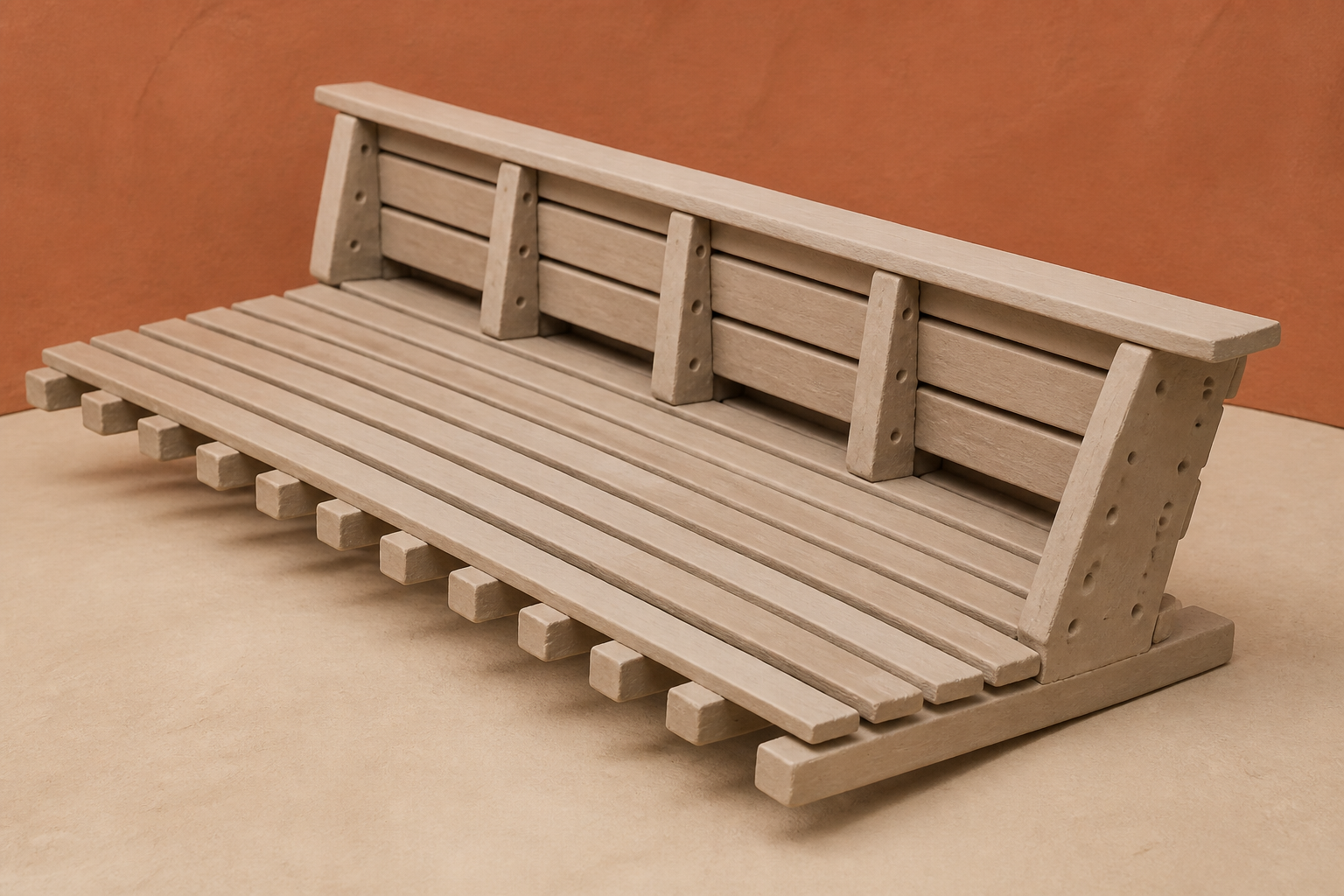
What changes in this design
Without this information, a reader might simply picture outdoor deck seating as boards put together in an unspecified shape.
This record identifies a shaped panel with three parallel horizontal edges and a separate back-rest edge set at a steep angle, for mounting with like panels and seat planks.
This lets a reader recognize the panel as part of outdoor deck seating, with edges that mark seating, a cap rail, and a back-rest.
The edge of the deck
On January 17, 1979, Ives L. Boisvert filed for a bracket meant to bolt a bench-type seat and a back joist onto the edge of a deck. It was a simple bargain: turn the perimeter, usually reserved for a railing, into somewhere to sit. The patent appeared in 1981, but the problem it took on is older than the paperwork. A deck edge has to make room for people looking out, keep people from falling, and carry the forces those jobs create.
That compromise now reaches a large, aging installed base. The North American Deck and Railing Association estimates that the United States has more than 60 million decks - 50 million residential and 10 million commercial - and about 30 million are past their useful life. A bench attached at the edge is therefore not merely a furniture idea. It meets weathered framing, old fasteners, and a safety barrier whose job becomes more demanding the moment someone can climb onto the seat.
One board under a bench
Wayne R. Carney's 1990 deck-seat-and-safety-rail patent framed the tradeoff with unusual candor. Earlier combined designs, it said, gave up floor area because the seat projected inward; cantilevered seating and railing arrangements had also run into structural and safety objections. That is the recurring sales pitch and engineering problem in one place: reclaim the railing line without borrowing too much usable deck.
Then came the sharpest indictment. Francis X. Graney's 1994 construction method singled out Boisvert's 1981 bracket, arguing that it sent an occupant's force to the deck edge and sometimes to only a small part of one board. Graney called that arrangement "destined to early failure and severe injuries." That was an inventor arguing for a different design, not an independent finding that every installed bracket failed. Still, I don't read that caveat as a reason to ignore the warning. The criticism is specific enough that it changes how I read every newer promise to put a seat at the edge.
Thirty-six inches above the seat
The building rules add a complication that patent drawings can make easy to miss. Decks.com describes the standard International Residential Code baseline as a guard at least 36 inches high, with California requiring 42 inches, and a top rail able to take a 200-pound concentrated load. Local rules and the particular installation still control, so those figures do not certify any one product. They do tell us what a deck-edge assembly must confront if it is to act as a guard.
Fixed seating changes where that height begins. BuildingAdvisor explains that when a bench sits beside or forms part of a guard, inspectors measure the required 36 inches from the seat surface rather than the deck floor, because a child may stand or walk there. The code rule, to my mind, is the quiet answer to decades of clever bracketry. A bench can save floor space yet create a higher effective fall point. The rail must answer to that point, not to the lower floor beneath it.
A panel with a back-rest edge
Into that history comes US20260256295A1, published as Deck Seating Assembly. Its seat deck panel is described through its edges: base, seat, and cap rail edges that are parallel and horizontal; a base-to-seat edge; an angled back-rest edge between 65 and 90 degrees from horizontal; and a rear edge. Like panels and seat planks are intended to mount together for outdoor deck seating.
That description makes the filing a proposed piece of repeatable geometry, not simply a one-off deck bench. The stated features establish a panel shape and an intended assembly, but they do not by themselves establish how loads reach the deck structure, how connections perform in old framing, or whether a finished installation meets the guard rule. What I cannot infer from those features is an answer to those questions. That uncertainty matters to me more than the clean line promised by an angled back-rest.
The harder half of the problem
The commercial appetite is real, though it should not be mistaken for a verdict on this design. One market-research publisher puts global composite decking at USD 4.92 billion in 2026 and forecasts USD 8.11 billion by 2032, a projected 8.59% compound annual growth rate. Yet a housing-industry survey reported by a national builders' association found 55% of respondents wanted decks, behind covered outdoor rooms at 73% and patios at 68%. People want outdoor space, but a deck bench still has to earn its place inside that broader choice.
I don't think the lasting question is whether someone can make a tidier panel for a deck edge. The older patents already show that this impulse has endured for more than 45 years. The harder question is whether a system can keep a seat comfortable, a deck floor open, a guard high enough from the new standing surface, and the occupant's load out of a vulnerable board. That is the part I would ask a builder, an inspector, and the next inventor to answer before treating a new edge-seat filing as progress. We have seen the shape of this ambition before; its proof has always been in the load path.
Sources
Reporting for this piece drew on the published filing and the references below.
- US20260256295A1 - Deck Seating Assembly
- US4285542A - Deck seat bracket
- US4918880A - Deck seat and safety rail combination
- US5337471A - Method of constructing a seat for a wooden deck
- Deck Safety Month - NADRA
- Deck Railing Height Codes & Requirements - Decks.com
- Building deck railings and porch railings to code - BuildingAdvisor
- What's Driving Outdoor Living Trends? - NAHB
- Composite Decking Market Size, Share & Forecast to 2030 - ResearchAndMarkets
The record, briefly. US20260256295A1, “Deck Seating Assembly” Described is a seat deck panel with base, seat, and cap rail edges parallel and horizontal; a base-to-seat edge; an angled back-rest edge between 65° and 90° from horizontal; and a rear edge, for mounting with like panels and seat planks for outdoor deck seating.
More angles on this
- CPC A47C: Chairs; sofas; bedsThe official classification family this record was filed into, published in the USPTO Cooperative Patent Classification scheme.
- CPC E04B: General building constructions; walls, e.g. partitions; roofs; floors; ceilings; insulation or other protection of buildingsThe official classification family this record was filed into, published in the USPTO Cooperative Patent Classification scheme.
- Two Rolling Brushes, Mirrored: A Cleaning Module That Says Which Way Its Bristles FaceAnother reading from the neighbouring A47L classification family, domestic washing or cleaning ; suction cleaners in general.
- A crampon that puts the adjustment in the wire, not in the two parts it joinsAnother reading from the wider A43C classification family, fastenings or attachments of footwear; laces in general.
- A drawer connector that turns once, then declines to be talked out of itAnother reading in the same Objects category on this site.
Read around this one:Public patent recordUSPTO published figure