Field Notes
A Directional Setting, Not a Promise
An old problem in cardiac care - a temporary wire that moves or injures the heart - meets a patent as medicine may need fewer of them.

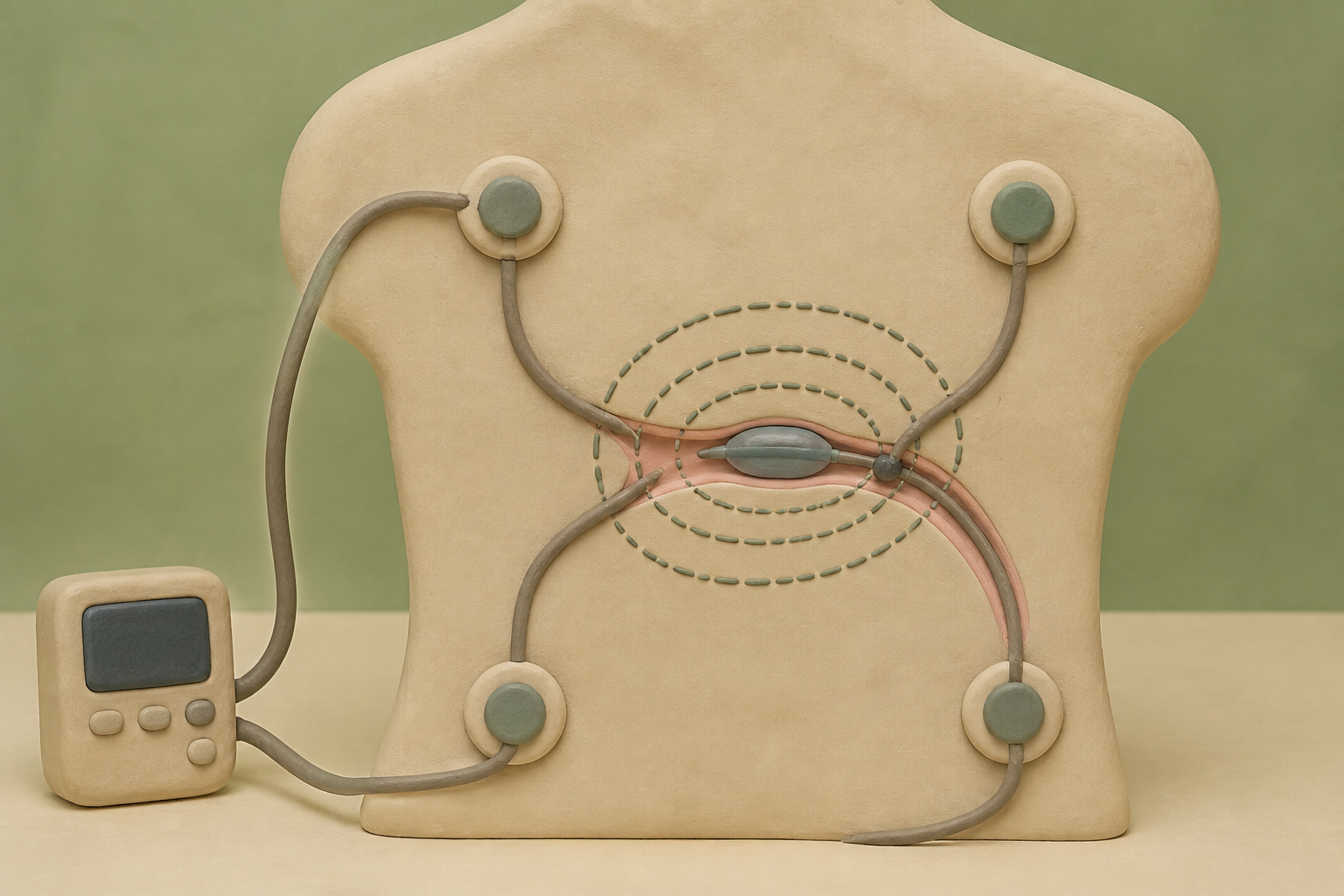
What changes in this design
A reader might otherwise assume that placing the lead is separate from learning where its far end lies and which way it faces. The record does not identify another way to obtain that information.
Here, the lead's far-end electrode sends an electrical signal. An expandable part hinders it more in some directions, and electrodes on the patient's skin may sense it. Those readings may be used to work out electrical values between the electrode and lead, as well as where the far end is in a blood vessel and which way it faces.
The point for a reader is that the signal is not only sent; it may also provide information about the far end's position and orientation in a blood vessel. The record gives no accuracy figure, outcome, or performance comparison.
The wire that moves
Temporary transvenous pacing leads are meant to be a short answer to an urgent problem: put an electrode through a vein, position it in the heart, and keep pacing available while a procedure or recovery unfolds. Their weak point is physical. A 2018 review reported cardiac perforation rates as high as 4%, while lead movement can cause loss of pace capture in 10% to 37% of cases. A wire that lands correctly and then shifts is not a small inconvenience when its job is to steady a heartbeat.
Those numbers explain why this remains a stubborn corner of cardiac care. The same review said conventional temporary leads had changed little over decades and that some hospitals temporarily used costlier permanent active-fixation leads to avoid perforation and dislodgment. What I found was a known compromise: speed and familiarity, set against a moving wire and a fragile wall.
The Tempo Lead
BioTrace Medical supplied a mechanical answer. Its Tempo Lead combines an elastomeric balloon with active-fixation stabilizer loops, meant to hold a temporary lead without relying on ordinary passive contact. The FDA cleared it in 2016 for transcatheter aortic-valve replacement, or TAVR. Dr. Susheel Kodali called it the first major advance in temporary pacing since the technology was introduced decades earlier. That is a large claim, but the lack of change gave it force.
Clinical reports reported reassuring results. A 224-patient multicenter US study recorded zero perforations, pericardial effusions, or device-related arrhythmias. A separate US retrospective study of 269 patients reported 98.1% successful placement, zero perforations or effusions, and 0.8% loss of pace capture; 71.6% of leads remained after the procedure, and 84.1% of those patients ambulated safely. These are not head-to-head results against every ordinary lead, and I would not treat them that way. Still, the reports make the danger hard to dismiss as theoretical.
The signal at the lead
That is the setting for US20260256376A1, Temporary Pacing Lead Navigation System. The filing makes the expandable member part of an electrical measurement: a distal implantable-lead electrode outputs a signal while the member directionally impedes it. Surface electrodes may sense the result, and the system may use electrode-to-lead impedance values to determine the distal lead's vascular position and orientation. It is about knowing where the tip is and how it is pointed.
The resemblance to Tempo matters, but the difference matters more. One approach uses a balloon and stabilizer loops as a physical response to perforation and dislodgment; this filing describes an expandable member directionally impeding a signal so the system can infer location and orientation. The public record does not establish that it is the same product, the same company, or a replacement for an existing lead. The filing gives no basis for my calling it a new clinical outcome. That is why I read it as a navigation refinement inside an already demonstrated design direction, not proof that temporary pacing has been reinvented.
The $0.3 billion market
One market forecast places global temporary pacing leads at $0.3 billion in 2025 and $0.7 billion in 2036, a 6.8% compound annual growth rate. It is a forecast, not an audited market total, but it describes a concentrated field: five established makers account for roughly 62% combined share, with Merit Medical among other tracked participants. Merit acquired BioTrace Medical's assets in an October 2022 asset purchase; its annual filing recorded the acquired technology as a developed-technology intangible.
The TAVR population, however, points toward fewer wires. Among 10,338 Medicare patients treated from 2017 through 2020, leadless pacemaker use rose 3.5-fold; recipients had fewer in-hospital complications, 7.2% versus 10.1%, and a 63% lower device-related complication risk than people with transvenous systems. Those are permanent-pacemaker data, not a trial of temporary leads. But newer valve generations and implantation technique have also lowered reported permanent-pacemaker rates after TAVR: around 5% or lower for one valve family, 6% to 8% for another, and around 10% for two others. If we call navigation the future, we have to reckon with a parallel future that avoids a permanent lead or reduces the downstream need for pacing.
What would have to be true
For this filing to matter beyond a patent document, several things would have to be true. Its impedance-based reading of position and orientation would need to be reliable enough to change a clinician's decision, not just add another signal. It would need to work alongside balloon-assisted hardware that has shown low complication rates, or show comparable safety with less complexity. It would also need to fit a procedure where time, access, and confidence at the bedside matter as much as elegant sensing.
My view is that the filing deserves attention precisely because its ambition is narrow. It focuses on the part of temporary pacing that still asks for confirmation: where is the lead, and which way is it facing? The older balloon lead sets a demanding benchmark, while leadless devices and better TAVR technique are shifting the wider problem away from transvenous leads and permanent pacing. Those data do not tell us how much temporary-lead use will fall. The test is not whether the system can measure an impedance. The test is whether that measurement prevents failure often enough to earn a place in a clinical need being pulled in more than one direction.
Sources
Reporting for this piece drew on the published filing and the references below.
- Temporary Pacing Lead Navigation System
- Rethinking the Temporary Pacing Lead
- The Tempo Temporary Pacing Lead
- FDA Clears BioTrace Medical's Temporary Pacing Technology for TAVR Procedures
- BioTrace Medical's Tempo Lead Obtains CE Mark for Temporary Intracardiac Pacing
- Merit Medical Systems, Inc. - Form 10-K FY2022
- Comparison of Leadless and Transvenous Pacemakers After TAVR
- Transcatheter Heart Valve Technology: An Update
- Temporary Pacing Leads Market Growth & Forecast
The record, briefly. US20260256376A1, “Temporary Pacing Lead Navigation System” A method outputs an electrical signal through a distal implantable-lead electrode while an expandable member directionally impedes it, and may sense it at patient surface electrodes to determine electrode-to-lead impedance values and the distal lead's vascular position and orientation.
More angles on this
- Two Fibers and the Burden of ContextAnother reading from the same A61B classification family, diagnosis; surgery; identification.
- The Boundary Inside Smart Pet MonitoringAnother reading from the same A61B classification family, diagnosis; surgery; identification.
- CPC A61B: Diagnosis; surgery; identificationThe official classification family this record was filed into, published in the USPTO Cooperative Patent Classification scheme.
- CPC A61N: Electrotherapy; magnetotherapy; radiation therapy; ultrasound therapyThe official classification family this record was filed into, published in the USPTO Cooperative Patent Classification scheme.
- The Light Loop Inside an Oral-Care RoutineAnother reading from the neighbouring A61C classification family, dentistry; apparatus or methods for oral or dental hygiene.
Read around this one:Public patent recordUSPTO published figure