Field Notes
A metal-MXene sandwich, and the quiet work of putting layers in the right order
An ultrathin Korean shielding film puts a larger question on the table: can MXene last long enough to protect everyday electronics?

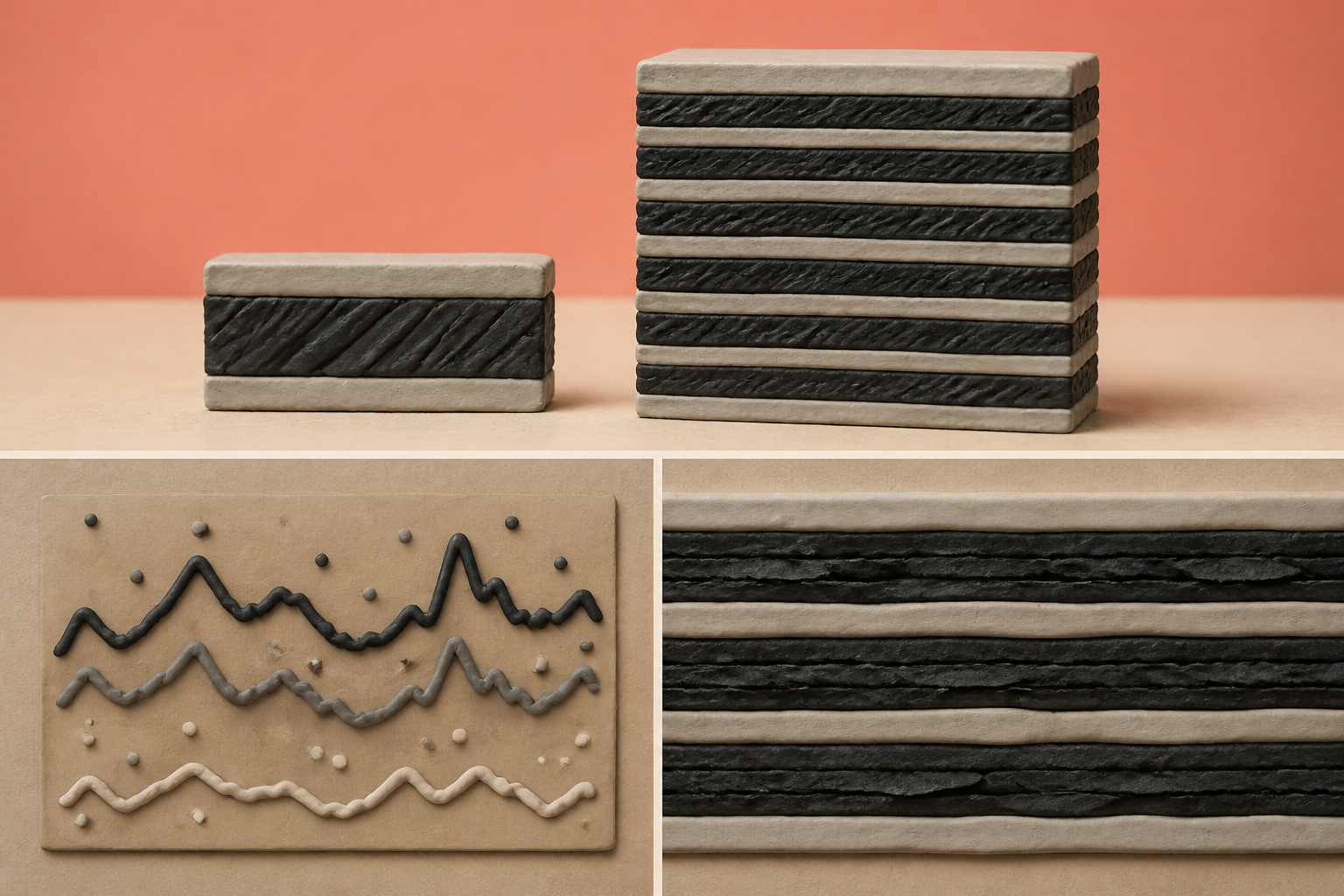
What changes in this design
Without more detail, a shielding film may sound like one continuous sheet that simply blocks interference. How such films are ordinarily built or tested is not stated.
Instead, this film is a sandwich of layers: MXene in the middle and metal thin films around it. The record also includes a method for preparing the film.
That pairing is the practical point highlighted here: excellent shielding efficiency at reduced thickness. The amount of reduction, measurement method, and comparison are not stated.
A micrometer on a USB drive
A USB drive has precious little room for a protective skin. A November 2025 Nature paper is why I began there: it proposed metal/MXene/metal films for shielding USB drives and flexible electronics, reporting about 70 dB of shielding effectiveness at only one micrometer. That is the kind of number that makes a materials result feel consequential, not decorative.
US20260255565A1 is the U.S. filing that sits beside that result. It concerns a heterogeneous metal-MXene stack, with an MXene layer between metal thin-film layers, meant to deliver strong interference shielding without the usual thickness. The filing isn't, as I read it, a gadget announcement. The filing reads to me as a claim on one answer to a stubborn materials problem.
February before November
The dates give the filing much of its meaning. The U.S. application was filed on January 14, 2026, and claims priority to a Korean application filed February 26, 2025. The closely aligned Nature paper appeared in November 2025, with 18 authors from four Korean institutions. That order reads to me as patent first, publish later: secure the configuration, then make the scientific case for it.
The named assignees are Gwangju Institute of Science and Technology and Seoul National University R&D Foundation. Their filing is not merely describing MXene's conductivity. It seeks protection for a configuration: metal on both sides, MXene in the middle. The paper reads to me as evidence for why that arrangement commands attention, and the filing as an effort to carry it beyond a paper.
Three layers at one micrometer
The proposed structure is simple to draw: metal, MXene, metal. In the Nature work, the researchers attribute the result to wave confinement at the metal-MXene interfaces. Those boundaries are presented as helping electromagnetic waves stay where the film can suppress them. That is how the one-micrometer stack reached about 70 dB in the reported experiment. The important claim, I think, is placement, not a newly discovered ability of MXene to conduct.
A clean leaderboard is not what I would make of the numbers. A 2016 study reported 92 dB for a 45-micrometer Ti3C2Tx MXene film, while a 2.5-micrometer version exceeded 50 dB. A 2020 collaboration later reported 99% shielding efficiency from a 55-nanometer MXene film. Different frequency ranges, thicknesses, and test methods change what a headline figure can tell us. Still, I can see the through-line: less material, with protection that remains useful.
The 27-day problem
Here is the failure mode I cannot wave away. Work on Ti3C2Tx oxidation reported that unprotected MXene fully oxidized in about two weeks in ambient air. Open-air storage was also associated with a 93% loss of electrical conductivity within 27 days. If conductivity falls away, I cannot assume the film will keep doing the job for which it was chosen.
That makes the metal outer layers especially interesting to me. They may help with shielding and may reduce the MXene's exposure. Whether they form a durable seal is the result I would want before treating this as a product-ready answer. Another 2025 effort used nitrogen-substituted MXene and reported 35,000 S/cm conductivity for sub-terahertz shielding at 5 to 10 micrometers. Durability, rather than conductivity alone, is now, I think, the difficult question.
Where this leaves things
One market analysis puts EMI shielding at $8.01 billion in 2025 and forecasts $13.63 billion by 2035, driven by 5G, connected devices, and automotive electronics. A forecast isn't, to me, destiny. The forecast is, to me, a measure of why thinner, lighter shielding matters, especially when conductive polymers and tapes are gaining ground beside traditional metal approaches.
This is why I find US20260255565A1 more interesting as a checkpoint than a finish line. It records a specific proposition, metal outside and MXene inside, at a point when a decade of research has made the material's promise hard to dismiss. The evidence I want next is ordinary and unforgiving: repeatable fabrication, survival in air, performance through bending, and shielding across the frequencies a device faces. Until that arrives, I see a clever structure with a durability test still ahead.
Sources
Reporting for this piece drew on the published filing and the references below.
- Electromagnetic Interference Shielding Film Comprising Heterogeneously Stacked Metal-Mxene And Method For Preparing The Same
- Electromagnetic interference shielding using metal and MXene thin films
- Albert S. Lee - News
- Electromagnetic interference shielding with 2D transition metal carbides (MXenes)
- Nanometer-Thick Electromagnetic Shielding Film Developed Using MXene
- Improving oxidation stability of 2D MXenes
- MXene offers exceptional high-frequency EMI shielding
- EMI Shielding Market Size, Share and Trends 2026-2035
The record, briefly. US20260255565A1, “Electromagnetic Interference Shielding Film Comprising Heterogeneously Stacked Metal-Mxene And Method For Preparing The Same” The inventive concept concerns an electromagnetic interference shielding film of heterogeneously stacked metal-MXene and its preparation, using a sandwich structure with an MXene layer between metal thin-film layers to achieve excellent shielding efficiency at reduced thickness.
Identity details. The saved title-page transcription needs review, so names are not repeated here. Check the official published title page.
More angles on this
- Why a Magnetic Latch Sits Between Your Phone and the AirwavesAnother reading from the same H05K classification family, printed circuits.
- Duo-Pump Liquid Cooling Device Treats the Relationship as the PointAnother reading from the same H05K classification family, printed circuits.
- CPC H05K: Printed circuits; casings or constructional details of electric apparatus; manufacture of assemblages of electrical componentsThe official classification family this record was filed into, published in the USPTO Cooperative Patent Classification scheme.
- CPC C23C: Coating metallic materialThe official classification family this record was filed into, published in the USPTO Cooperative Patent Classification scheme.
- The Substrate That Gave Its Two Recesses Unequal DepthAnother reading from the neighbouring H10F classification family, inorganic semiconductor devices sensitive to infrared radiation.
Read around this one:Public patent recordUSPTO published figure