Objects
A Power Circuit With the Drawer Open
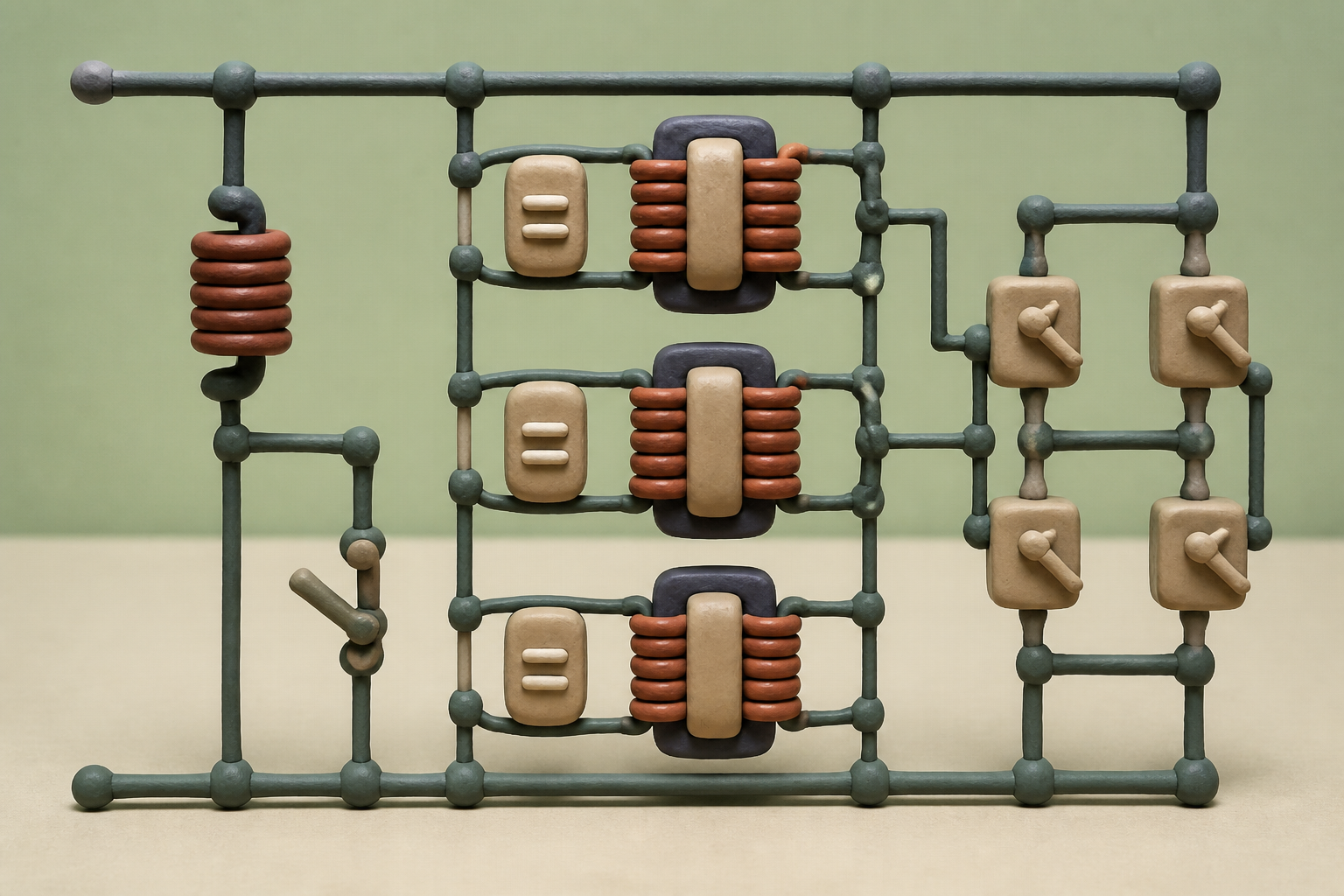
Circuit and System form one stated connection: The application describes a scalable power circuit having multiple power circuit units with a main inductor.

First, the setting
Many parts of daily life depend on electricity arriving in the right form: charging a vehicle, running machinery, keeping buildings comfortable, and supplying devices that cannot simply plug straight into a wall outlet. People work on the equipment between the source and the load because power must be guided, adjusted, and handled safely.
In a utility room, workshop, or charging area, a metal cabinet may sit behind a panel while cables carry energy to equipment nearby. A driver connects a cable, an operator starts a machine, or a technician checks indicator lights. The person may only notice steady operation, warmth from working equipment, and the quiet sound of cooling.
What changes in this design
A reader might first picture one electrical path producing one output. Without more detail, it is natural to assume the parts are connected in just one fixed pattern.
This record describes multiple power-circuit units connected in parallel. Within each unit, capacitor-and-transformer sections are combined through series and parallel connections, alongside a main inductor and switch.
The key idea is not a single component but how several units and their sections are connected. That helps explain why the system is presented as scalable across different voltage and power ranges.
Power Circuit Purpose
A kitchen drawer's purpose is clearest before the morning rush, when you can see which tool to take. That modest habit is the lantern for US20260261192A1, published September 3, 2026, under the title Scalable Power Circuit System And Control Method Therefor. The filing describes a scalable power circuit made from multiple power circuit units, so the first purpose is not to ask one unnamed block to carry all the explanation. Instead, you are given a practical picture before the specialist nouns arrive: several similar units set beside one another, each participating in an arrangement described across a range of voltages and powers. That is a small change in posture, but it asks you to look as someone choosing from a labeled drawer rather than reaching into a dark cupboard.
Units, Assemblies, and Output
From that picture, the terms deserve patient handling. A power circuit unit is one of the multiple recurring groups described in the filing. Each unit has a main inductor, meaning the inductor singled out as main; a switch; and circuit assemblies, meaning grouped circuit parts. Each assembly includes a capacitor and a transformer. Those names are not decorative nouns to skate past: capacitor and transformer are the two components specified inside every assembly, while the inductor and switch mark elements of every unit. The circuitry has the air of a committee that insists each role be named before the meeting starts. That is not a performance promise, and it does not tell you what any one part accomplishes alone. It is evidence that the arrangement can be inspected component by component before a larger story is attached to it.
With those labels in place, the mechanism becomes legible without pretending it is simpler than the filing makes it. The multiple power circuit units are connected in parallel, meaning they are placed alongside one another in the stated arrangement rather than described as one single chain. The assemblies are said to provide a combined series-parallel output: series identifies connections set in sequence, while parallel identifies connections placed alongside one another. The published record connects that combined output with a range of voltages and powers. No quantities are supplied here, so the evidence is architectural rather than numerical. The arrangement is less like a vague handoff and more like a stage manager who labels the entrances. What made me look twice was not a claim that the scheme wins a contest, but the decision to make the route from repeated units to combined output visible enough for you to follow.
That visibility clarifies the contrast with a broad description of power delivery that merely says something is passed onward. Such a handoff can leave you wondering what repeats, which grouping relates to the output, and where the stated connections belong. This application instead supplies three visible landmarks: multiple units, assemblies containing capacitors and transformers, and parallel plus series-parallel relationships. The result is as if a librarian had arranged the options by voltage and power before anyone asked for one. That image should not be stretched into a promise that any option is better; the filing only describes output over a range of voltages and powers. Still, two transferable observations sit plainly in view: repeatable units give a system explanation a steady rhythm, and named relationships between parts give you something firmer than an instruction to trust the box.
A Modest Reader Test
Because of that contrast, the takeaway is not that every technical description should become a wiring diagram, or that this one settles questions the published record does not address. The more modest lesson concerns evidence before action. When you encounter a system described at a high level, look first for the repeated unit, the contents of the recurring group, and the declared way those groups connect. I notice that this filing gives you those anchors in a compact sequence: unit, main inductor, switch, assembly, capacitor, transformer, parallel connection, then combined series-parallel output. Even a limited description can be more useful when it leaves a trail of named relationships. The filing has the air of a careful label-maker who knows that an unlabeled drawer saves no time once the lights are low.
That trail leads back to the opening drawer. You do not need to infer an inventor, a market, a result, or a use from this arrangement in order to find it worth attention; none of those are established by what I read. What is there is narrower and, for that reason, easier to carry into ordinary systems thinking: ask what is repeated, ask what each repeated group contains, and ask how the groups are related before deciding what the whole is for. In US20260261192A1, the answers named by the filing are multiple power circuit units, assemblies with capacitors and transformers, parallel unit connections, and a combined series-parallel output over a range of voltages and powers. The reader test is calm: before you act on a technical description, can you point to the parts, their grouping, and their stated connections without filling the empty spaces yourself?
The record, briefly. US20260261192A1, “Scalable Power Circuit System And Control Method Therefor” The application describes a scalable power circuit having multiple power circuit units with a main inductor, switch, and circuit assemblies. Each assembly includes a capacitor and transformer; units are connected in parallel and assemblies provide combined series-parallel output over a range of voltages and powers.
More angles on this
- CPC H02M: Apparatus for conversion between ac and acThe official classification family this record was filed into, published in the USPTO Cooperative Patent Classification scheme.
- Under 55 mm, a Handoff Gets Its PlaceAnother reading from the neighbouring H02K classification family.
- When an Energy Bin Stops Short and Alignment Starts SpeakingAnother reading from the wider H01M classification family, processes or means, e.g. batteries, for the direct conversion of chemical energy into electrical energy.
- A Port, Two Gloves, and the Quiet Work of AlignmentAnother reading in the same Objects category on this site.
Read around this one:Public patent recordUSPTO published figure