Field Notes
A Tray That Gives Alignment a Place
Start with Key detail and Arrangement: A multifunctional tray has a glass-receiving first orifice with a narrow peripheral gap.

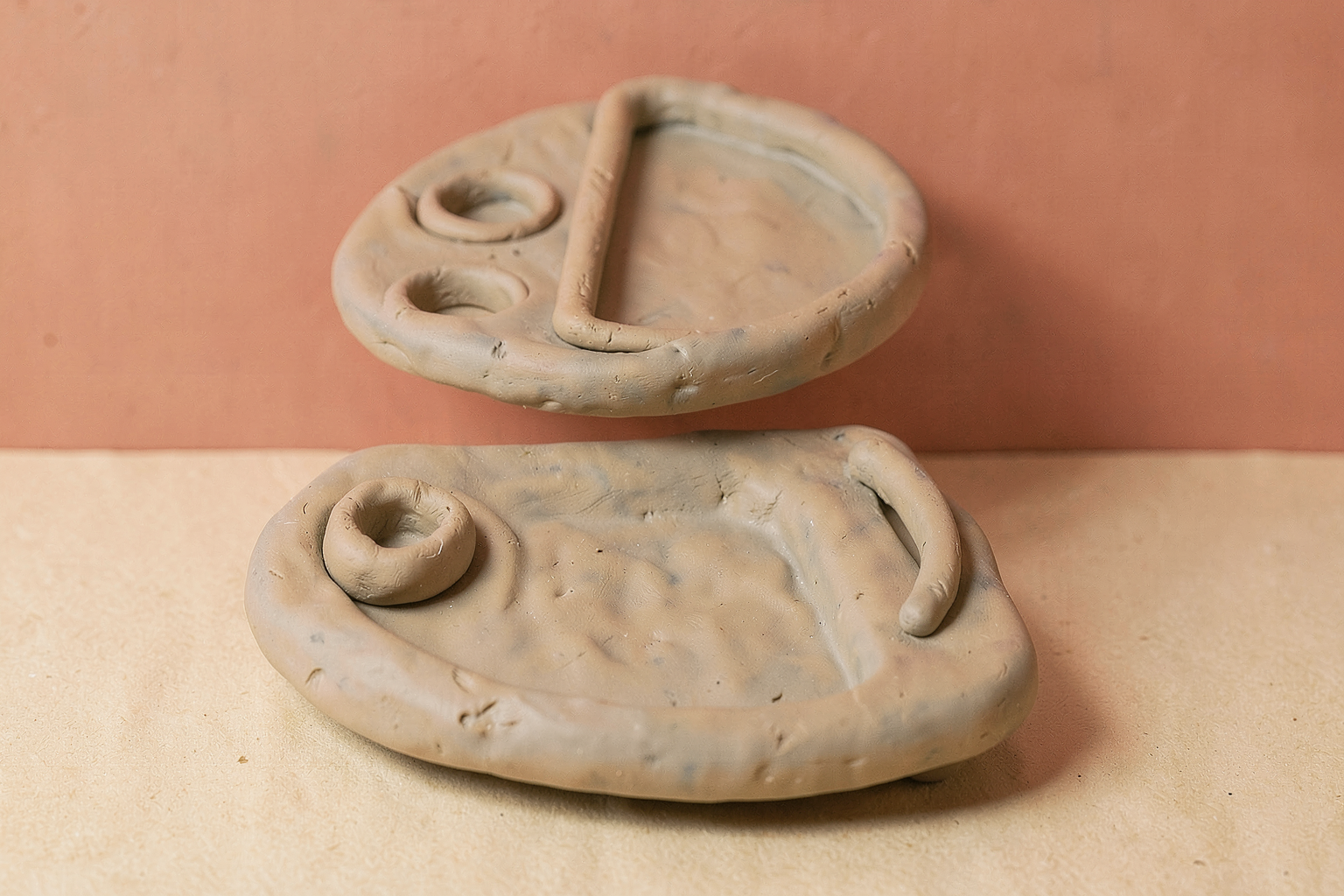
First, the setting
Sharing drinks and small bites often means balancing glasses, plates, and conversation in a busy space. A host or guest wants to carry refreshments without spills spreading across a table, floor, or clothing. Small serving details matter when hands are full and people are moving nearby.
At a reception, someone carries a drink across a room while greeting others or finding a place to sit. The tray rests in one hand, with the glass held in place and any stray liquid kept near the serving surface. People nearby can move past without watching every wobble.
What changes in this design
With an ordinary tray, a drink may simply sit on its flat surface, and a person grips the outer edge. Any spill can move across the surface unless something else stops it.
Here, the drink is given a dedicated opening with a narrow gap around it. A separate hole admits a thumb, and a barrier area on the top collects liquid or limits how far it spreads beyond the glass area.
It shows that the tray is not presented as only a flat carrying surface. Its glass opening, thumb hole, and spill-controlling upper area explain how the object is intended to be held and used.
Openings, Grip, and Boundary
When a glass sits within an opening while a thumb passes through a separate hole, the two positions turn a tray into a small coordination problem. The ordinary assumption is that a tray merely offers a flat place to rest something while you move it. Not quite. The published patent, US20260262861A1, titled Multifunctional Apéritif Tray and dated September 10, 2026, complicates that expectation by placing a glass position, a holding position, and a liquid boundary within one arrangement. That sequence made me look twice, because the object is presented less like a tabletop with manners and more like a modest stage manager, assigning each part a place before anything begins. It makes a familiar form ask a more exact question: not only where a glass goes, but how the hand and liquid are situated in relation to it. The point is deliberately narrow: the relation among those places matters here, while the published record does not support a larger story from it.
From that initial condition, the picture shifts from an undifferentiated surface to a top side with deliberate interruptions. You can picture the glass position as an anchor, the thumb opening as a point of hold, and the treatment of liquid as an edge to notice rather than ignore. The layout has the air of a polite committee that has decided a glass, a thumb, and liquid should each have separate seating. That image is not evidence of how the tray would feel in use. It is a way to see the spatial question the filing puts on the page: where does each relationship begin, and where is it meant to stop? The image stays deliberately small, which is why the placement is easier to notice. Once that question is visible, the technical names stop sounding ornamental and start doing quiet explanatory work.
That spatial question leads to the terms, which deserve ordinary-language treatment before they acquire too much ceremony. The filing calls the glass-receiving opening a first orifice; here, orifice simply means an opening. Its peripheral gap is the narrow space around the opening's edge. The holding hole is described as passable by a thumb, so it identifies a place for that part of the hand rather than another location for the glass. The upper-side barrier zone is the area on the top side designated to collect liquid or limit its spread outside the first zone. These labels behave less like a cabinet of fancy names and more like a label-maker that wants nobody wandering into the wrong space. Each term attaches to a location or condition rather than to an asserted benefit. The terms therefore clarify roles before they suggest any outcome.
Glass, Thumb, and Liquid
With the vocabulary settled, the mechanism can be described without dressing it up. The filing describes a glass-receiving first orifice with a narrow peripheral gap, alongside a thumb-passable holding hole and an upper-side barrier zone. The barrier zone is identified as collecting liquid or limiting its spread outside the first zone. That is a precise distribution of duties. No more is established. The glass has its receiving opening; the thumb has a passable opening; liquid has a stated area of collection or a stated limit on where it spreads. The narrow gap belongs at the glass opening's perimeter, so even the small interval around that position is part of the described arrangement. The arrangement's order is spatial, not a reported sequence of results. I cannot tell from the published record how any particular tray might feel or behave, and no such conclusion follows from this account. The interest lies in the specified alignment, not in inventions of our own.
Because those duties are separated, the contrast with the broad ordinary idea of a tray becomes a modest but specific revision. A flat support can be understood as one general surface. This arrangement instead describes a defined glass position, a defined thumb passage, and a designated upper-side area for liquid collection or for limiting spread beyond the first zone. Not a redesign of everything. A change in which relationships receive a place. One transferable observation for an everyday system you are trying to make clearer is to give its central object a defined position before adding features around it. Another is to decide where the leftover condition, here liquid, is allowed to go or be gathered. Neither observation imports conclusions the filing does not offer. Both simply keep responsibility from dissolving into the surrounding surface.
Questioning the Flat Default
Those observations return us to the quieter question beneath the visible openings: what does alignment save a design from having to explain later? It can keep the main object, the hand, and the liquid boundary from being treated as afterthoughts in the same undifferentiated field. That is why this modest configuration deserves attention without being inflated into a verdict: it asks whether a familiar surface can communicate roles before anything else is asked of it. I think the lasting prompt is both simple and bounded. When a glass, a thumb, and liquid each receive a stated relationship, the tray becomes less like a blank plane and more like a restrained librarian keeping the important parts from talking over one another. Ask the flat-surface default to justify itself.
The record, briefly. US20260262861A1, “Multifunctional Apéritif Tray” A multifunctional tray has a glass-receiving first orifice with a narrow peripheral gap, a thumb-passable holding hole, and an upper-side barrier zone that collects liquid or limits its spread outside the first zone.
More angles on this
- A bath mat with a split grommet ring, and the drying decision it hands back to youAnother reading from the same A47G classification family, household or table equipment.
- A Beverage Package and the Evidence Before ActionAnother reading from the same A47G classification family, household or table equipment.
- CPC A47G: Household or table equipmentThe official classification family this record was filed into, published in the USPTO Cooperative Patent Classification scheme.
- When Capsule Recognition Needs Another ComparisonAnother reading from the neighbouring A47J classification family, kitchen equipment; coffee mills; spice mills; apparatus for making beverages.
- When Soil, Vehicle, and Control Share the Next ChoiceAnother reading from the wider A01B classification family, soil working in agriculture or forestry.
Read around this one:Public patent recordUSPTO published figure