Field Notes
Chocolate that bakes with the dough, and the sugar ratio asked to hold its crunch
Key detail is here, it means the sugar balance: sucrose and/or glucose is paired with isomaltulose, trehalose, maltitol, or more than one of them, in a specified ratio.

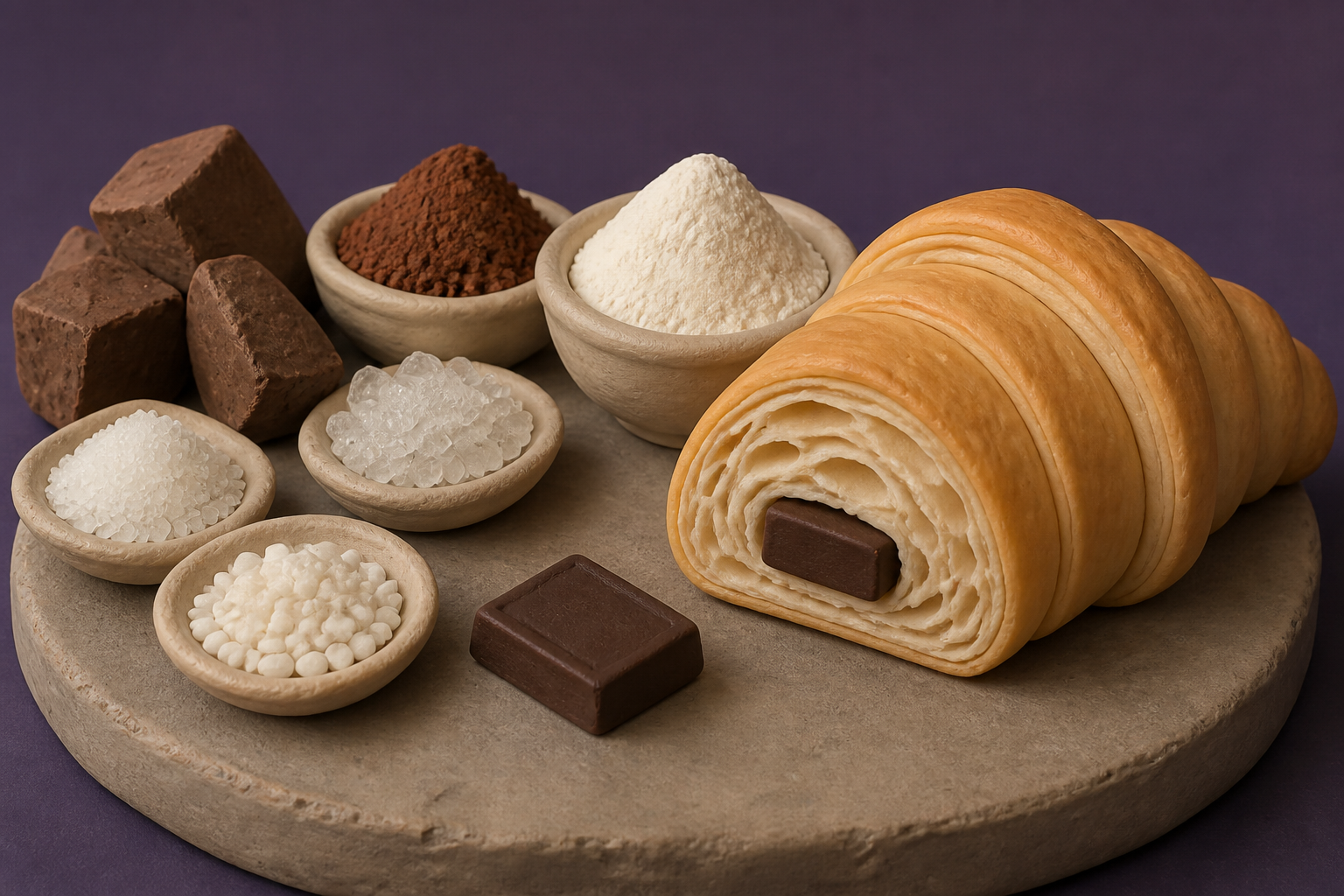
First, the setting
People often bake bread, buns, cookies, and pastries that include chocolate. Heat, moisture, and mixing can change how ingredients taste and feel, so bakers pay attention to what happens inside the oven. The ordinary goal is familiar: serve something enjoyable to bite into after it has cooled.
In a home kitchen or bakery, someone folds pieces of chocolate into dough, shapes the mixture, and places a tray in the oven. Later, a person may pick up a bun or pastry, tear it open, and notice the contrast between the soft baked part and the chocolate within.
What changes in this design
Without the extra sugar details, a reader might simply think of chocolate as an ingredient added to dough before baking, with no stated focus on its sugar balance.
Here, the chocolate is for baking at the same time as water-containing bread or sweet baked dough. It calls for sucrose and/or glucose plus one or more of isomaltulose, trehalose, and maltitol at a specified ratio.
That focus makes the goal easy to see: the formula is concerned with how the chocolate tastes and feels after it shares the oven with water-containing dough, especially its firm crunch.
Chocolate that has to bake with the dough
The compact claim first: in this arrangement the chocolate is asked to survive the bake, instead of the bake being rearranged around the chocolate. US20260256163A1, published September 3, 2026, describes chocolate for simultaneous baking with water-containing bread dough or baked confectionery dough. One oven, both components, the same heat at the same time. What is meant to survive is stated plainly: chocolate flavor, and a crunchy, hard texture. That is the purpose, and it is also, conveniently, something you can check with your teeth.
A few of those words carry weight, so let me define them as I read them. Water-containing dough is what it sounds like, dough with water in it. Simultaneous baking means the chocolate is not added afterward to a cooled product; it goes in with the dough. Sucrose and glucose are the familiar sugars, and isomaltulose, trehalose and maltitol are the three other sugar-family ingredients named here. The specification pairs a set amount of sucrose and/or glucose with one or more of those three at a specific ratio. The sugar list reads less like a flavor decision and more like a stage manager quietly deciding who moves when the heat starts.
Sucrose, isomaltulose, and the ratio that holds
Hold that ratio in mind, because the picture it belongs to is small. A tray goes in carrying two things with opposite preferences: dough that wants water driven off and structure set, and chocolate that would rather not be handled that way at all. Nothing stands between them. The only report arrives later, at room temperature, in a bite - either the chocolate still tastes like chocolate and breaks cleanly, or it has gone soft and dull.
That bite is the signal, and it is worth being exact about what the record hands you. It gives a lever, the identity of the sugars and the ratio between them, and it states what that lever is meant to hold: flavor and a crunchy, hard texture through a shared bake. It does not hand you the chemistry. So the experiment the arrangement implies is unusually clean - keep the dough and the bake fixed, vary only the sugar composition of the chocolate, and let the cooled bite decide. The chocolate is not being shielded from the dough so much as given its own instructions, as if someone handed it a separate clipboard on the way into the oven.
What that experiment exposes is a contrast with the broad version of the same task, and the contrast is really about who carries the burden. When two components share one process and one of them suffers, the usual instinct is to change the process: shift the timing, split the steps, add the delicate part after the heat. Here the process stays and the delicate part is respecified until it can take those conditions unchanged. That is the first thing I would carry elsewhere - when a shared step cannot be split, specify the passive component rather than negotiating with the schedule. It has the air of a librarian who says nothing at all and simply reshelves one book so the whole row stops leaning.
The crunch test and the next record like it
Which leaves the question I would bring to the next record shaped like this one: what can you check without instruments, and is the specification written as a ratio or only as a list? Both matter here, because crunch after cooling is a verdict you reach in a second, and because a proportion travels where a bare list of ingredients does not. That is the second thing worth keeping. I will end there, and keep it modest: the next time two components must go through one unavoidable process together, the pressure lands on whichever one you never bothered to respecify.
The record, briefly. US20260256163A1, “Chocolate For Simultaneous Baking With Water-Containing Bread Dough Or Baked Confectionery Dough” Chocolate for simultaneous baking with water-containing bread or baked confectionery dough contains a specified amount of sucrose and/or glucose and one or more of isomaltulose, trehalose, and maltitol at a specific ratio to retain chocolate flavor and a crunchy, hard texture.
Identity details. The saved title-page transcription needs review, so names are not repeated here. Check the official published title page.
More angles on this
- Inside edible coating compositionAnother reading from the same A21D classification family, treatment of flour or dough for baking, e.g. by addition of materials; baking; bakery products.
- A Baked Product's Specified Sugar RelationshipAnother reading from the same A21D classification family, treatment of flour or dough for baking, e.g. by addition of materials; baking; bakery products.
- CPC A23G: CocoaThe official classification family this record was filed into, published in the USPTO Cooperative Patent Classification scheme.
- CPC A21D: Treatment of flour or dough for baking, e.g. by addition of materials; baking; bakery productsThe official classification family this record was filed into, published in the USPTO Cooperative Patent Classification scheme.
- The cheese ripening record that coats every face, then leaves two of them openAnother reading from the neighbouring A23C classification family, dairy products, e.g. milk, butter or cheese; milk or cheese substitutes; preparation thereof.
Read around this one:Public patent recordUSPTO published figure