Objects
English Word Generation And Reading Platform Makes a Small Case for Better Timing
A twenty-four-year patent trail shows how reading tools traded mechanical wheels for electronic voice chips, right as research reveals why automated toys quiet our kids.

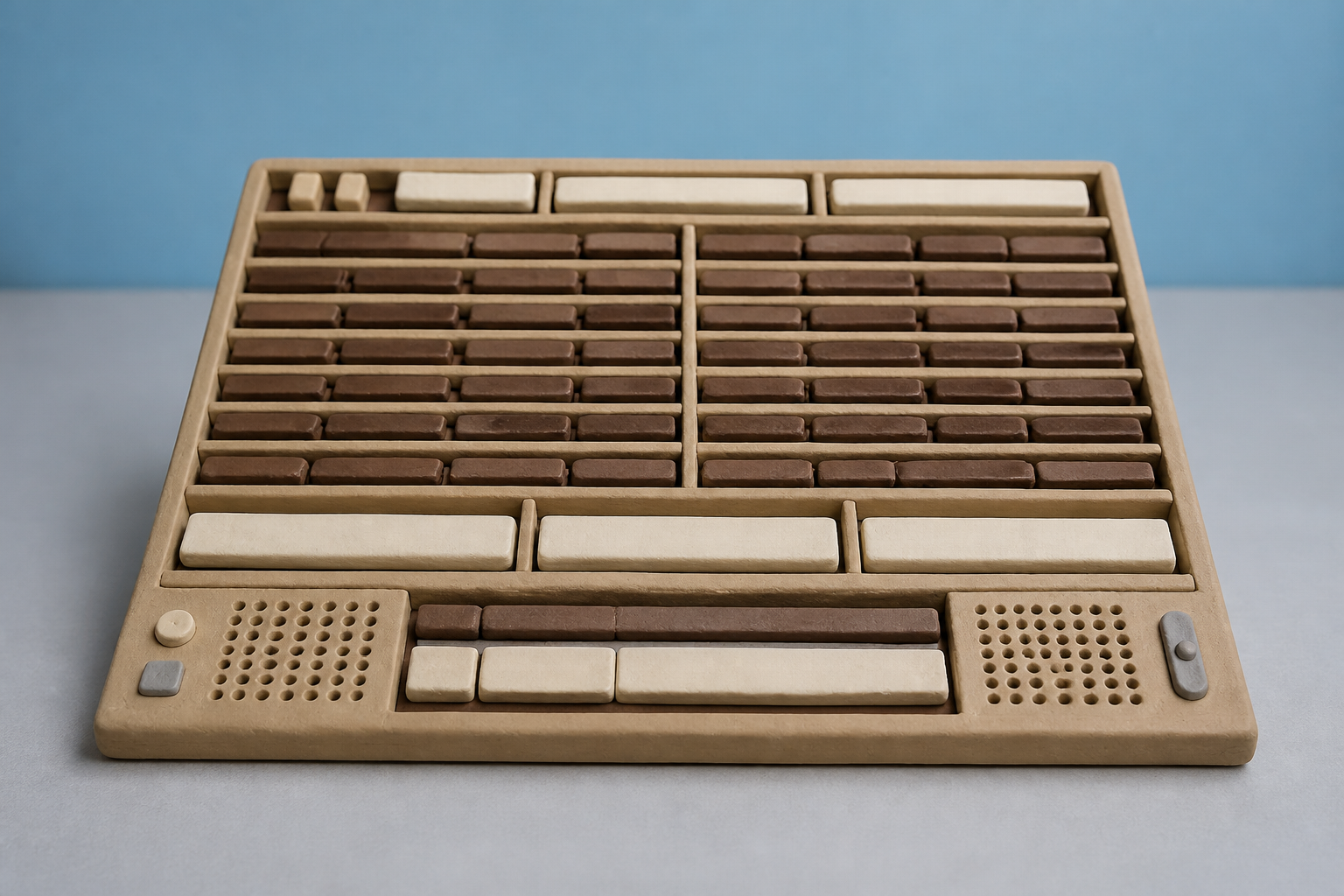
What changes in this design
People typically learn English vocabulary by reading static printed flashcards or typing letters into software on a screen, which separates physical handling from auditory feedback.
Instead of relying on purely digital screens or inert paper cards, this physical base combines storage, physical word carriers, and linked electronic components that identify placed tiles and vocalize the resulting words.
Combining physical letter manipulation with immediate audio output offers an integrated physical station where users can organize components and hear pronunciations in one place without needing external speakers.
The cardboard dial of 2000
In July 2000, an inventor named Ruyun Li filed a patent application for a simple reading toy made of concentric wheels. You spun the inner circle to choose a starting sound like "b-" or "fl-", spun the outer circle to match an ending like "-at" or "-ock", and watched a word form across the plastic rings. It required no batteries, ran no software, and made no sound on its own. The entire premise relied on a child turning the dials and reading the blended sounds out loud to someone sitting nearby.
Twenty-four years later, learning to read in America has turned into an urgent national emergency. National Assessment of Educational Progress data from 2022 revealed that only 33 percent of fourth-grade students in the United States performed at or above the proficient level in reading, a two-point drop from 2019, while 37 percent landed below the basic reading threshold. In response, 43 states and the District of Columbia enacted structured literacy mandates requiring classrooms to teach systematic phonics. That legislative push created a massive commercial appetite for any device promising to turn struggling decoders into fluent readers.
Adding the voice chip
When I traced Li's filings across the decades, the evolution of that simple wheel tracked our changing cultural impulse to automate instruction. In 2007, Li moved into computational rules with an international application detailing algorithmic syllable separation and stress-accent marking. Now, in a newly published patent application titled English Word Generation And Reading Platform, the mechanical wheels have been replaced entirely by circuit boards.
The modern patent describes a platform body split into two functional sections: a word generation and recognition area and an adjacent storage tray. Instead of turning nested dials, a child places physical word carriers - divided into main and auxiliary letter blocks - into designated sensing slots. Beneath the surface, an integrated electronic recognition and reading module links sensors to a controller and a vocalization unit. The platform identifies the physical pieces, processes the letter combination, and speaks the completed word through an internal speaker.
The race for smart tiles
Li is far from the only person attempting to build a tactile bridge between physical alphabet blocks and digital feedback. Commercial startups have spent years trying to solve the same classroom puzzle. Square Panda built a multisensory learning system with 45 physical letter blocks that pair wirelessly with tablets to teach 44 phonemes through tactile slot-in trays. Another popular system, Osmo, bypassed electronic boards altogether, using mirror optics clamped over an iPad camera to detect letter tiles on the table across more than 30,000 classrooms.
There is real science behind the appeal of physical pieces. Decades ago, the National Reading Panel established that explicit, systematic phonemic manipulation produces substantial reading gains. In 2015, a study in the journal Sensors showed that tangible user interfaces using 13.56 megahertz radio-frequency identification tags helped children with Down syndrome grasp letter-sound associations far better than purely virtual touchscreens. Moving a physical block leaves a spatial memory that dragging a finger across glass simply cannot match.
The problem with talking toys
We tend to assume that adding an automated voice to a physical block makes it even better. Yet pediatric and cognitive research paints a far more troubling picture. A 2022 study published in Frontiers in Psychology compared traditional, non-electronic manipulatives with battery-powered educational toys that produce automated speech and sound effects. The researchers found that electronic toys caused a sharp decline in child vocalizations, reduced the lexical diversity of the words spoken, and significantly suppressed reciprocal conversational turns between children and adults.
That conversational give-and-take is the exact mechanism that builds vocabulary and phonological awareness. When a wooden block sits silently on a desk, a child has to sound out the phonemes, hesitate, try again, and look up at a parent or teacher for confirmation. When a circuit board handles the vocalization, the machine does the hard work. The child simply becomes a button pusher waiting for the toy to chime.
The part worth watching
I cannot help but wonder what problem our educational hardware is actually trying to solve. Standalone reading platforms that process letter combinations locally avoid the regulatory scrutiny of the Federal Trade Commission's COPPA rules, which tightly police connected hardware collecting data on children under 13. That self-contained design is practical engineering, but the pedagogical trade-off remains steep.
I find myself thinking about that original cardboard-and-plastic dial from 2000. In my view, the value of a physical reading manipulative was never that it could be wired up to talk. Its true power lay in forcing the human sitting in front of it to speak.
Sources
Reporting for this piece drew on the published filing and the references below.
- US20260260577A1 - English Word Generation And Reading Platform
- US6358059B1 - Method and apparatus for teaching rapid decoding (reading) and encoding (spelling) - Google Patents
- WO2009003308A2 - Separating and accent marking method of english word and application thereof - Google Patents
- Report of the National Reading Panel | NICHD - Eunice Kennedy Shriver National Institute of Child Health and Human Development
- NAEP Reading: National Achievement-Level Results
- Which States Have Passed 'Science of Reading' Laws? What's in Them?
- Multisensory Phonics Learning System | Square Panda
- Osmo — Hands-On Learning Games for iPad | PlayOsmo
- Creating TUIs Using RFID Sensors—A Case Study Based on the Literacy Process of Children with Down Syndrome - PMC
- Electronic Toys Decrease the Quantity and Lexical Diversity of Spoken Language Produced by Children With Autism Spectrum Disorder and Age-Matched Children With Typical Development
- Children's Online Privacy Protection Rule ("COPPA") | Federal Trade Commission
The record, briefly. US20260260577A1, “English Word Generation And Reading Platform” An English word generation and reading platform comprises a platform body with a word generation and recognition area and a storage area. The platform body supports a constituting word carrier module, divided into main and auxiliary word carriers, and an electronic recognition and reading module that includes interconnected recognition, control, and vocalization units.
More angles on this
- System And Method For Emergency Dispatch Questions the Default ArrangementAnother reading from the same G10L classification family, speech analysis techniques or speech synthesis.
- CPC G09B: Educational or demonstration appliancesThe official classification family this record was filed into, published in the USPTO Cooperative Patent Classification scheme.
- CPC G10L: Speech analysis techniques or speech synthesisThe official classification family this record was filed into, published in the USPTO Cooperative Patent Classification scheme.
- Shift Register Unit, Driving Method Thereof, Display Substrate And Display Marks a Pause Worth NoticingAnother reading from the neighbouring G09G classification family, arrangements or circuits for control of indicating devices using static means to present variable information.
- Mapping Acoustic Certainty Over Time in Ultrasound DiagnosticsAnother reading from the wider G06N classification family, computing arrangements based on specific computational models.
Read around this one:Public patent recordUSPTO published figure