Machines
Extended Reality Headset With Shared Ocular Region Sensor Makes the Next Move Easier to See
Qualcomm's new XR patent aims to make one inward sensor read gaze and expression as headsets turn into glasses with almost no spare room.

What changes in this design
A reader might otherwise expect a headset to focus mainly on putting a display and lenses in front of the eyes, with any monitoring of the eye area treated as a separate concern.
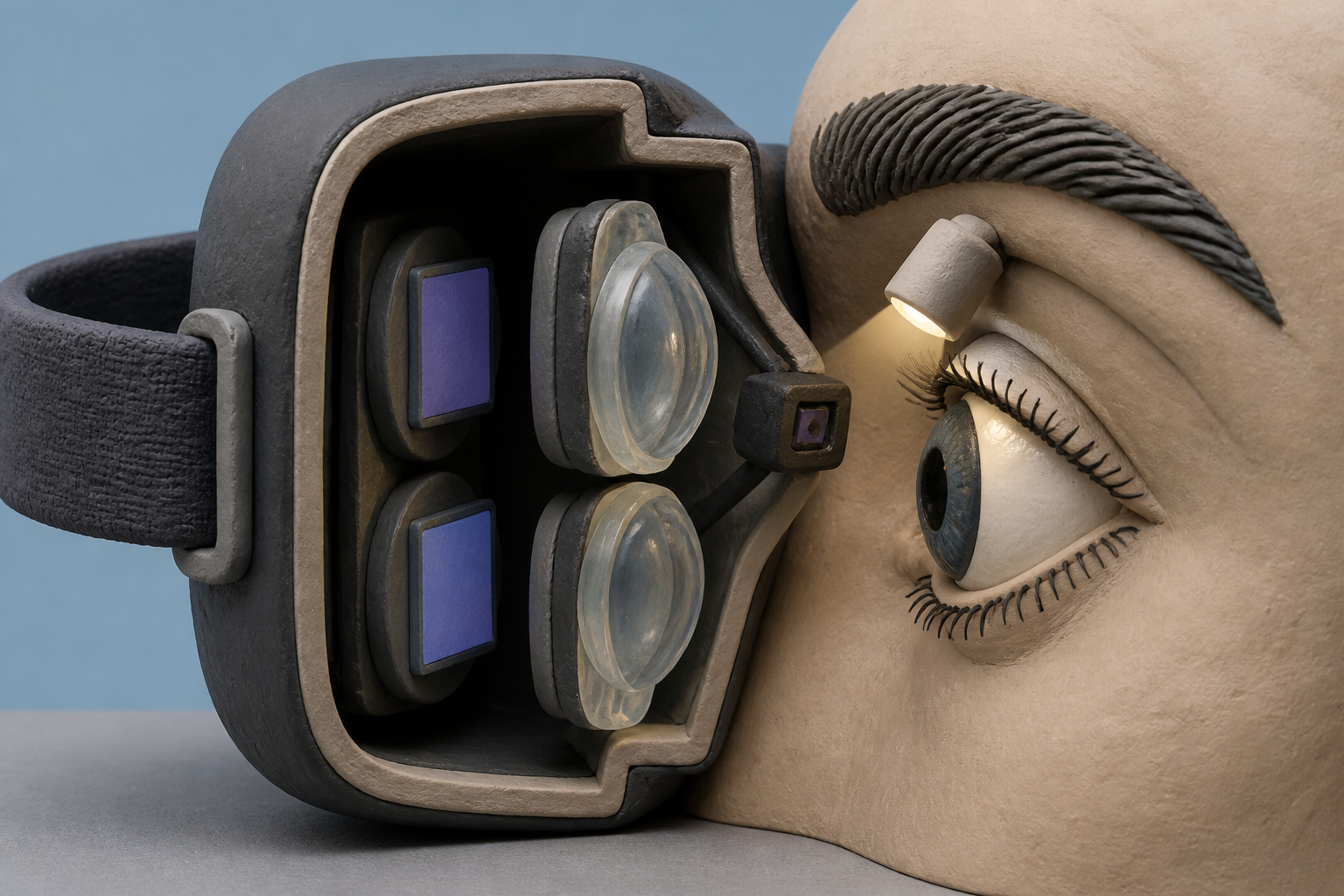
This record combines a face-worn housing, display, eye-specific optical pieces and lenses with an ocular sensor that tracks eye movement and facial characteristics. It also includes an illumination source for an eye and its corresponding facial region.
That framing helps explain why the eye area receives attention beyond the screen and lenses. The headset is presented as both something worn over the face and a place where eye movement and nearby facial characteristics are tracked.
FOVE 0, November 2016
In November 2016, the FOVE 0 shipped with built-in real-time eye tracking, a first for a commercial VR headset. It was an early promise that a device could react not only to where a wearer moved, but to where they looked.
Then the consumer story stalled. A decade later, the technology is being used in Japanese universities and healthcare settings for cognitive screening, rather than becoming a major gaming product. That history matters because I keep wondering whether eye tracking has been waiting for a smaller, less demanding job than the one early VR assigned it.
The outer corner of an eye
Qualcomm had already helped make eye tracking familiar behind the scenes. Its 2020 XR2 5G reference design used Tobii technology for foveated rendering and social gaze, part of a continuing licensing relationship. The new application, US20260259417A1, published on September 3, takes a more compact direction: one ocular-region sensor is intended to collect both eye movement and facial characteristics.
The hardware is unusually specific. At least one display, optical assembly, and lens sit within a face-worn housing, with illumination aimed at the eye and nearby facial region. The sensor is described near the lower eyelid at the outer corner of the eye, with a field of view of at least 90 degrees. A ring of infrared illuminators around the lens and a 500-microsecond to 2-millisecond exposure are meant to catch pupil and eyebrow movement in one exposure. The number that stopped me was not the patent's 24 claims, but that short exposure window: this is a bid to make two forms of biometric observation happen at once.
Room inside glasses
A market report puts global XR shipments at 14.5 million units in 2025. Smart glasses accounted for 7.25 million of them, or half the category, while VR and mixed-reality headsets accounted for 4.3 million. Space for extra inward-facing cameras is becoming a commercial constraint, not an engineering footnote. That framing turns a component decision into a product constraint: gains in capture have to justify space that glasses simply do not offer freely.
As devices shrink, cameras pointed back at the wearer are pushed into increasingly distorted angles, especially when they are trying to see the mouth. One headset maker has used a separate training headset with additional cameras to teach its software what those distorted views mean. I don't think Qualcomm's filing solves that whole problem. Its proposed sensor lives close to the eye, where gaze remains practical, while expression capture still requires software to separate eyebrow movement from the gaze signal.
Two biometric streams
Combining those tasks is not merely a tidier parts list. Gaze can indicate attention; facial characteristics can support expression-driven avatars and other interpretations of a wearer. A recent research paper warns that eye-tracking and VR motion data may remain identifying when handled together, even if one stream has been anonymized on its own. I would not turn that finding into a prediction about every headset, but it is a useful warning against treating a shared sensor as a privacy simplification.
European Union rules prohibit systems that infer emotions from biometric data in workplaces and schools, while consumer XR use sits outside that specific restriction. The law therefore draws one boundary without settling the broader question of what a device may infer from a face. My concern is less that this patent records an eyebrow than that its compact design could make capture feel ordinary before people understand what the combined data can reveal.
The open question
This is still an application, not a product announcement. It was filed on August 19, 2025 as a continuation of a 2023 international filing, and one patent-analysis service listed it as ready for examination on June 1, 2026 with a medium grant-likelihood rating. None of that establishes that the sensor will fit comfortably in a shipping headset, work reliably across faces, or earn user trust.
What I cannot tell from the published application is whether the industry will use this kind of hardware chiefly to make smaller devices more useful, or to collect more intimate signals because it can. The patent's narrow technical proposition is credible: one well-placed sensor may reduce the hardware burden. The larger proposition remains unsettled. As XR moves toward glasses, the hardest thing to miniaturize may be the decision about which parts of a person's face should become input at all.
Sources
Reporting for this piece drew on the published filing and the references below.
- Extended Reality Headset With Shared Ocular Region Sensor
- Qualcomm Patent: Extended Reality Headset with Shared Ocular Region Sensor
- Qualcomm XR Headset Eye-Tracking Patent Analysis
- Tobii Eye Tracking in the New Qualcomm Snapdragon XR2 5G Reference Design
- Fove
- Vision Pro's New Personas Are a Big Improvement, But How Will They Scale to Smaller Headsets?
- XR & Spatial Computing / Smart Glasses Market Statistics Report
- Exploring the Uncoordinated Privacy Protections of Eye Tracking and VR Motion Data for Unauthorized User Identification
- Red Lines under EU AI Act: Unpacking the Prohibition of Emotion Recognition
The record, briefly. US20260259417A1, “Extended Reality Headset With Shared Ocular Region Sensor” An XR system has a face-worn housing, at least one display, optical assemblies and lenses for corresponding eyes, an ocular sensor tracking eye movement and facial characteristics, and an illumination source for the eye and a corresponding facial region.
More angles on this
- Method For Tunable Chromatic Aberration Projection Makes the Next Move Easier to SeeAnother reading from the same G02B classification family, optical elements, systems or apparatus.
- Inside waveguide photodetectorsAnother reading from the same G02B classification family, optical elements, systems or apparatus.
- CPC G02B: Optical elements, systems or apparatusThe official classification family this record was filed into, published in the USPTO Cooperative Patent Classification scheme.
- Inside multi-tiered semiconductor waveguideAnother reading from the neighbouring G02F classification family, optical devices or arrangements for the control of light by modification of the optical properties of the media of the.
- Inside road safety system including multiple roadAnother reading from the wider G01W classification family, meteorology.
Read around this one:Public patent recordUSPTO published figure