Machines
Fog, Turns, and the Timing of a Handoff
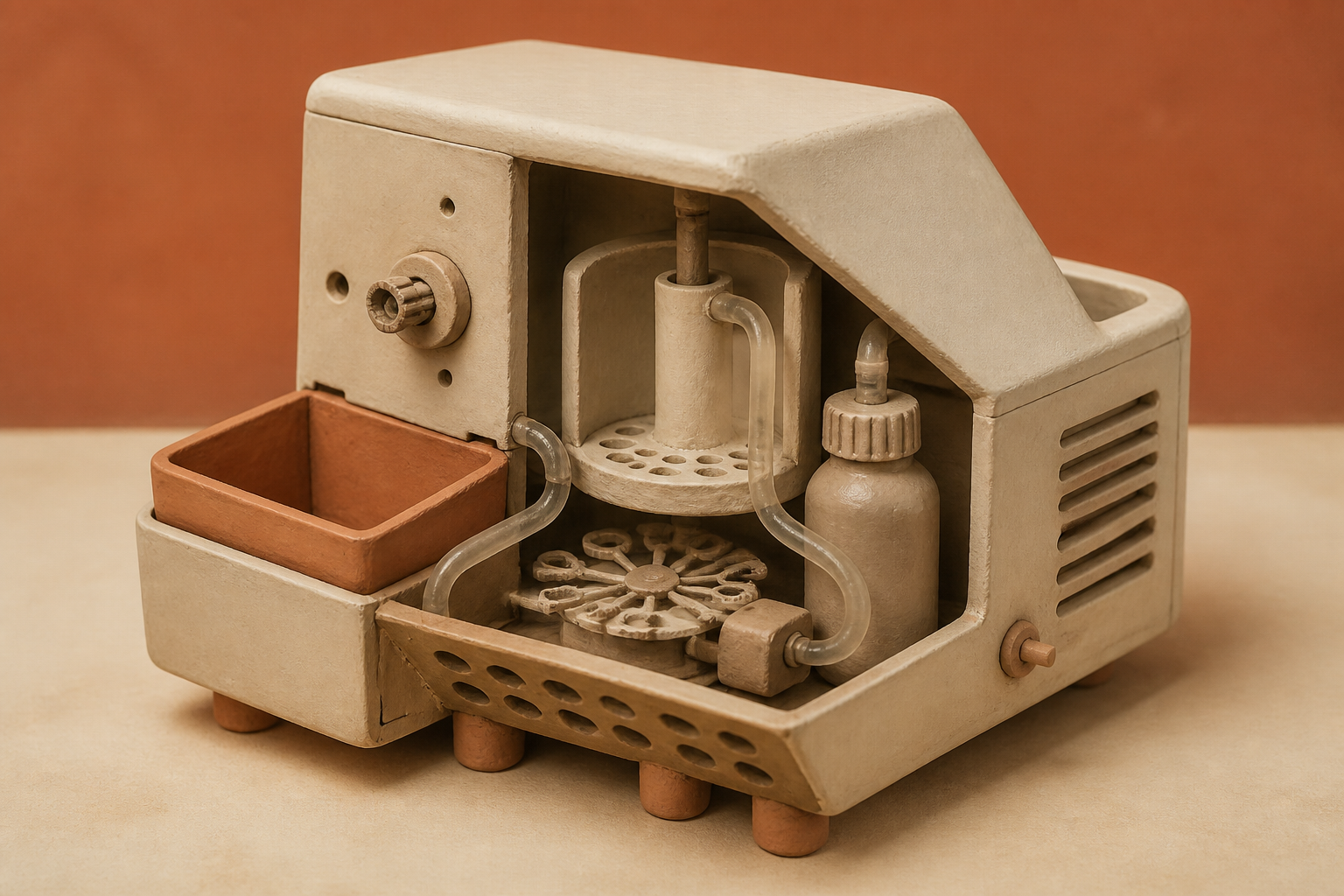
Key detail and Arrangement form one stated connection: A fog collecting box and a bubble machine are provided.
First, the setting
At parties, school performances, playrooms, and seasonal displays, people use drifting bubbles and mist to make a room feel more lively or theatrical. Lights catch the moving air, children follow it, and a plain corner becomes part of the activity.
A host or performer sets a small machine near a stage edge or table. Bubbles float across the room while a soft cloud of mist moves through a box and out through an opening. People nearby watch the light catch the bubbles and see them drift through the display.
What changes in this design
A reader might expect an inlet and outlet on a box to be linked by a direct, short passage.
The channel inside this box bends at least once, making its overall length greater than the straight-line distance from inlet to outlet.
It makes clear that the length of the path inside the box matters, not just the positions of its two openings. Its exact shape, dimensions, and measurements are not stated.
The Box's Bent Channel
Cause: picture fog at an inlet; effect: a channel turns on its way toward an outlet; next choice: judge the handoff by its route rather than its endpoints. The published record for US20260257143A1, titled Fog Collecting Box And Bubble Machine and published September 3, 2026, makes that small scene worth pausing over. You can picture two openings and a route between them, with the route declining to go straight just because the openings look nearby. The inlet and outlet stand less like a shortcut and more like two labels waiting for the route to explain them.
That picture needs names before it needs conclusions. An inlet is the opening where something enters, an outlet is the opening where it leaves, and a channel is the passage joining them. The filing describes a channel between the two openings, so the handoff is not simply a matter of placing points on a diagram. It is a matter of following the passage that links them.
Once those terms are in place, the mechanism becomes unusually legible. A bending section is a portion of the channel that changes direction, and the filing specifies at least one of them. Because of that bend, the channel's total length is greater than the linear distance - the direct straight-line distance - from inlet to outlet. The bend has the air of a stage manager holding a cue for one extra beat. What made me look twice was not a promised outcome, but the decision to make route length part of the arrangement.
Box and Bubble Roles
That decision clarifies the roles without pretending they are the same job. The published record provides a fog collecting box and a bubble machine; within the stated box arrangement, inlet, channel, and outlet have distinct routing terms. The described route begins at the inlet, runs through the channel, and ends at the outlet, while the bubble machine remains the other named element in the provided pair. This is a modest design lesson: when a handoff matters, give each part a job that can be described separately.
Channel Length and Distance
With those roles separated, the comparison stops being a guess about what seems close. An ordinary sketch might ask only how far apart two openings appear. The patent gives a defined response instead: compare the channel's total length with the linear distance between inlet and outlet, knowing the bending section makes the first exceed the second. On the page, the channel reads as if a quiet committee required the fog to take the long way around.
That defined response turns into a practical test you can carry into other systems. First, mark the handoff points; then trace the actual route; finally, ask how bends revise the timing question suggested by proximity. A clipboard beside the diagram would ask less like "How near are these?" and more like "What path has been assigned between them?" The transferable observations are concrete: endpoint distance and route length are different descriptions, and named roles make it easier to notice which part changes the sequence. The consequence is useful anywhere you pass something from one stage to another: the shortest-looking handoff may not be the one the arrangement has chosen.
The record, briefly. US20260257143A1, “Fog Collecting Box And Bubble Machine” A fog collecting box and a bubble machine are provided. The box includes an inlet, an outlet, and a channel between them; the channel has at least one bending section so its total length exceeds the linear distance between inlet and outlet.
More angles on this
- An Inflatable Costume Prepares for Lift-OffAnother reading from the same A63H classification family, toys, e.g. tops, dolls, hoops or building blocks.
- CPC A63H: Toys, e.g. tops, dolls, hoops or building blocksThe official classification family this record was filed into, published in the USPTO Cooperative Patent Classification scheme.
- When a Squat Machine Treats the Handoff as the Main EventAnother reading from the neighbouring A63B classification family, apparatus for physical training, gymnastics, swimming, climbing, or fencing; ball games; training equipment.
- Method For Treating Cancer By Anti-B7H3 Antibody-Drug Conjugate Makes a Small Case for Better TimingAnother reading from the wider A61K classification family, preparations for medical, dental or toiletry purposes.
- Golf Swing Evidence, Carried by a WearableAnother reading in the same Machines category on this site.
Read around this one:Public patent recordUSPTO published figure