Machines
When a Squat Machine Treats the Handoff as the Main Event
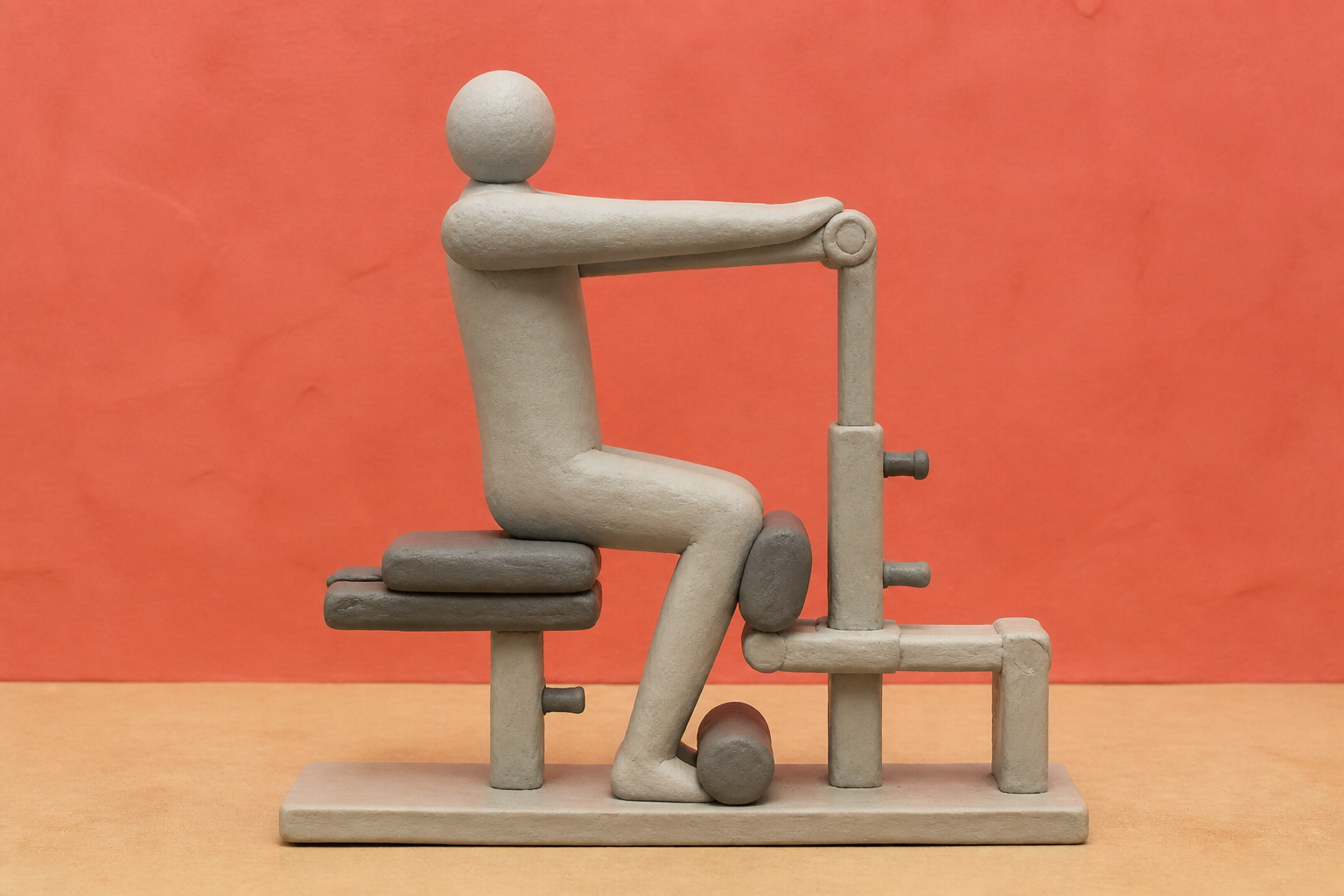
Follow Key detail alongside Arrangement: A controlled squat strength-training machine includes a base mounting forward.

First, the setting
People use strength training to build confidence in everyday movement, from getting up from a chair to carrying groceries or playing with family. Gyms and rehabilitation spaces offer structured ways to practice demanding movements while people learn balance, posture, and how their bodies respond to resistance.
In a fitness room, a person stands on a sturdy platform with their shoulders and legs positioned against padded supports. They bend and rise while a connected resistance mechanism moves with them. A trainer or nearby gym-goer may adjust a setting, watch their form, or wait for the equipment.
What changes in this design
How people ordinarily perform squat strength training, or what equipment they might otherwise use, is not stated.
This machine has a base with forward, intermediate, and rear uprights. Its intermediate upright pivots only a limited amount forward and back, while knee pads restrain the user’s knees and resistance is adjustable.
For someone looking at the illustration, these features explain the machine’s setup for controlled squat exercises: knee restraint, limited movement in the middle upright, and resistance that can be changed.
Uprights Set the Sequence
At first, you might assume a squat machine simply asks its pieces to hold still while a user moves. Not quite. The published record for US20260257101A1, titled Controlled Squat Strength-Training Machine and dated September 3, 2026, instead pictures a base that mounts forward, intermediate, and rear uprights. The layout has the air of a restrained committee, with three uprights convened on one base. I looked twice at that arrangement because it makes the question of who moves, and when, more interesting than the usual one-piece mental picture.
That timing question needs plain names before it can carry any lesson forward. An upright is a standing support on the base, and the intermediate upright is the middle one; in this filing, it pivots, meaning it turns on a joint, with limited fore-and-aft rotation, or constrained motion toward the front and back. It is less like a fixed post than a stage manager allowed one careful cue. The limitation matters because a pivot is not being presented as free wandering; the published record specifically describes its range as limited.
With that constraint in view, the handoff becomes easier to picture. The base holds the three uprights, the intermediate upright takes its limited front-to-back turn, and knee pads restrain the user's knees while adjustable resistance varies the exercises. That is a sequence of roles, not a claim that every part is doing every job. The mechanism has the quiet manners of a librarian directing traffic, as if movement needs a little order before it is allowed to proceed.
Knee Pads and Resistance
Because the parts are assigned rather than merely collected, the arrangement points to a practical systems question: where should control sit when a task has several moving conditions? The filing gives a bounded answer here: controlled squat strength-training, with knee restraint, limited fore-and-aft pivoting, and resistance that can be adjusted to vary exercises. It does not turn those elements into a grand theory of every squat machine. Good. The modest point worth your attention is that control can come from coordinating distinct duties, not from asking one component to be heroic.
That modest point revises the ordinary comparison. Rather than treating a squat machine as a single, fixed arrangement, you can view this one as a base-supported arrangement in which a middle upright has limited motion, knee pads restrain knees, and resistance adjusts across exercises. The contrast is modest but specific: fixedness gives way to a defined handoff between restraint, pivot, and adjustment. We should resist reading more into it than the patent provides, but the separation of duties is visible enough to be useful.
A Squat Is Not One Motion
From that comparison, two transferable observations stay with you. When several parts share a task, name the handoff before celebrating the parts themselves; let a constraint describe a role rather than disappear behind a broad word such as control. The intermediate upright is not simply active. It is limited. That small distinction is the challenge to the old default: stop treating coordinated parts as a single mute block.
The record, briefly. US20260257101A1, “Controlled Squat Strength-Training Machine” A controlled squat strength-training machine includes a base mounting forward, intermediate, and rear uprights. Its intermediate upright pivots with limited fore-and-aft rotation, knee pads restrain users' knees, and adjustable resistance varies the exercises.
More angles on this
- A Glove With a PortfolioAnother reading from the same A63B classification family, apparatus for physical training, gymnastics, swimming, climbing, or fencing; ball games; training equipment.
- CPC A63B: Apparatus for physical training, gymnastics, swimming, climbing, or fencing; ball games; training equipmentThe official classification family this record was filed into, published in the USPTO Cooperative Patent Classification scheme.
- An Inflatable Costume Prepares for Lift-OffAnother reading from the neighbouring A63H classification family, toys, e.g. tops, dolls, hoops or building blocks.
- A Directional Setting, Not a PromiseAnother reading from the wider A61B classification family, diagnosis; surgery; identification.
- A Lanyard System That Waits for EvidenceAnother reading in the same Machines category on this site.
Read around this one:Public patent recordUSPTO published figure