Objects
Foldable Solar Panel: Folding as a Signal for Attachment
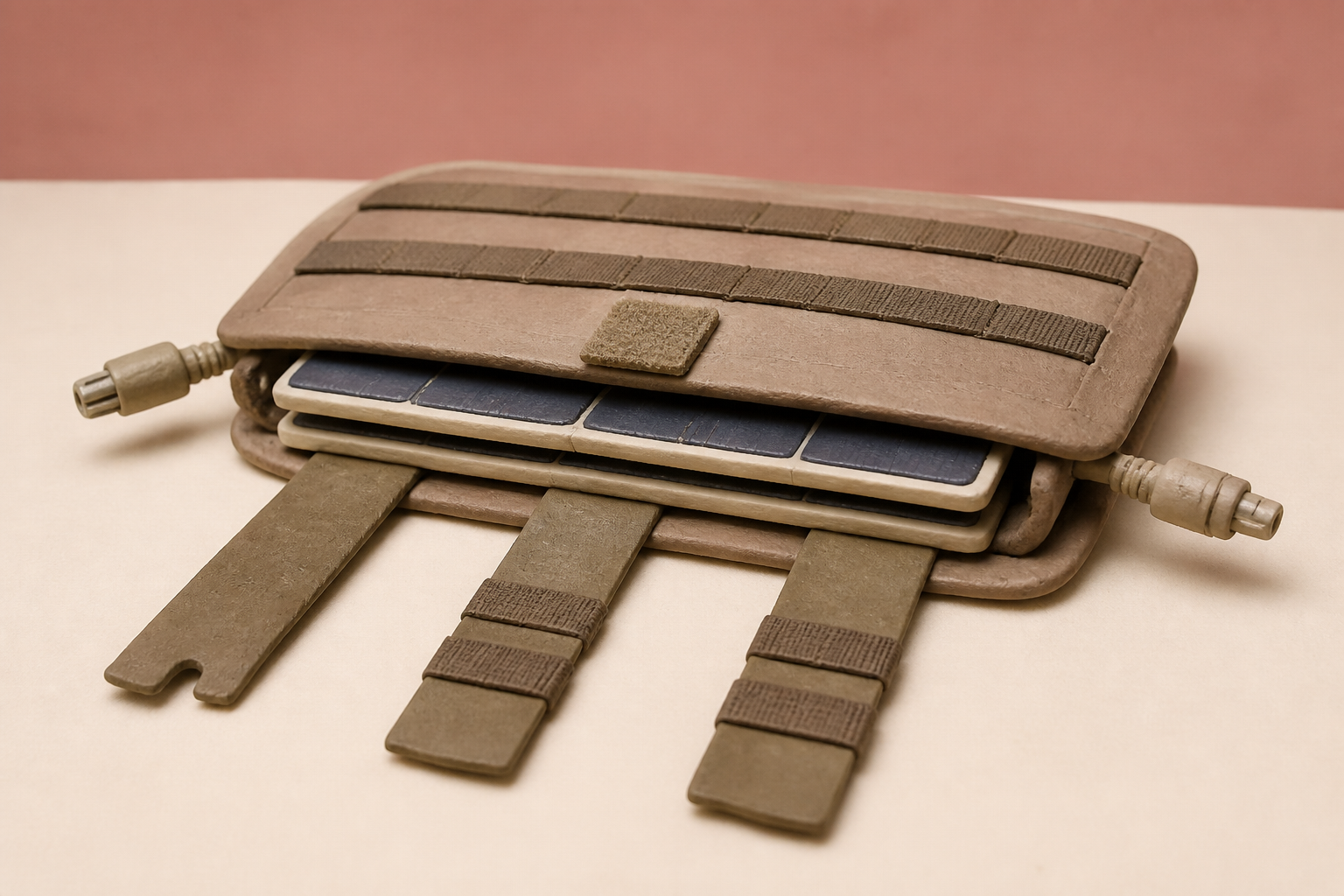
Module plus Hook-And-Loop Tape carry the practical point: A foldable solar panel has at least two solar modules on a substrate.

First, the setting
People who spend time away from wall outlets still need power for lights, phones, maps, and small gear. On a trail, at a campsite, or during outdoor work, carrying equipment means balancing usefulness with the space and weight available in a bag or on a vehicle.
At a campsite, someone unfolds a panel beside a tent or across a pack, facing it toward the sun. When it is time to move, they fold the fabric-like surface, fasten it closed, and secure it onto a backpack, cart, or other gear platform.
What changes in this design
People may picture a solar panel as one flat piece, without considering how it stays folded or connects to something carrying weight.
Here, at least two solar units sit on a backing material, while hook-and-loop tape holds the folded panel closed. At least two straps and horizontal webbing rows provide attachment to a load-bearing platform.
It shows that folding the panel and mounting it to a weight-bearing platform are both part of the object presented here.
Folding, Tape, and Attachment
Folding is the cause, a secured condition is the effect, and attachment to a platform is the next choice. Ordinary objects earn attention when they turn a routine into a decision you can see: gather something, secure it, then determine what it will meet. The published application, US20260261234A1, dated September 3, 2026, describes a Foldable Solar Panel, and that three-part motion is the signal worth following. Instead of treating "foldable" as an attractive adjective, you can ask what the fold settles. You already know the human version of that question from coats, maps, and lunch containers: closing an object is one event, while knowing what follows it is another. Here, the published arrangement gives the folded state a way to be secured and identifies an attachment route to a load-bearing platform. The folded arrangement has the air of a librarian closing a book before deciding where it belongs.
That opening question moves naturally to the nouns that do the work. The application describes at least two solar modules, meaning solar-producing components, on a substrate, a base layer that carries them. It names hook-and-loop tape, a paired fastener whose hooks and loops catch together, to secure the panel while folded. That language makes the ordinary action of closing something more specific: the modules and substrate are not merely folded in imagination; the tape is assigned the securing role. The terminology matters because a routine becomes easier to reason about when each part is given a job in the sentence. Hook-and-loop tape waits like a stage manager with one quiet cue: folded now. What made me look twice was the choice to name that little handoff instead of letting folding do every job by implication.
With that securing role visible, the picture expands past a panel that simply bends. The filing also describes at least two straps with at least two horizontal webbing rows for attachment to a load-bearing platform. "Horizontal webbing rows" can sound grander than the image requires: webbing is woven strap material, and horizontal marks rows running across rather than up and down. A load-bearing platform is a platform meant to bear a load. What you need to picture is modules on their base layer, a folded condition held by tape, then straps and horizontal rows as the stated attachment features. The stated counts need no embellishment; their value is in showing that the filing ties particular parts to the picture. The horizontal webbing rows are less like decoration and more like a label-maker for possible attachment.
Straps and the Decision Chain
That complete picture turns uncertainty into a decision by moving in order rather than piling features in a heap. First, at least two solar modules sit on the substrate; next, hook-and-loop tape secures the folded condition; after that, at least two straps with at least two horizontal webbing rows are identified for attachment to a load-bearing platform. Cause leads to effect, then effect leads to the practical question: can you point to what holds the folded state and what carries the attachment decision? The answer here is defined in named parts, not left to a reader to supply. That order is the editorial hinge: it changes a bundle of features into a trail of decisions. A useful three-beat test for a comparable arrangement follows from it: separate the thing being gathered from the thing securing it, then look for the stated feature that meets the next surface. The point is not to grade an object's performance; it is to notice whether a description replaces a guess with a response.
Defined Responses After Folding
That test makes the contrast clearer without turning it into a contest. A broad picture of a foldable panel might stop at the idea that a panel can be folded; what happens after the fold would remain a guess. This filing sets out a defined response instead: solar modules on a substrate, hook-and-loop tape for the folded condition, and straps with horizontal webbing rows for attachment to a load-bearing platform. The distinction is not that one picture is more impressive; it is that the later choice has been given its own vocabulary. If you were comparing descriptions, that is a concrete way to keep a broad phrase from swallowing the later step. A folded bundle can resemble a polite committee that has adjourned, but the straps and rows tell you the meeting has an agenda after the chairs are stacked. That is why the terms deserve attention: they divide securing from attachment rather than treating both as one vague act.
From that contrast, the transferable consequence is small and very usable. When you encounter an ordinary object that must change state and then connect to something else, ask two concrete questions: what feature settles the first state, and what separately named feature makes the next connection legible? In this published record, tape answers the first question for the folded condition, while straps and horizontal webbing rows answer the second for attachment to the platform. I think that division is worth carrying elsewhere because it keeps a familiar action from hiding its handoffs. A clasp, a label, a row, or a strap need not be dramatic to be decisive in a description; each can tell you where uncertainty stops and the next choice begins. The consequence you can use elsewhere is to look beyond the fold for the signal that tells you what the object is prepared to do next.
The record, briefly. US20260261234A1, “Foldable Solar Panel” A foldable solar panel has at least two solar modules on a substrate, hook-and-loop tape to secure it folded, and at least two straps with at least two horizontal webbing rows for attachment to a load-bearing platform.
More angles on this
- When an Energy Bin Stops Short and Alignment Starts SpeakingAnother reading from the same H01M classification family, processes or means, e.g. batteries, for the direct conversion of chemical energy into electrical energy.
- The Small After-Effect of a Bent Signal PinAnother reading from the same H01M classification family, processes or means, e.g. batteries, for the direct conversion of chemical energy into electrical energy.
- CPC H02S: Generation of electric power by conversion of infrared radiationThe official classification family this record was filed into, published in the USPTO Cooperative Patent Classification scheme.
- CPC A45F: Travelling or camp equipment: sacks or packs carried on the bodyThe official classification family this record was filed into, published in the USPTO Cooperative Patent Classification scheme.
- Under 55 mm, a Handoff Gets Its PlaceAnother reading from the neighbouring H02K classification family, dynamo-electric machines.
Read around this one:Public patent recordUSPTO published figure