Field Notes
How a Modular Clip Turns Rigid Case Frames into Adaptable Stations
A suburban dance studio couple designed a modular luggage clip to solve backstage chaos, only to face flimsy duffel racks and strict patent office obviousness rules.

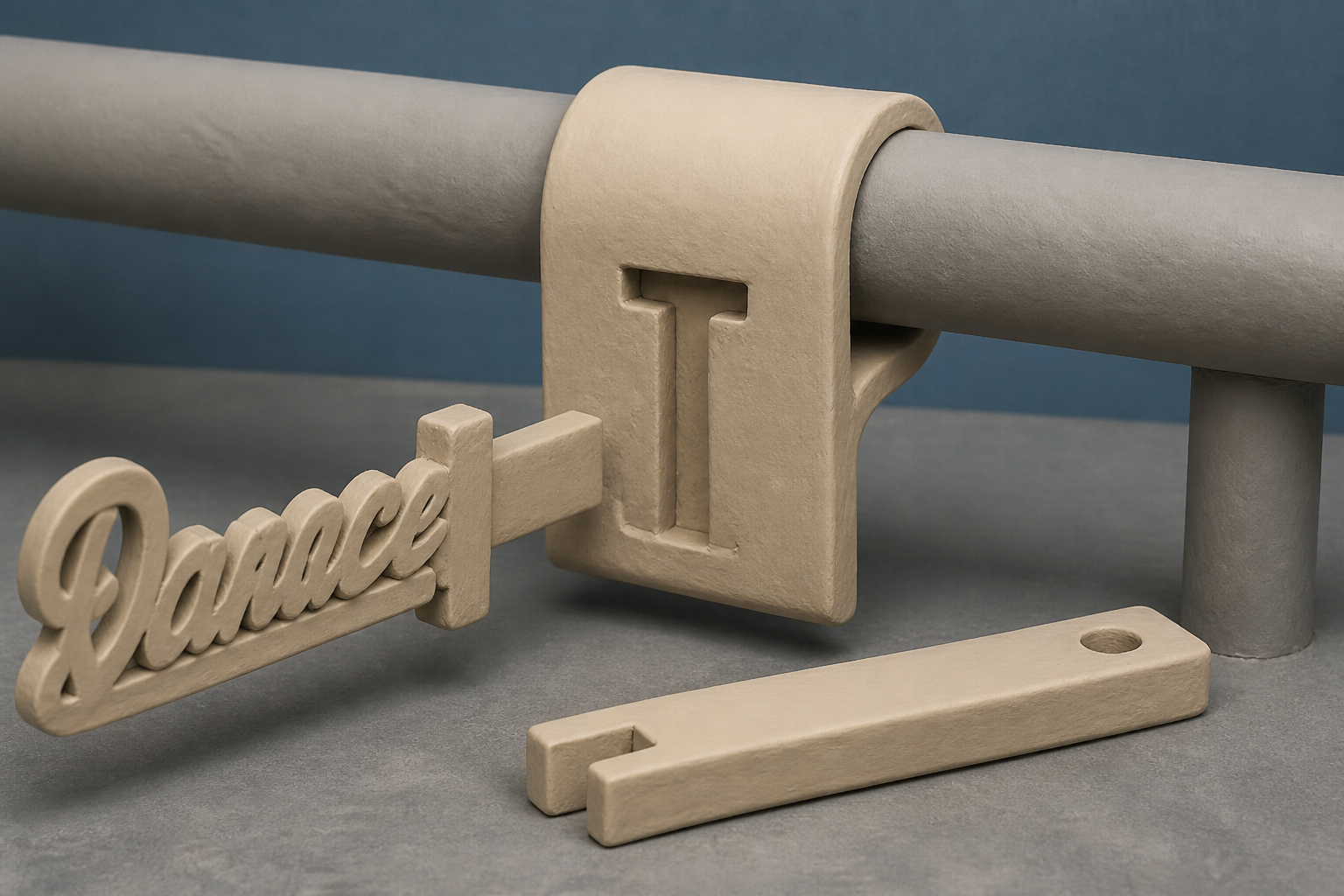
What changes in this design
Standard luggage frames generally offer no built-in way to fasten separate accessories, or they rely on fixed brackets that cannot be easily removed or swapped.
This approach provides a removable clip that anchors to a case's rigid frame, utilizing interlocking T-shaped slots and tabs to connect swappable accessories like trays and drink holders.
Understanding this distinction shows how a simple clip can make a rigid bag versatile, allowing someone to customize their setup for different activities without permanent alterations.
Two hundred identical black bags
In 2004, Sharon Middup built the first mobile garment-rack luggage for dancers, launching Rac N Roll and establishing an entire category of portable backstage gear. Twenty years later, youth dance competitions run on rigid schedules and serious financial commitments. Families pay an annual registration fee of thirty dollars per dancer, commit to eleven months of tuition, and buy mandatory non-refundable costumes for every routine. They also pack three-hundred-dollar rolling duffels that look virtually identical. When an entire competition season of intensive training, travel expenses, and custom costumes is packed inside an anonymous black nylon duffel, misplacing that bag becomes a high-stakes crisis for a family.
Backstage dressing rooms are notoriously cramped. When dozens of dancers unpack identical black bags in a crowded hall, gear vanishes and bags get swapped in the rush between numbers. Dance parents frequently warn each other about dressing room etiquette and the scramble to find lost costumes during rapid changes. A dancer facing a tight three-minute turnaround between routines cannot afford to rifle through multiple identical bags to locate a missing headpiece or garment bag. To my eye, that confusion is what makes a clear, elevated identification tag feel like essential survival equipment rather than an optional add-on.
The prop maker and the dance teacher
Tenisha Miedel has spent twenty-eight years as a SAG-AFTRA performer and serves as Artistic Director at Moves Dance Studio, founded in Wheaton, Illinois, in 1987. Her co-inventor, Bryan Miedel, manages business development and prop engineering for the studio's productions. Between running classes, managing rehearsals, and building stage sets, the couple watched families struggle with the luggage pileup weekend after weekend. That combination of daily studio operations and mechanical stagecraft gave them direct insight into the friction points of competitive dance.
Their solution is a modular hardware system commercialized as Dazzle Clipz. The published record, filed as a utility patent application, describes a clip configured to clamp securely onto the rigid frame or telescoping handle of a rolling bag. Instead of tying ribbons to a zipper pull, taping names onto nylon fabric, or looping paper luggage tags that easily tear off in crowded dressing areas, the clip fastens directly to the metal bar and provides a standardized mounting slot positioned prominently at eye level.
Sliding into the slot
The core mechanism in the filing is a T-shaped attachment channel. The base clip grips the luggage pole, while its outer face features an open track designed to receive modular accessories. Items like personalized nameplates, drink holders, or trays slide into the channel using matching T-shaped protrusions. By relying on a sliding channel rather than individual strap mounts, the design establishes a universal docking interface directly on the luggage frame.
I spent an afternoon looking through the patent filing to see how far the inventors wanted to take the concept. The drawings detail everything from acrylic name badges to cantilevered drink caddies. At forty dollars, the commercial kit targets parents looking for an all-in-one organizer. Dancers can display their name for morning call times, swap it for a beverage caddy during rehearsals, and snap on a phone mount while waiting for award ceremonies. The patent documents make clear that the broader vision is to convert the luggage handle into an adaptable backstage workstation that adjusts to each phase of competition day.
The physics of a cantilever
The difficulty arises when you move past flat nameplates and examine how dance luggage performs in practice. Hands-on reviews of popular rolling dance bags show that telescoping rack poles frequently lean or buckle under heavy loads, and my impression is that hanging costumes already push these frames to their limit. The thin metal rods are designed to support downward vertical weight along their axis, not asymmetric lateral loads. Adding side-mounted accessories introduces mechanical stresses that standard garment duffels were never engineered to absorb.
I doubt whether a slender aluminum extension pole can support a full water bottle clamped six inches out on a horizontal bracket without twisting. Clamping a loaded drink holder onto a telescoping rod turns the accessory into a lever arm that exerts continuous rotational torque on the tubing. While an identification plate adds almost no torque, heavier modular attachments test the physical limits of the luggage itself, risking bent poles or jammed telescoping joints right when dancers need them most.
The harder half of the problem
Structural physics is only the first obstacle facing the design. Under federal patent law, specifically 35 U.S.C. 103 and the obviousness standards in MPEP section 2143, the patent office routinely rejects applications that simply combine familiar mechanical elements to achieve predictable results. The core legal test examines whether a person having ordinary skill in the mechanical arts would find the assembly of known components an obvious step.
A tube clamp is standard hardware, and sliding T-slots have been used across machine shops and framing systems for generations. Putting a T-slot onto a pipe clip produces exactly what any mechanic would expect: a clamp that holds modular parts. Our reading of patent examination guidelines suggests the application faces a steep hurdle in proving that this pairing represents an inventive leap rather than a straightforward combination of prior art.
What we cannot know yet is whether the patent office will find a narrower patentable feature in the specific geometry of the clip. Bryan and Tenisha Miedel built a tidy answer to a real backstage headache, but turning a grassroots dance-parent hack into an enforceable patent remains the harder half of the problem.
Sources
Reporting for this piece drew on the published filing and the references below.
- Case Identifying Clip For Accessories (US20260260588A1)
- Dazzle Clipz
- About Us - Family-Run Dance Studio Since 1987 | Moves Dance Studio
- Tuition & Studio Fees | Moves Dance Studio
- Our Story | Rolling Dance Bag With Rack | Rac N Roll
- The Ultimate Dance Bag Review | The Dancing Dance Mom
- Dressing Room Etiquette | The Dancing Dance Mom
- 2143 Examples of Basic Requirements of a Prima Facie Case of Obviousness
The record, briefly. US20260260588A1, “Case Identifying Clip For Accessories” A modular system includes a clip configured to removably attach to a rigid portion of a case such as a dance bag. The clip includes an attachment mechanism, such as a T-shaped slot, that allows accessories like name plates, drink holders, or trays to be interchangeably attached via corresponding structural elements like T-shaped protrusions.
More angles on this
- Accessory And Drinkware Assemblies: The Choice After ConnectionAnother reading from the same A45C classification family, purses; luggage; hand carried bags.
- Why a Magnetic Latch Sits Between Your Phone and the AirwavesAnother reading from the same A45C classification family, purses; luggage; hand carried bags.
- CPC G09F: Displaying; advertising; signs; labels or name-plates; sealsThe official classification family this record was filed into, published in the USPTO Cooperative Patent Classification scheme.
- CPC A45C: Purses; luggage; hand carried bagsThe official classification family this record was filed into, published in the USPTO Cooperative Patent Classification scheme.
- Pairing Synthetic Anatomy with Matched Tools for Deliberate PracticeAnother reading from the neighbouring G09B classification family, educational or demonstration appliances.
Read around this one:Public patent recordUSPTO published figure