Objects
Inside fiber optic connector assembly
A three-year-old glue patent surfaces just as Corning admits it can't build fiber connectors fast enough, and hedges with a fiber-free rival design too.

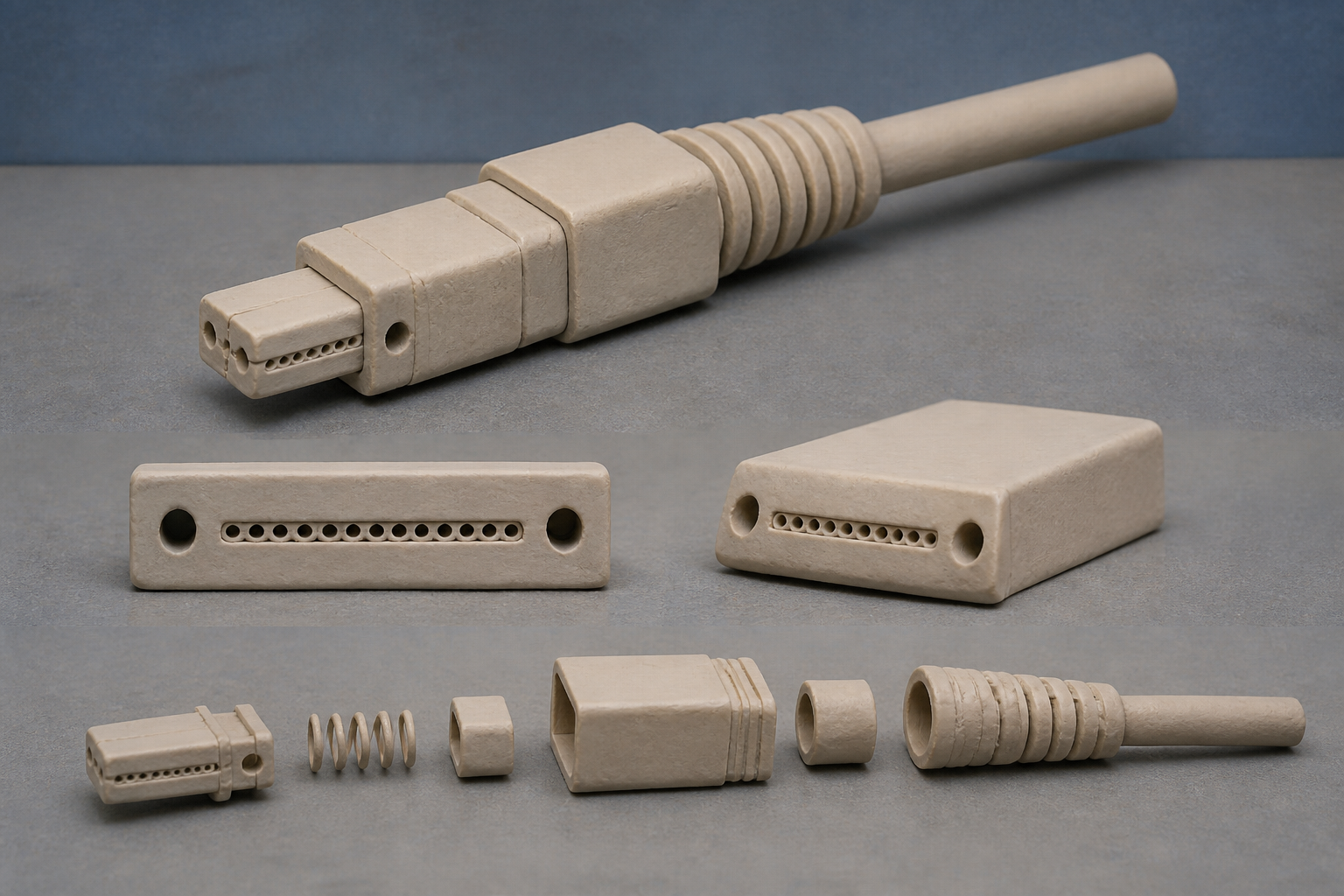
What changes in this design
Fiber connectors are typically assembled by hand-applying a two-part epoxy around each fiber inside the ferrule, then curing it with heat or time before polishing the tip. Getting even heating and consistent bonding across many tightly packed fibers can be tricky, and any unevenness risks distorting the front face where the fibers need to line up precisely.
Here, a thermoplastic adhesive — a plastic that melts when heated and hardens again as it cools — is melted into the fiber channels, and heat is applied in a controlled gradient across the ferrule body so the plastic solidifies from one end toward the other, letting the fibers set firmly while the front end face keeps its exact shape.
Knowing this matters because the front face of a fiber connector has to stay extremely flat and precisely shaped for light to pass between connected fibers without loss. A process built around controlling heat as adhesive hardens speaks directly to that shared challenge of joining many delicate fibers without disturbing the one surface that has to stay perfect.
A Filing From Before The Shortage
On October 31, 2023, months before anyone was talking about an AI-driven fiber shortage, engineers at Corning filed a provisional patent for something that sounds almost mundane: a better way to glue optical fibers into a connector.
The application that grew out of it was filed in April 2026 and published this September as US20260259380A1, titled "Fiber Optic Connector Assembly And Fabrication Method Incorporating Multi-Fiber Ferrule And Thermoplastic Adhesive."
I had to read that title three times before it stopped sounding like a description of caulk.
What A Ferrule Actually Holds
A ferrule is the small block, usually plastic or ceramic, that holds a bundle of stripped optical fibers in exact alignment so that when two cable ends meet, each fiber lines up with its counterpart, core to core.
Corning's method fills the ferrule's internal channels with a thermoplastic adhesive, then runs a controlled thermal gradient across the block so the plastic melts and resets around each fiber, without disturbing the polished front face where the actual optical contact happens.
That face has to stay dimensionally precise to a fraction of a fiber's width, or the light doesn't couple cleanly from one connector into the next.
More Orders Than Corning Can Fill
The reason this filing is surfacing now, rather than sitting quietly in a drawer, is the sudden appetite for exactly this kind of connector.
A single Nvidia Blackwell-generation server rack can need roughly sixteen times more fiber than an ordinary cloud rack, and a full AI data center can need something like thirty-six times more fiber than one built around standard processors.
Corning's own numbers show what that demand looks like from the supply side: its optical communications business brought in $2.07 billion in the second quarter of 2026, up 32 percent from a year earlier, with net income up 77 percent.
Management said plainly that the company could sell more if it could manufacture more. My read of that line is that Corning's problem isn't finding buyers. It's building fast enough.
Betting On Two Fixes At Once
The connectors this patent describes still work the old way, in principle: fiber tips physically touch when two cables mate, so every fiber has to be held exactly in place by the ferrule and whatever's gluing it there.
Corning is also involved, alongside three other connector makers, in a very different approach shown at a conference in Los Angeles in March 2026: an expanded-beam ferrule that uses small lenses instead of polished, touching fiber tips.
That design cuts the force needed to connect two cables by 70 percent and is far less bothered by the kind of dust or debris a factory floor produces.
I don't think that makes this patent worthless. It just means Corning isn't betting the whole company on either fix winning.
An Old Weakness In The Glue
Corning already sells fiber connectors built on adhesive, listed in its own catalog under a "Heat Cure Epoxy-Polish" line: oven-cured resin, then hand polished.
A peer-reviewed study of that older, thermoset epoxy found a real long-term weakness, sometimes called nano-creep: shear stress, thermal stress, and the resin's own cure shrinkage can let a fiber slowly work its way out of position over years of service.
Swapping in a thermoplastic that resets under a controlled thermal gradient, rather than curing once in an oven, is a genuine change, and it may ease some of that drift.
We are, in other words, watching Corning refine the same basic idea it patented a related fix for back in 2022, when a different filing solved multi-fiber alignment by flexing the ferrule body itself rather than improving the glue.
The open question
None of this settles which fiber-termination technology ends up carrying most of the traffic into the next generation of AI data centers, and nobody outside Corning's own roadmap can say for certain either.
What the filing shows is a company covering its own flank: refining the epoxy-and-polish process it already sells at volume, while at the same time backing a contactless alternative that could make that very process beside the point.
Both bets are cheap next to a $2 billion quarter. That gap between the 2023 filing date and the 2026 publication is one I keep turning over, since it means this patent was conceived in a world without an AI fiber shortage and only became newsworthy once one arrived.
Whether glue or lenses end up terminating the fiber feeding the next round of GPU racks isn't something a patent filing can answer. It only tells you Corning wants a claim staked in both camps.
Sources
Reporting for this piece drew on the published filing and the references below.
- US Conec, Corning, Fujikura and Sumitomo announce multi-source framework for expanded beam ferrules
- Corning's Strong Second-Quarter 2026 Financial Results - Investor Relations
- Corning Optical Communications sales jump 32% on AI data center demand - Converge Digest
- How will fiber and equipment vendors meet 2026 AI data center fiber demand - IEEE ComSoc
- Analysis of nano-creep deformation of epoxy adhesive in optical fiber connectors - ScienceDirect
- Fiber Optic Ferrule, MTP - Corning eCatalog
- US12259584B2 - Multi-fiber connector and fabrication method - Google Patents
The record, briefly. US20260259380A1, “Fiber Optic Connector Assembly And Fabrication Method Incorporating Multi-Fiber Ferrule And Thermoplastic Adhesive” Describes a fiber optic connector assembly using thermoplastic adhesive between stripped optical fiber regions and ferrule micro-passages to retain multiple fibers, made by applying a thermal gradient across the ferrule body so molten adhesive solidifies around the fibers without compromising the front end face's dimensional integrity.
More angles on this
- Optical Processing System Questions the Default ArrangementAnother reading from the same G02B classification family, optical elements, systems or apparatus.
- Luminous Laminated Glass Panel Comprising A Functional Coating Questions the Default ArrangementAnother reading from the same G02B classification family, optical elements, systems or apparatus.
- CPC G02B: Optical elements, systems or apparatusThe official classification family this record was filed into, published in the USPTO Cooperative Patent Classification scheme.
- Inside multi-tiered semiconductor waveguideAnother reading from the neighbouring G02F classification family, optical devices or arrangements for the control of light by modification of the optical properties of the media of the.
- Inside road safety system including multiple roadAnother reading from the wider G01W classification family, meteorology.
Read around this one:Public patent recordUSPTO published figure