Field Notes
Liquid in the can, whipped on the way out: a narrow pH band at work
An Italian aerosol specialist repurposes an old whipped-cream can to keep whey in cheese, amid corporate upheaval.

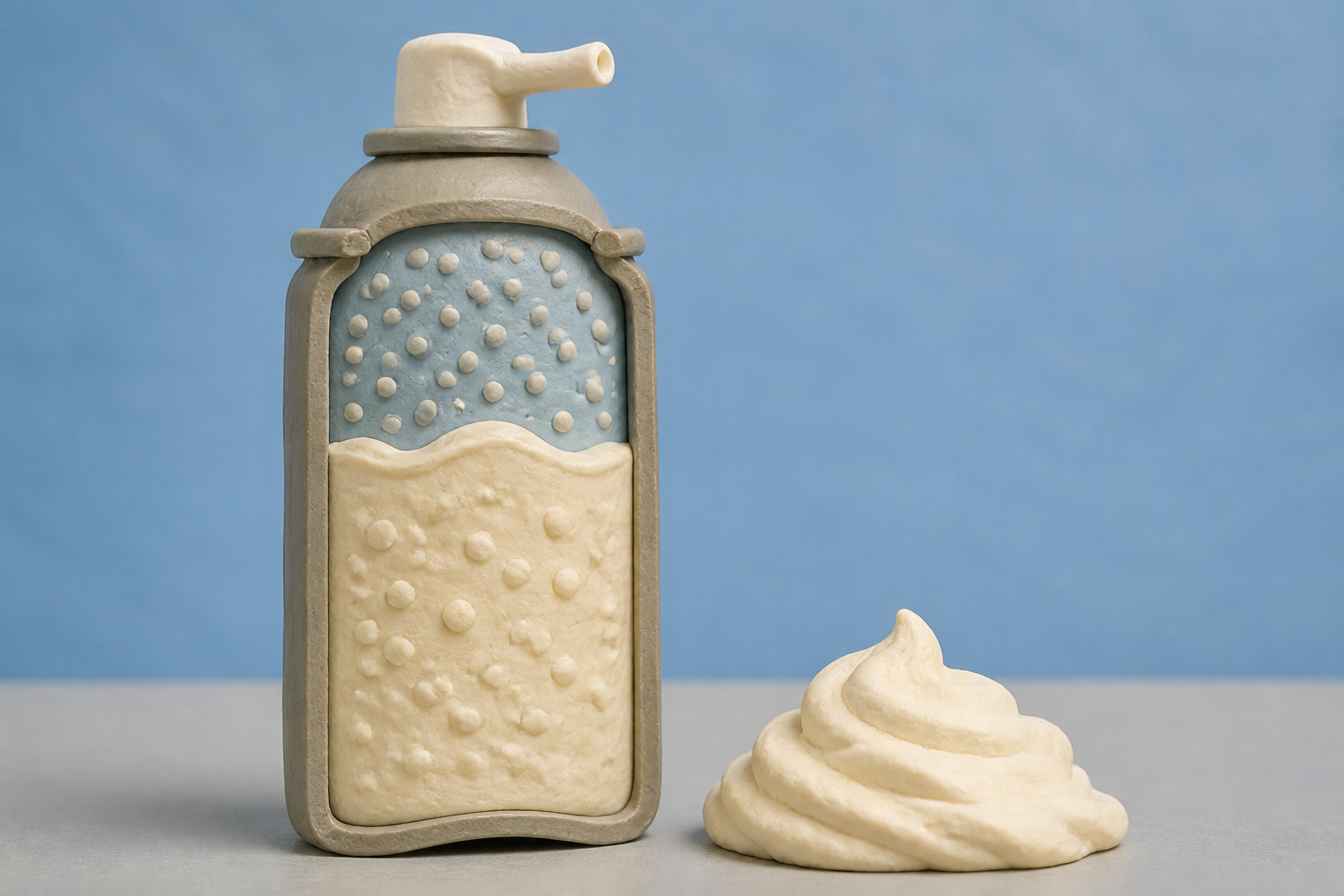
What changes in this design
How fresh cheese is normally packaged or prepared is not stated, so a standard baseline for comparison is not available.
This cheese has an acidified milk-base particle matrix - small milk-base particles in a mixture made more acidic - with 33-47% dry residue, the portion other than water, 53-67% moisture, and pH 4-5.2, a measure of acidity. In a propellant aerosol, it is liquid at room temperature and dispenses as whipped, spreadable cheese with air mixed in.
The practical point is the form change: liquid at room temperature in the propellant aerosol, then whipped and spreadable on dispensing. When used immediately, it is free of syneresis - liquid separation.
Pozzuoli, 1970
In 1970, a food company in Pozzuoli launched Spray Pan, an aerosol whipped-cream brand. The company's own history calls it Europe's first specialist in whipped cream in aerosol packages, founded only two years earlier, and that's why I started there. The can's history is longer than it first appears.
More than half a century later, IFFCO Italia, which traces its history to that company, filed a US patent application using aerosol delivery for fresh cheese. The application was filed on June 27, 2023 and published on September 3, 2026 as US20260256161A1. What drew me was less the novelty of whipped cheese than the old aerosol method being asked to solve a stubborn dairy problem.
The whey left behind
Cheese making leaves whey behind. It is the liquid that separates as curds form, and this filing proposes keeping it in the food rather than discarding it. That is not a small housekeeping detail. A review of whey use puts annual global output at about 115 million tonnes and estimates that 47 percent is disposed of directly into drains.
The waste has a cost beyond volume. The same review reports chemical oxygen demand of 50 to 80 grams per litre and biological oxygen demand of 40 to 60 grams per litre. Those numbers read to me as the scale of a disposal problem, not a side stream we can wave away. The filing points toward a food use for whey, including beta-lactoglobulin and alpha-lactalbumin, rather than stripping those proteins out.
The can and the membrane
Researchers have tried to recover those proteins with ultrafiltration. One study reported recovering 51 to 84 percent of whey protein under its optimized conditions, producing a concentrate that was 45 percent protein. It also said native whey proteins still passed through the membrane. That looks to me like a serious industrial answer built around separation.
IFFCO Italia takes a more direct route, at least on paper. Its application describes acidifying a milk-base particle matrix, leaving out stabilisers and texturisers, keeping the mixture liquid at room temperature in a propellant aerosol, then dispensing an aerated, still, spreadable product. It says the result is free of syneresis, or visible liquid separation, when used immediately. The immediate-use condition is one I take seriously. The claim is about the moment of dispensing, not a promise that the aerated product will sit for a long time afterward. The can, I think, is being asked to do work normally assigned to an ingredient or a membrane.
That makes the propellant more than a detail. Which propellant would be used is something I don't know, and I won't call it nitrous oxide. That distinction matters. Britain reclassified nitrous oxide as a Class C drug in 2023, while exempting legitimate use as a whipped-cream propellant and in food packaging.
Fifty-five percent moisture
That claim does not give the product a free pass to be called cream cheese in the United States. Federal rules cap cream-cheese moisture at 55 percent by weight and require at least 33 percent milkfat. The filing's moisture range is 53 to 67 percent. Any version above 55 percent would sit outside that named standard.
This doesn't, I think, make the filing misleading. Its title calls the product an acid-coagulated spreadable fresh cheese, not cream cheese, and it claims no stabilisers or texturisers. But names matter at the shelf. The wet end of this range may resemble a familiar spread while remaining legally something else in the United States.
What the filing is really betting on
The corporate backdrop makes the September publication feel less abstract. IFFCO Italia's parent, IFFCO Group, was reported in May 2026 to be moving toward provisional liquidation with roughly $2 billion owed to creditors after restructuring talks failed. That report came about four months before this US publication. A patent application is not, in my view, evidence of a rescue, a collapse, or a plan. It only shows that somebody worked on this particular technical claim.
Still, I think the filing makes a clear and modest wager. A company whose history is rooted in aerosol whipped cream is claiming that the can can hold a higher-moisture fresh cheese, retain its whey, and avoid the stabilisers or texturisers earlier whey-retaining attempts needed. Packaging may replace part of the formulation and processing burden. Whether consumers want it, whether it scales, and what it can be called are questions the filing cannot answer.
Sources
Reporting for this piece drew on the published filing and the references below.
- Acid Coagulated Spreadable Fresh Cheese And Relative Production Method
- Acid Coagulated Spreadable Fresh Cheese
- Our story - IFFCO Italia
- Whey Utilization: Sustainable Uses and Environmental Approach
- Use of Ultrafiltration Technology to Concentrate Whey Proteins after White Cheese Manufacturing
- 21 CFR 133.133 - Cream cheese
- Dubai food giant IFFCO Group moves toward liquidation amid $2 billion debt
- Nitrous oxide ban guidance
The record, briefly. US20260256161A1, “Acid Coagulated Spreadable Fresh Cheese And Relative Production Method” An acid-coagulated spreadable fresh cheese has an acidified milk-base particle matrix, 33-47% dry residue, 53-67% moisture, pH 4-5.2, and no stabilisers or texturisers; in a propellant aerosol it is liquid at room temperature and dispenses as an aerated, still, spreadable whipped product free of syneresis when immediately used.
Identity details. The saved title-page transcription needs review, so names are not repeated here. Check the official published title page.
More angles on this
- Method For Producing Fermented Milk Makes the Next Move Easier to SeeAnother reading from the same A23C classification family, dairy products, e.g. milk, butter or cheese; milk or cheese substitutes; preparation thereof.
- The Judgment Space Between Washing and PackagingAnother reading from the same B65D classification family, containers for storage or transport of articles or materials.
- CPC A23C: Dairy products, e.g. milk, butter or cheese; milk or cheese substitutes; preparation thereofThe official classification family this record was filed into, published in the USPTO Cooperative Patent Classification scheme.
- CPC B65D: Containers for storage or transport of articles or materialsThe official classification family this record was filed into, published in the USPTO Cooperative Patent Classification scheme.
- Inside edible coating compositionAnother reading from the neighbouring A23B classification family, preservation of foods, foodstuffs or non-alcoholic beverages; chemical ripening of fruit or vegetables.
Read around this one:Public patent recordUSPTO published figure