Machines
One Cable at the Server Boundary
One patent about a management cable becomes more revealing beside sanctions, renamed server units, and a remote-control flaw.

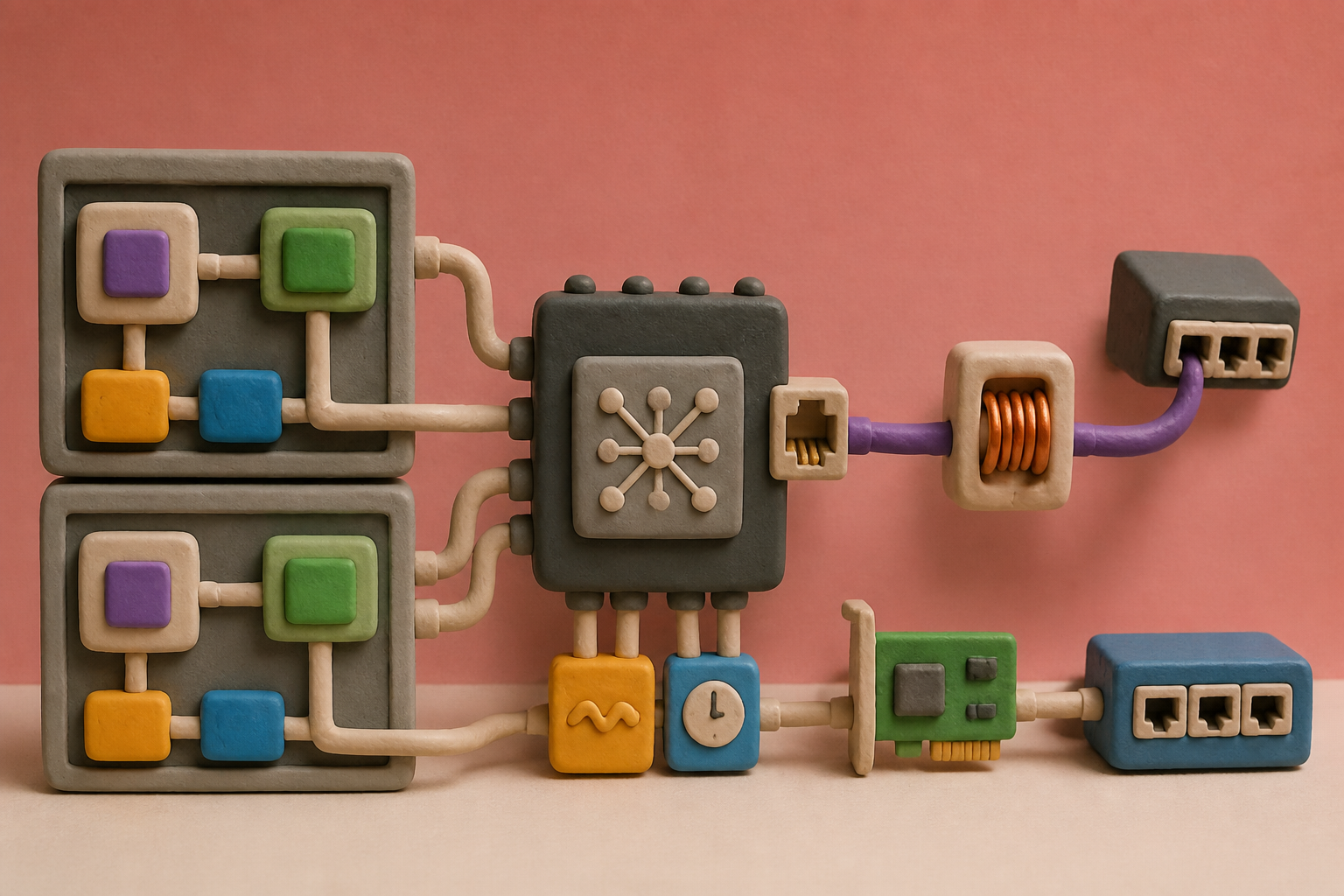
What changes in this design
An exact alternative wiring is not stated. The issue being addressed is a setup with more connection cables and switch ports in use.
Here, the management switch may be connected directly through one cable in a multi-node server system. This can release switch ports.
Fewer connection cables and released ports may improve how the system's hardware resources are used. It may also help reduce operation and maintenance cost.
March 18, 2025
On March 18, 2025, security researchers disclosed CVE-2024-54085, a vulnerability rated 10.0 out of 10 in widely used BMC firmware. Their account was stark: an attacker could bypass authentication, take full remote control of a server, and potentially render it unusable. The report described it as the eighth known flaw in that firmware line since December 2022.
A BMC is the small remote-management controller that can reach a server even when its main operating system is unavailable. It is useful precisely because it can restart, inspect, and recover a distant machine. What caught my attention was how a patent about saving management cables sits beside a subsystem with that much power and such a repeated security history.
One cable, many BMCs
Two years earlier, on March 9, 2023, Suzhou Metabrain Intelligent Technology Co., Ltd. filed the Chinese application that later became US20260254778, published in the United States on August 27, 2026. Its subject is physical rather than cryptographic: the crowded wiring behind a multi-node server.
Conventional designs, the application explains, give each BMC subsystem its own cable into an out-of-band management switch. The proposed arrangement may directly connect the switch with one cable, freeing switch ports, reducing cables, and lowering claimed operations and maintenance costs. That is a modest promise, but a practical one. A 2010 standard called NC-SI already offered another answer to the same problem by allowing a BMC to share an existing network-controller cable rather than consume a dedicated management-switch port. The new filing is one more attempt to make remote management less physically expensive.
Names after the listing
The priority date lands within days of Inspur Group's March 2023 placement on the U.S. Commerce Department Entity List. Suzhou Metabrain is presented as an Inspur-family applicant, which makes the timing hard to ignore even though a patent filing is not proof of a response to sanctions. That timing makes me reluctant to treat a single-cable claim as merely a tidy piece of engineering detached from its corporate setting.
The following years brought a chain of renamed U.S.-linked entities, according to reporting and a 2024 patent suit brought by HPE against Inspur and several related defendants. That complaint alleges infringement involving network-manageability technologies and alleges that renamings helped evade sanctions. Those are allegations, not court findings. In March 2025, the Commerce Department added six specified Inspur affiliates to the Entity List and applied a license-denial policy for covered U.S.-origin items. The notice did not name Suzhou Metabrain. I could not establish from these sources that the patent applicant itself received an Entity List designation.
468 filings, one small claim
This is not a lone experiment. A patent-portfolio database lists 468 U.S. patents or applications for Suzhou Metabrain, including 245 granted and 223 pending, concentrated in server hardware, cooling, power, and bus protocols. It reports 126 filings in 2024, 165 in 2025, and 177 already in 2026. The cable patent belongs to an active effort to claim the unglamorous parts of how servers are assembled and managed.
Scale gives the small claim weight. A March 2026 market report using 2025 figures put worldwide server revenue at $444.1 billion, with a renamed Inspur unit statistically tied for third place globally at 4.1 percent share. I do not treat market share as validation of this design, and a patent application is not proof that a product ships. The market figure gives me a better sense of why reclaimed ports and fewer cables are worth fighting over.
Where the risk actually sits
The filing promises a cleaner route into the management switch. It does not promise a safer BMC, safer firmware, or a smaller remote-control trust boundary. Earlier reporting on MegaRAC vulnerabilities listed Inspur among at least 15 server manufacturers using that BMC firmware. A shared supplier can turn one failure into a problem for many brands at once.
Fewer cables can still be a genuine operational gain. I would rather see that benefit described plainly than inflated into a security achievement. The risk actually sits in the privileged controller, its firmware, its authentication, and the networks allowed to reach it. US20260254778 is evidence that this layer is being engineered for efficiency. The vulnerability history is evidence that efficiency cannot be the only standard by which it is judged. The two records answer different questions: one concerns the physical path through a rack, while the other concerns what can happen when privileged management remains exposed.
Sources
Reporting for this piece drew on the published filing and the references below.
- Out-Of-Band Ethernet Interface Switching Apparatus, Multi-Node Server System And Server Device
- New Critical AMI BMC Vulnerability Enables Remote Server Takeover and Bricking
- Severe AMI MegaRAC flaws impact servers from AMD, ARM, HPE, Dell, others
- US seeks to tighten the entity list net on China's Inspur
- HPE sues China's Inspur Group over server patents
- Additions to the Entity List
- NC-SI
- Worldwide Server Market finished 2025 with all-time record $444 billion revenue
- Suzhou Metabrain Intelligent Technology Co., Ltd. patent portfolio
The record, briefly. US20260254778A1, “Out-Of-Band Ethernet Interface Switching Apparatus, Multi-Node Server System And Server Device” The application provides an out-of-band Ethernet interface switching apparatus, a multi-node server system, and a server device in which the out-of-band management switch may be directly connected via one cable, releasing switch ports, improving hardware resource utilization of the server system, reducing the number of connection cables, and helping reduce operation and maintenance cost.
More angles on this
- When Service Selection Becomes a Matter of OrderAnother reading from the same H04L classification family, transmission of digital information, e.g. telegraphic communication.
- A New Timing Cue at the Device BoundaryAnother reading from the same H04L classification family, transmission of digital information, e.g. telegraphic communication.
- CPC H04L: Transmission of digital information, e.g. telegraphic communicationThe official classification family this record was filed into, published in the USPTO Cooperative Patent Classification scheme.
- Tracking Wireless Monitoring With Reduced Data Loss Questions the Default ArrangementAnother reading from the neighbouring H04W classification family, wireless communication networks.
- A Segment That Cools And A Segment That Carries FlavourAnother reading from the wider H05B classification family, electric heating.
Read around this one:Public patent recordUSPTO published figure