Objects
Simulating Ship Painting on Real Steel Without the Solvent Cloud
Shipbuilders want to train painters without toxic fumes, but the race between smarter spray guns and hull-crawling robots is already underway.

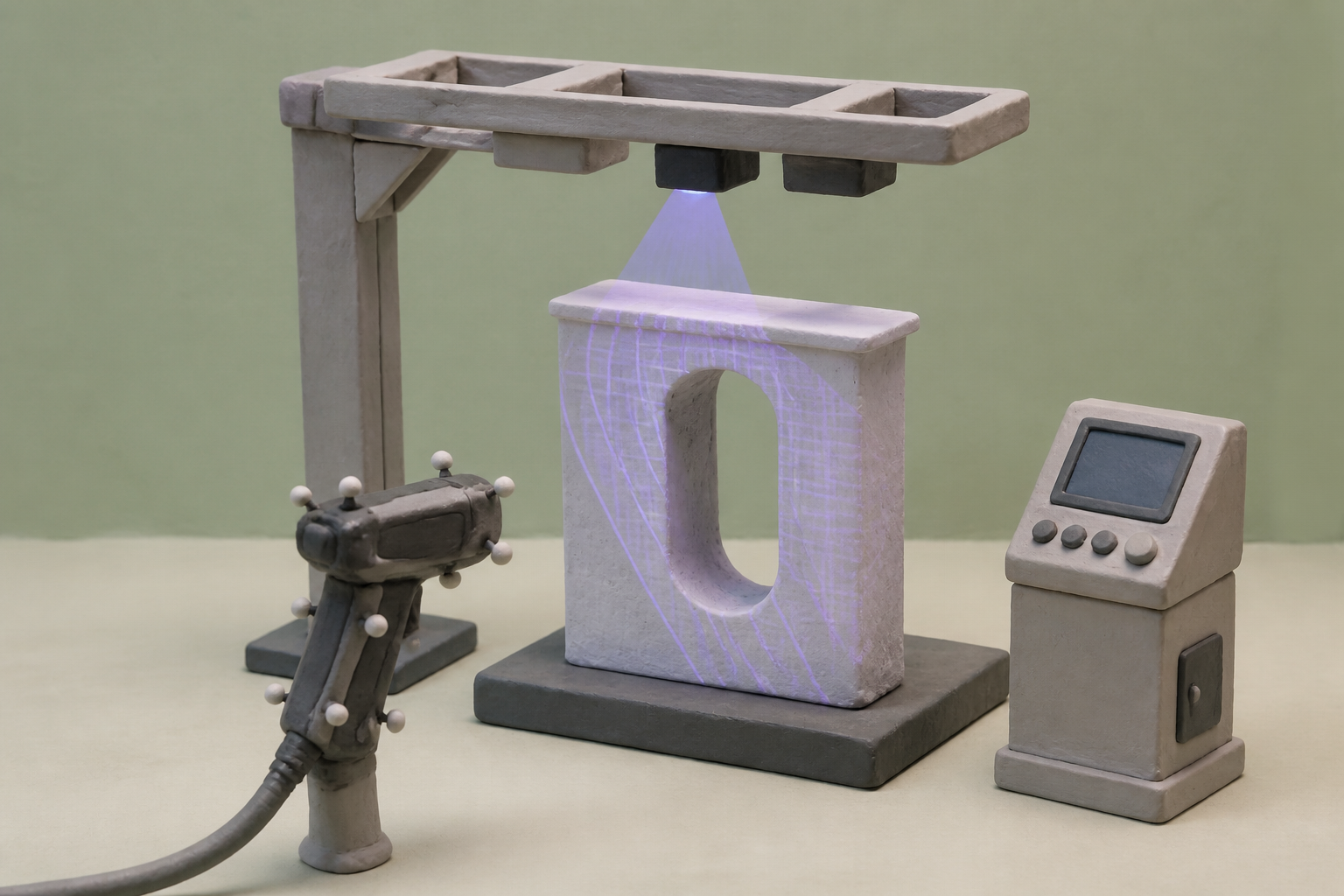
What changes in this design
Simulating a paint job is often handled entirely within a virtual computer environment, or workers must spray real coating onto steel, releasing airborne chemical fumes and using up valuable supplies.
This approach brings the trial run into the physical world by using an actual ship structure alongside a genuine airless spray gun. Special tracking monitors the gun's exact location to measure how paint patterns would distribute.
Testing techniques directly on steel avoids releasing volatile organic compounds into the air. It also spares operators the financial burden of wasted paint and high booth running fees.
Fifteen years inside a dark ballast tank
Marine corrosion costs the shipping industry between $50 billion and $80 billion every year, carving out a hefty chunk of the $2.5 trillion global damage tab. Much of that battle happens in places passengers never see. On December 8, 2006, the International Maritime Organization adopted Resolution MSC.215(82), mandating strict protective coating standards for seawater ballast tanks on every ship of 500 gross tonnage or more. Under these rules, an epoxy barrier inside a steel tank is expected to endure for fifteen target years, backed by a detailed Coating Technical File that tracks every layer from blast profile to cure.
Getting paint onto steel sounds basic until you step into a shipyard. Regulators at the US EPA enforce hazardous air pollutant limits under 40 CFR Part 63 Subpart II, pushing yards to slash hundreds of tons of xylene, toluene, and volatile organic compounds each year. Applicators must maneuver heavy airless spray guns in tight, humid voids without sagging the wet film or leaving dry pinholes. When a coating peels early, failure rarely comes from a bad batch in the can; it comes from rushed prep, ambient moisture, or an unsteady hand losing angle on a stiffener.
Training hands without spraying solvent
Shipyards cannot simply hand an apprentice an airless gun loaded with solvent-borne epoxy and turn them loose in a drydock. Training on live steel burns expensive raw materials, chokes spray booths, and expels hazardous vapors. For years, the sector leaned toward digital alternatives. Commercial virtual-reality rigs proved that trainee painters could build muscle memory up to five times faster while cutting material waste in half, producing zero chemical runoff in the process. A defense painting program in Iowa paired 3D virtual tracking with kinematic analysis to boost transfer efficiency by an average of 28.5 percent.
Yet pure virtual reality comes with a quiet flaw that anyone who has worked with heavy tools understands. A plastic headset and a featherweight controller cannot replicate the drag of a pressurized hose, the kick of a high-pressure trigger, or the physical constraints of climbing through a cramped double bottom. I spent an afternoon comparing these training methods, and the gap between a video display and cold steel felt hard to ignore.
A real gun against actual steel
A recent patent filing, US20260260576A1, proposes an intriguing middle path called an "Eco-Friendly Painting Simulation Device For Ships." Instead of strapping a visor onto a painter and dropping them into computer graphics, the inventors mount a tracking apparatus directly onto an actual ship object. The trainee holds a genuine airless spray gun, moving over real steel structures under shop conditions.
Sensors track the position, distance, speed, and angle of the spray gun in real time. The system calculates how the simulated spray fan hits the steel, logging coverage, overlap, and dry film thickness without releasing a single drop of liquid epoxy or venting any volatile organic compounds. What I find clever about this design is its refusal to abandon physical geometry. Our trade crafts rely on tactile feedback, and practicing on authentic marine steel bridges the muscle memory that pure software models tend to miss.
The crawler on the hull
While training rigs try to polish human technique, another quiet revolution is rolling across the docks. Major shipbuilders like HD Hyundai are pouring engineering resources into robotics to relieve human crews from dangerous, dirty yard work. Magnetic crawler robots now stick to vertical and curved hull plates, blasting steel clean with ultra-high pressure water jets and preparing surfaces with mechanical consistency that no human arm can match across an eight-hour shift.
If we look at the trajectory of shipyard automation, the timing of this simulation filing is telling. It arrives at the exact moment yards are deciding whether to train better manual sprayers or eliminate human spraying altogether. The physical simulation rig bets that human sprayers remain indispensable for convoluted internal compartments where crawlers cannot fit. I suspect that division of labor will define yard operations for years: robots covering the broad exterior hull, while human painters handle the labyrinth inside.
What would have to be true
For this physical simulation device to justify its workshop footprint over pure software setups, shipyards must verify that training on physical mock-ups translates directly into fewer ballast-tank failures over that mandatory fifteen-year lifespan. Yard managers would need to see measurable reductions in rework and Coating Technical File defects that outweigh the cost of maintaining dedicated steel mock-ups and precision sensor rigs.
Finally, the hardware must hold up in dirty shipyard environments where abrasive dust, magnetic interference, and heavy handling quickly destroy delicate tracking optics. If the device can deliver that durability while keeping volatile compounds at zero, it will give human painters a fighting chance against full automation.
Sources
Reporting for this piece drew on the published filing and the references below.
- US20260260576A1 - Eco-Friendly Painting Simulation Device For Ships
- Shipbuilding and Ship Repair (Surface Coating): National Emission Standards for Hazardous Air Pollutants (NESHAP) | US EPA
- IMO PSPC(Performance Standard for Protective Coatings) | ClassNK - English
- SimSpray - VRSim
- STAR4D Certification | Iowa Waste Reduction Center
- The A, B, Seas of Corrosion Management
- HD Hyundai Moving Forward with Humanoid Welding Robot for Shipyards
- VertiDrive - Magnetic crawler blasting and washing solutions
- Surface Preparation and Coatings Panel Meeting – NSRP
The record, briefly. US20260260576A1, “Eco-Friendly Painting Simulation Device For Ships” An eco-friendly painting simulation device for ships performs simulation using an actual ship object rather than a virtual space, utilizes a real airless spray gun, precisely tracks spray gun positions to quantitatively analyze paint patterns, eliminates VOC emissions, and reduces paint and booth operation costs.
More angles on this
- CPC G09B: Educational or demonstration appliancesThe official classification family this record was filed into, published in the USPTO Cooperative Patent Classification scheme.
- Shift Register Unit, Driving Method Thereof, Display Substrate And Display Marks a Pause Worth NoticingAnother reading from the neighbouring G09G classification family, arrangements or circuits for control of indicating devices using static means to present variable information.
- Mapping Acoustic Certainty Over Time in Ultrasound DiagnosticsAnother reading from the wider G06N classification family, computing arrangements based on specific computational models.
- Selective Variable Relocation In Constrained Calculation SystemsAnother reading in the same Objects category on this site.
Read around this one:Public patent recordUSPTO published figure