Objects
Splitting Appliance Control Between Physical Safety and an Operating System
As washing machines turn into connected platforms facing strict update rules, appliance makers are splitting silicon in two to stop internet crashes from breaking hardware.

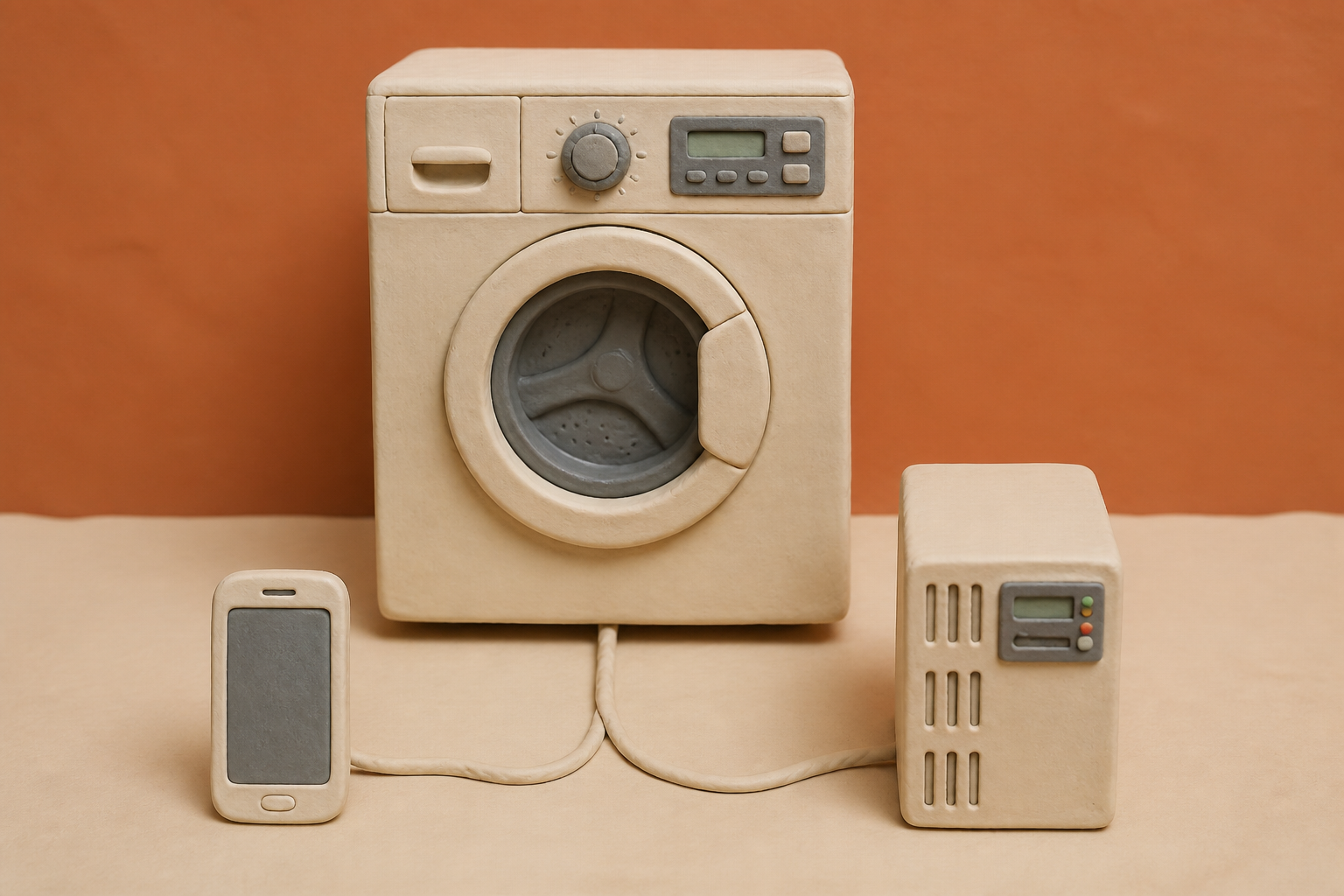
What changes in this design
A reader might expect a household appliance to run all of its computing tasks on a single processing unit, handling software features and basic mechanical functions together in one shared stream.
The record describes a processor with two distinct cores. The first core handles load or safety control directly, while the second core runs an operating system and installs upgrades sent from an external server or phone.
Dividing these responsibilities keeps external software upgrades and operating system tasks isolated from the core circuits that supervise safety and machine loads.
The motor and the modem
A front-loading washing machine spinning at 1,400 revolutions per minute carries enough kinetic energy to cause serious damage if its motor runs wild. When we look back at older machines, safety was largely a matter of mechanical switches and simple microcontrollers. Those dedicated chips had one job: read a temperature sensor, open a water valve, and keep the motor running smoothly. If something failed, the machine shut down.
That simple arrangement is colliding with the internet. Appliance makers are turning refrigerators and washers into connected devices that receive remote software updates, smart diagnostic routines, and new cycle settings from cloud servers. At the same time, regulators are stepping in. The European Union passed the Cyber Resilience Act, requiring connected consumer hardware to support secure over-the-air updates, with mandatory vulnerability reporting starting in September 2026. What we often forget is that a spinning drum carries serious mechanical force, and mixing high-voltage hardware with internet code creates real safety risks.
Dividing the silicon
Under international safety standards like IEC 60730 Class B, home appliance controls must pass continuous hardware self-tests. The chip must constantly check its own registers, verify memory integrity with cyclic redundancy checks, and test internal clocks to prevent runaway heaters or unlocked doors.
On September 3, 2026, LG Electronics published a patent application, US20260259535A1, titled simply "Home Appliance." The filing tackles this clash by reorganizing the central processor into an asymmetric multicore architecture. Instead of running everything on a single operating system or relying on a swarm of separate microcontrollers, the design places two distinct cores on one circuit device. The first core is locked down for real-time load control and safety routines. The second core runs a full operating system dedicated to user features, network communications, and system upgrades received from a mobile phone or an external server. By walling off load control from the operating system, the machine can download and install new software without interrupting the code that prevents the drum from spinning out of control.
Software bridges and safety tests
This approach reflects a broader shift across embedded engineering known as asymmetric multiprocessing. In industrial systems and robotics, engineers frequently use open communication frameworks, such as the OpenAMP standard, to pass messages between a general operating system and an isolated real-time core. Shared memory channels allow the two sides to coordinate without letting the operating system seize direct control of physical actuators.
In my view, bringing this architecture into household white goods shows how complex everyday appliances have become. A washing machine isn't just a collection of relays and timers; it is running the same split-brain computing model found in automated factory equipment. Core one executes its mandatory RAM and CPU checks in silence, while core two talks to the local Wi-Fi network and processes customer settings.
The hidden bottleneck
The hardware divide sounds clean on paper, but consolidating two different worlds onto one chip brings its own headaches. When mixed-criticality workloads share silicon, true physical isolation isn't as simple as a block diagram suggests.
Recent computer architecture research on interrupt management highlights the problem. Even when two processor cores run separate software stacks, they still compete for the same underlying memory buses, caches, and interrupt controllers. If the second core is busy ingesting a large firmware update over the network, that data flood can create microarchitectural traffic jams on the shared bus, delaying time-critical signals on the safety core. I could not find a detailed explanation in the filing for how the circuit device manages that shared bus contention during peak network activity. When internet workloads generate unexpected hardware interrupts, maintaining predictable millisecond timing on motor control requires specialized traffic prioritization that basic multicore chips often lack.
The part worth watching
We are asking household appliances to behave like smartphones without giving up the absolute dependability of an analog thermostat. As the European Union's update rules take effect and manufacturers pursue software-driven business models, the physical separation of safety and network features will become a baseline requirement for consumer white goods.
The real test, in our assessment, will come during edge cases in the home: a dropped Wi-Fi connection midway through a firmware flash, or a corrupted update package delivered while a heating element is running at full power. If the boundary holds, consumers will get updated features without risking a kitchen fire. If the shared hardware leaks delay across the bus, the complexity of connected convenience may end up threatening the basic reliability that household appliances spent half a century perfecting.
Sources
Reporting for this piece drew on the published filing and the references below.
The record, briefly. US20260259535A1, “Home Appliance” A home appliance includes a circuit device with a processor having a first core for load or safety control and a second core configured to control an operating system-based operation mode. The second core performs upgrades based on information from an external server or mobile terminal, separating load control from operation mode control.
More angles on this
- Selective Variable Relocation In Constrained Calculation SystemsAnother reading from the same G05B classification family, control or regulating systems in general.
- Reconciling Sensor Posture and Geometry Before Generating Inspection Text CodeAnother reading from the same G06F classification family, electric digital data processing.
- CPC G05B: Control or regulating systems in generalThe official classification family this record was filed into, published in the USPTO Cooperative Patent Classification scheme.
- CPC G06F: Electric digital data processingThe official classification family this record was filed into, published in the USPTO Cooperative Patent Classification scheme.
- Mapping Acoustic Certainty Over Time in Ultrasound DiagnosticsAnother reading from the neighbouring G06N classification family, computing arrangements based on specific computational models.
Read around this one:Public patent recordUSPTO published figure