Machines
Staying Put Without Pretending Stillness
An oil major's floating wind patent turns out, in its surviving claim, to be about dumping heat into the sea - and that tells you what the portfolio is for.

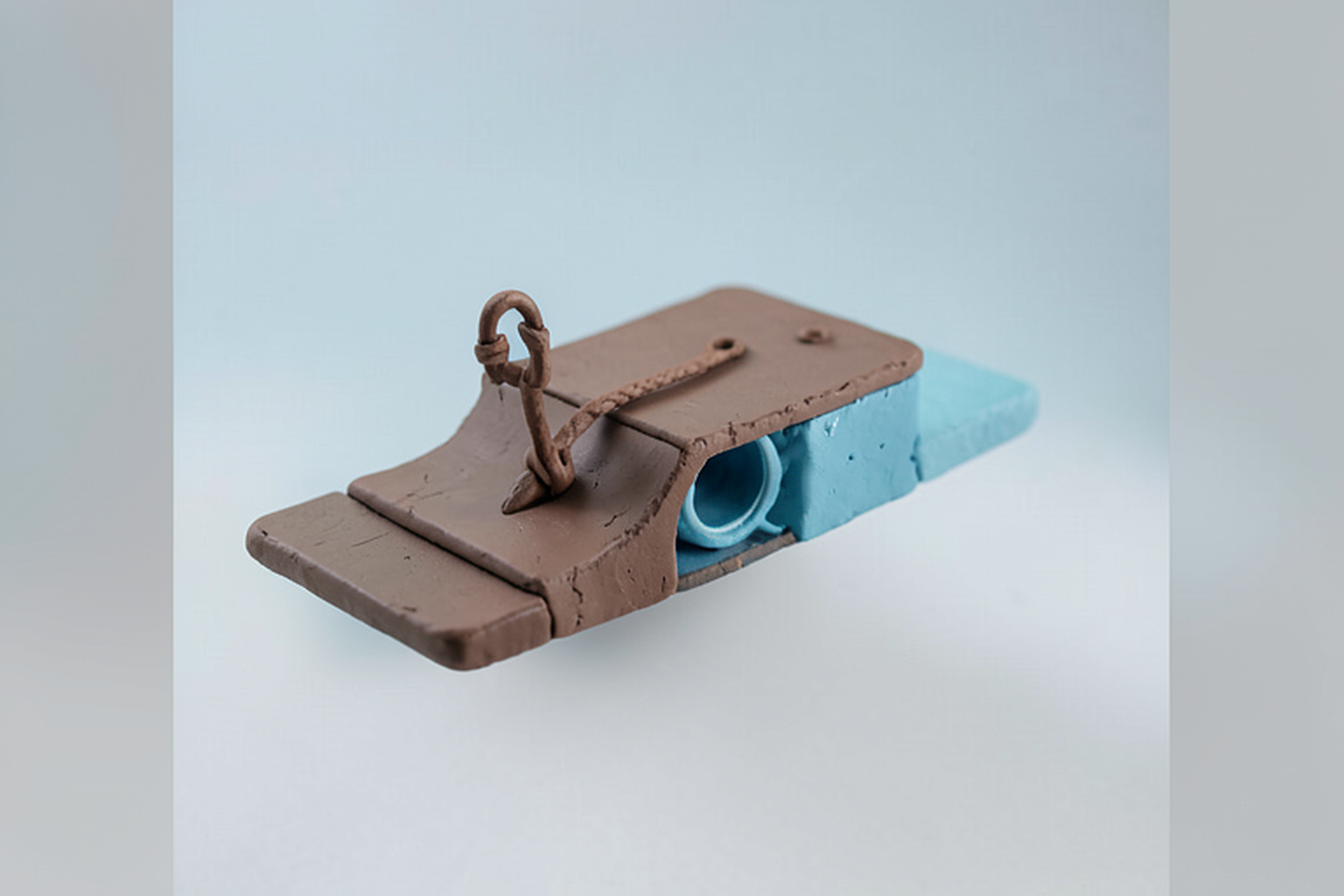
What changes in this design
A reader might assume that keeping a floating offshore structure in place means making the connection to its holding system as rigid as possible and treating all movement as a problem.
Instead, its mooring pieces meet at connections that can turn relative to one another. It also includes a heavy anchor, separately identified structural pieces alongside that anchor, and an air route beneath the main structure that exchanges heat with water below the waterline.
This is worth knowing because it identifies both a way for connected holding pieces to turn and a route where air exchanges heat with water. What effect those features have on operation, or how much they change it, is not stated.
A turbine off Apulia, up in 2007, gone in 2008
In December 2007 a small consortium put the world's first floating wind turbine into 113 metres of water off Apulia. It sat on a tension leg platform, the design oil companies had been using since the first one was mated in the Moray Firth in 1984 for a field called Hutton. That platform had sixteen tension legs and a twenty-five year design life. The turbine off Apulia was decommissioned at the end of 2008. I keep coming back to that pairing, because it tells you what the tension leg platform actually is: a mature, expensive, well-understood piece of oil infrastructure that people have been trying to hand over to wind for nearly twenty years without much to show for it.
What survived the carve-out
So when I read a floating offshore structure application published on 27 August 2026 by Petroliam Nasional Berhad, Malaysia's state oil company, I expected another mooring patent. The summary on the front is exactly that: articulated linkage parts with pin joints, a gravity anchor with interference members. But this is a divisional, split off from a 2023 application that traces back to a Malaysian priority filing of 1 October 2020. And claim 1 of the divisional is not the mooring at all. It is an inlet and an outlet above the water line, joined by an air flow path that dips below the surface and sits, in the filing's words, in heat transfer communication with the water. The hull is a heat exchanger. The stated reason is unwanted heat build-up in equatorial regions.
A wind platform for a country with no wind
The background of the filing names wind turbines and hydrocarbon exploration as applications, and calls tension leg platforms highly capital intensive. That's honest. The wind part is harder to square. Malaysia has 0 GW of installed wind capacity. Its average wind speed is around 1.8 m/s, against roughly 5.8 m/s before a utility-scale machine is worth building; the national renewables roadmap leans on solar and hydro. The market it would serve also got smaller while the family was pending. One offshore wind forecaster cut its 2030 pipeline outside China by 28% in December 2025, with Asia-Pacific cut hardest, and put floating wind at 4.1 GW installed or underway by 2030, of which 0.7 GW was actually operational.
Anchors, standards and a sibling that lapsed
Two more things sit awkwardly. The industry's own reference guide for floating wind lists three anchor types it expects to see - drag embedment, driven pile, suction pile - and gravity anchors are not among them, partly because a tension leg platform pulls vertically and only some of those take multi-directional load. And the design standards, DNV-ST-0119 for the structures and the position mooring standard beneath it, were written around anchors and connectors that already exist. A novel articulated linkage and a deadweight anchor are a real, dateable delay between a granted claim and a certified structure.
There's also a sibling. The same applicant filed an offshore wind turbine application in November 2021, claiming a three-blade rotor on a tension leg platform. Its legal status is ceased, expiring in May 2024, exactly the thirty-month deadline for taking an international application onward. Two floating wind families in thirteen months, and the explicitly wind one is the one nobody paid to keep.
Where the risk actually sits
The divisional was filed in April 2026, while the company was announcing a cut of about 5,000 jobs, after net profit fell 31.7% year on year, and while a state holding most of the country's reserves was in court over the act that created its national mandate. A company in that position keeps very few claim sets alive by accident. What it kept was cooling. Its own three-year outlook doesn't name offshore wind as an activity, but does highlight thermal fluids, including one for data centre cooling.
I don't think this is a wind patent that mentions heat. I think it's a heat patent that had to be filed inside a wind and oil platform, because that's where the 2020 priority date lived. Read it as a plan and it looks weak: no home market, an anchor type outside the guidance, a certification path nobody has walked. Read it as optionality and it's cheap and rational. The only floating wind farm on tension legs that has actually been commissioned is 25 MW off the French Mediterranean coast, and it took nine years from state selection to full commissioning. Against that clock, keeping a claim alive costs almost nothing. The risk isn't that the structure never gets built. It's in reading a portfolio like this as a transition strategy when it's a list of things that might one day be worth money.
Sources
Reporting for this piece drew on the published filing and the references below.
- WO2023090995A1 - An improved offshore wind turbine
- Tension-leg platform
- B.3.1 Anchors - Guide to a Floating Offshore Wind Farm
- DNV-ST-0119 Floating wind turbine structures
- Malaysia renewables strategy downplays wind power
- Offshore Wind Forecast Slashed, but Signs of Recovery Emerge for 2026
- Provence Grand Large: Full Commissioning of the First French Floating Offshore Wind Farm
- PETRONAS to reduce workforce by 10% as part of transformation drive
- PETRONAS Activity Outlook 2026-2028
- More Than a Legal Battle: The Political Stakes of the Petronas-Sarawak Dispute
- US20260249957A1 - Floating Offshore Structure (public record)
The record, briefly. US20260249957A1, “Floating Offshore Structure” The public record describes articulated mooring-linkage parts with pin joints, a gravity anchor with interference members, and a substructure air-flow path that exchanges heat with water below the waterline.
More angles on this
- Why a Deliberately Weaker Signal Can Make a System More HonestAnother reading in the same Machines category on this site.
- The Small Condition in a Memory Core's GeographyAnother reading in the same Machines category on this site.
- A Small Committee Before StressAnother reading in the same Machines category on this site.
- The Doorbell Before the ParcelAnother reading in the same Machines category on this site.
- Editing at the Distance of a FrameAnother reading in the same Machines category on this site.
Read around this one:Public patent recordUSPTO published figure