Machines
Susceptor Arrangement For Induction-Heated Aerosol Delivery Device Marks a Pause Worth Noticing
A new tobacco-heating filing arrives after an import ban and a global truce, while the category's central health question remains unresolved.

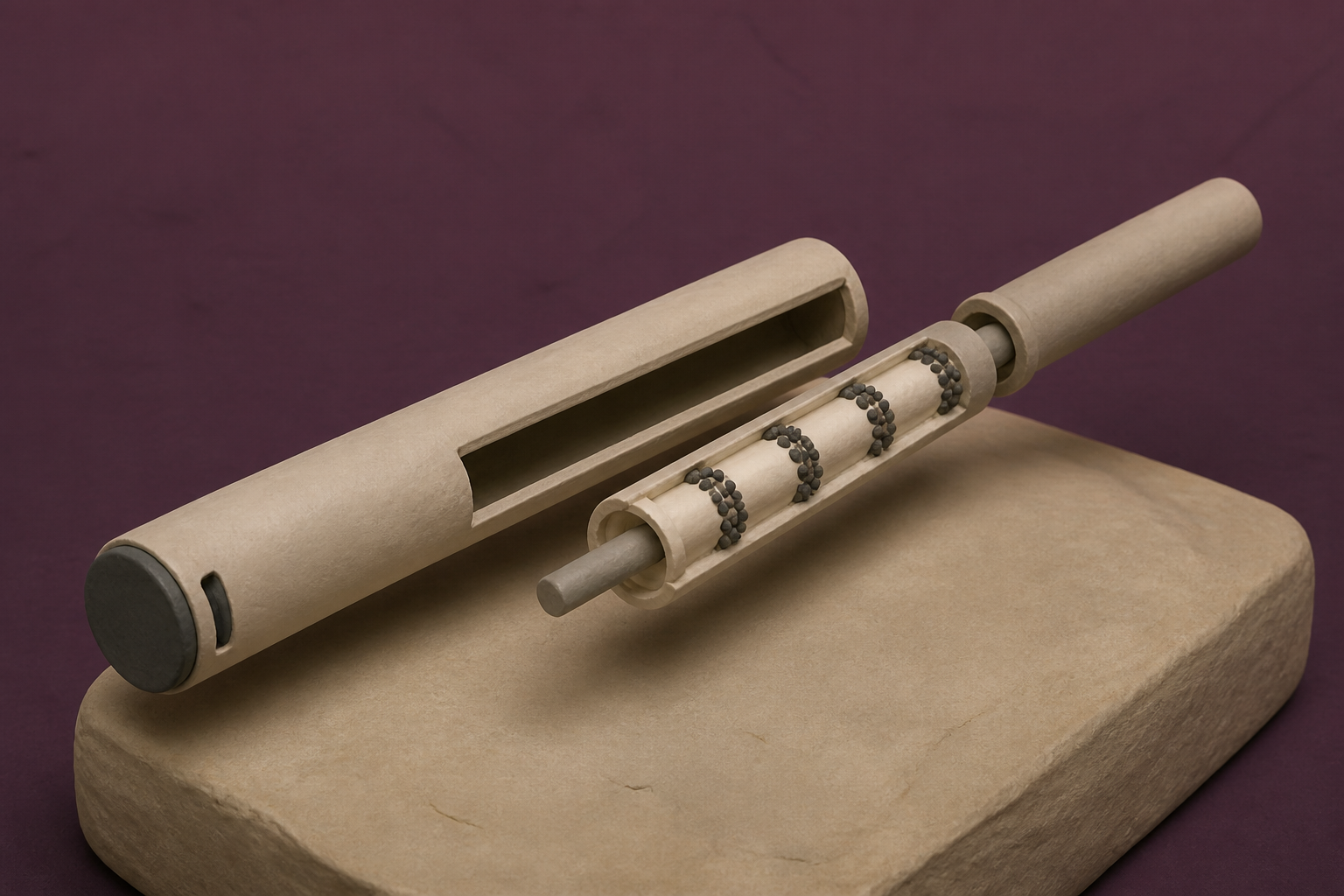
What changes in this design
Without these details, a reader might assume the particles could be positioned anywhere in the source component, because no particular layout would be apparent.
Instead, the source component has a substrate portion with separated bands. Each band contains spaced susceptor particles, and the bands are set either around the lengthwise line or roughly parallel to it.
This detail identifies where the particles sit relative to the source component's lengthwise line. It does not state what output, measurement, or performance follows from that placement.
September 29, 2021
On September 29, 2021, a US trade tribunal issued a limited exclusion order that blocked imports of Philip Morris's IQOS heated-tobacco device into the United States. A new patent filing about small pieces of metal makes sense only after we see the stakes, which is why I start there. A detail inside a heater had become part of a border dispute over a consumer product.
The order followed a six-day hearing in January 2021 and a finding that IQOS infringed three patents held by RAI Strategic Holdings. RAI became a wholly owned British American Tobacco subsidiary in a 2017 deal, valued at $49 billion, that gave BAT full ownership of its US parent. A federal appeals court affirmed the ruling on September 14, 2023. The case isn't a sideshow to this filing, as I see it. It tells us that the way tobacco is heated has already carried real commercial consequences.
A family from 2019
The new publication, US20260255451A1, is titled "Susceptor Arrangement For Induction-Heated Aerosol Delivery Device." The same title turned up on a patent granted to RAI in May 2026 when I looked. The matching title, the family's January 29, 2019 priority date, and its international record make it reasonable, though not certain from these records alone, to read the new publication as another US branch of that family.
That family traveled well before this publication arrived. A PCT application was filed in 2020, and related grants are listed in Europe, Japan, Korea, China, and New Zealand. One family record lists filings in twelve countries. That reach is evidence, I think, of sustained patenting around a product, not proof that the design works better.
Bands around the source
The engineering comes into view only now. The source member described in US20260255451A1 has a substrate portion with spaced susceptor bands. Those bands sit radially around, or substantially parallel to, the member's long axis, and each contains spaced susceptor particles. The arrangement is, as I read it, an attempt to control where induction heating happens inside the source member, but the publication does not turn that design into a promise of better user experience.
The earlier family describes a problem with inconsistent performance in electrically heated aerosol devices and names IQOS and glo as commercial reference points. That background is, I think, the useful translation. The bands are a proposed response to inconsistent performance on paper, not a demonstrated consumer result in the material I reviewed.
48.9 million users
Researchers estimated 48.9 million people worldwide used heated tobacco products in 2024, with a range of 45.6 million to 52.1 million. IQOS was dominant, while glo and other products trailed. In 2021, glo held 15.3% of the global heated-tobacco market, below a 2019 internal target of 25-35% by 2024. That scale is what I keep in view because it explains why this small arrangement of particles sits in a much larger story. It is hardware for a category used by tens of millions of people, not laboratory equipment with no public consequence.
The patent fight did not freeze the category. In February 2024, Philip Morris and British American Tobacco reached a non-monetary global settlement ending their heated-tobacco and vapor patent litigation worldwide. Related injunctions and exclusion orders were lifted. The agreement is, to me, a reset of the contest, not an end to the engineering. This later publication shows that efforts to stake out the hardware continue.
Where this leaves things
A health claim for a pattern of susceptor particles isn't one I can make, and neither should anyone else. A review of 40 clinical trials found results inconclusive across 143 biomarkers; 29 of the 40 trials were industry-funded. That review concluded that the long-term health effects of heated tobacco products, and whether they reduce disease and death, remain unknown. That uncertainty is more important to me than a tidy story about a clever heater.
A 2020 statement from a global health body made the caution sharper: lower chemical exposure in heated-tobacco aerosol does not by itself establish lower health risk, and some toxins may be higher than in cigarette smoke. The US regulator's authorization for IQOS also said the product was not safe and was not approved. This filing belongs in its proper place, I think. It records a determined contest over heat, performance, and market access. It does not tell us the product at the end of that contest is harmless.
Sources
Reporting for this piece drew on the published filing and the references below.
- US20260255451 - Susceptor Arrangement For Induction-Heated Aerosol Delivery Device
- US12628247B2 - Susceptor Arrangement for Induction-Heated Aerosol Delivery Device
- NZ778890B2 - Susceptor arrangement for induction-heated aerosol delivery device
- IL283862B2 - Susceptor arrangement for induction-heated aerosol delivery device
- R.J. Reynolds successfully enforces patents in ITC trial against Philip Morris
- Philip Morris, British American Tobacco announce global patent settlement
- Global Heated Tobacco Product User Estimates, 2014-2024
- As heated tobacco products reenter the US market, evidence on their safety remains sparse
- WHO statement on heated tobacco products and the US FDA decision regarding IQOS
- Reynolds American acquired by British American Tobacco Plc in deal valued at $49 billion
- Heated Tobacco Products: British American Tobacco
The record, briefly. US20260255451A1, “Susceptor Arrangement For Induction-Heated Aerosol Delivery Device” An aerosol delivery device and aerosol source member are provided. The source member includes a substrate portion with spaced susceptor bands arranged radially about or substantially parallel to its longitudinal axis, each band comprising spaced susceptor particles.
Identity details. The saved title-page transcription needs review, so names are not repeated here. Check the official published title page.
More angles on this
- CPC H05B: Electric heating; electric light sources not otherwise provided for; circuit arrangements for electric light sources, in generalThe official classification family this record was filed into, published in the USPTO Cooperative Patent Classification scheme.
- Duo-Pump Liquid Cooling Device Treats the Relationship as the PointAnother reading from the neighbouring H05K classification family, printed circuits.
- Apparatus And Method For Reorder Buffer With Sliding Window In A Treats the Relationship as the PointAnother reading from the wider H04L classification family, transmission of digital information, e.g. telegraphic communication.
- Inside the haptic deviceAnother reading in the same Machines category on this site.
Read around this one:Public patent recordUSPTO published figure