Objects
The Next Choice in a Random Card Order
Start with Device and Method: A device provides sets of cards by distributing cards from N card delivery units to M card storage means.

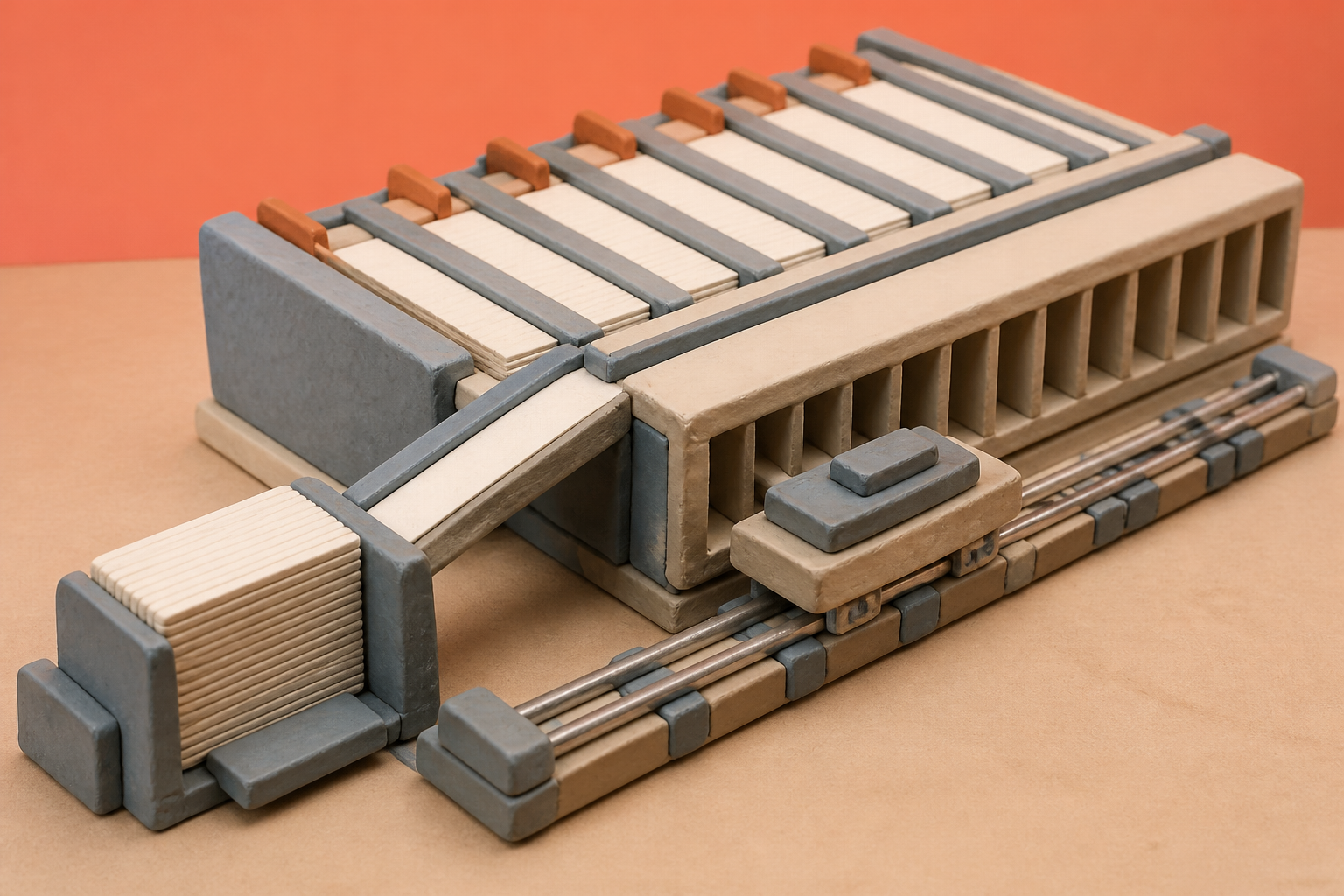
First, the setting
Card games depend on a fresh, unpredictable order of cards. Before a hand begins, players want the deck prepared and ready to deal, without anyone needing to track where particular cards have gone. In busy gaming settings, preparing cards can become a repeating behind-the-scenes task.
At a gaming table or card room, an attendant places used cards into a machine while players wait nearby. Inside, cards slide through narrow paths and settle into separate spaces. A prepared stack later reaches the dealer, who handles it at the table as the next round begins.
What changes in this design
A reader might picture cards being placed by hand, or assigned to predetermined spots. In those cases, the order would follow a person's choices or a fixed placement plan.
Here, equipment receives identified cards and sends them from card delivery units to storage units. Each storage unit has compartments, and a compartment is selected at random while cards are delivered.
The random choice occurs while cards are being placed into compartments. That helps explain that the focus is on how card order is formed during handling. What happens after the cards enter the compartments is not stated.
Delivery, Storage, and Order
When identified cards leave N card delivery units - the places that send them onward - the effect is not simply a copied queue; the next choice is which compartment receives each card. Published on September 3, 2026, US20260257125A1, titled A Method To Provide A Set Of Randomly Ordered Cards, describes M card storage means, meaning M places that hold cards, with P compartments, or separate spaces, in each one. An ordinary picture of distribution would let the sending order settle the destination order, but this arrangement places a fresh decision between those two events.
That fresh decision is what made me look twice. The arrangement is less like a card player preserving a sequence and more like a stage manager assigning quiet places before the curtain rises. You can picture the M collections of P compartments as destinations, while the filing separately names N receiving points - the points from which identified cards are delivered. The important contrast begins there: a destination is not just inherited from the sending sequence.
From that picture, the terms become less forbidding. I found the vocabulary clearer once its parts were named. An identified card is a card treated as known for the delivery step, and sequential steps are actions taken one after another rather than all at once. This is as if a librarian with a clipboard directed each identified card to a shelf space chosen on the spot. Instead of treating the outcome as a guess about where cards will land, the filing describes a defined response: deliver identified cards from receiving points, in sequence, to randomly selected compartments.
Random Selection in Sequence
That is where the small correction hides. The filing describes the provision of card sets by distributing cards from N delivery units to M storage means, each with P compartments; it then locates random compartment selection inside the sequence of deliveries from N receiving points. The sequence has the air of a label-maker pausing between cards, because the placement decision occurs one delivery at a time. In other words, the mechanism puts identification, a receiving point, a randomly selected compartment, and delivery into an order that can be followed rather than guessed.
Order Made by a Choice
Once that coupling comes into focus, the stated purpose - a set of randomly ordered cards - becomes concrete without becoming grander. The order is not described as a property cards bring with them; it follows from where the sequential procedure places them. That difference is worth your attention because it turns a broad impression of randomness into a practical test: identify what stays known, identify what is chosen, and identify when the choice occurs.
That test is the consequence you can use elsewhere, without borrowing anything more from this filing than its discipline of sequence. First, separate the thing a routine recognizes from the destination it chooses; second, separate a final appearance from the step that creates it. When a process looks automatic, ask where its next choice enters and whether the result follows from a defined step or from an ordinary assumption. The answer may be small, but it gives you a way to turn vague order into a question with parts, conditions, and a next decision.
The record, briefly. US20260257125A1, “A Method To Provide A Set Of Randomly Ordered Cards” A device provides sets of cards by distributing cards from N card delivery units to M card storage means, each having P compartments, through sequential steps that deliver identified cards from N receiving points to randomly selected P compartments.
More angles on this
- When a Basketball Court Becomes a MessageAnother reading from the same A63F classification family, card, board, or roulette games.
- CPC A63F: Card, board, or roulette games; indoor games using small moving playing bodies; video games; games not otherwise provided forThe official classification family this record was filed into, published in the USPTO Cooperative Patent Classification scheme.
- A Bat Cavity and the Quiet Work of AlignmentAnother reading from the neighbouring A63B classification family, apparatus for physical training, gymnastics, swimming, climbing, or fencing; ball games; training equipment.
- When a Ramp Turns Containment Into a Checkable SequenceAnother reading from the wider A62C classification family, fire-fighting.
- When Pressure Meets Video, the Quiet Work of AlignmentAnother reading in the same Objects category on this site.
Read around this one:Public patent recordUSPTO published figure