Objects
The Small Condition at a Solar Panel’s Edge
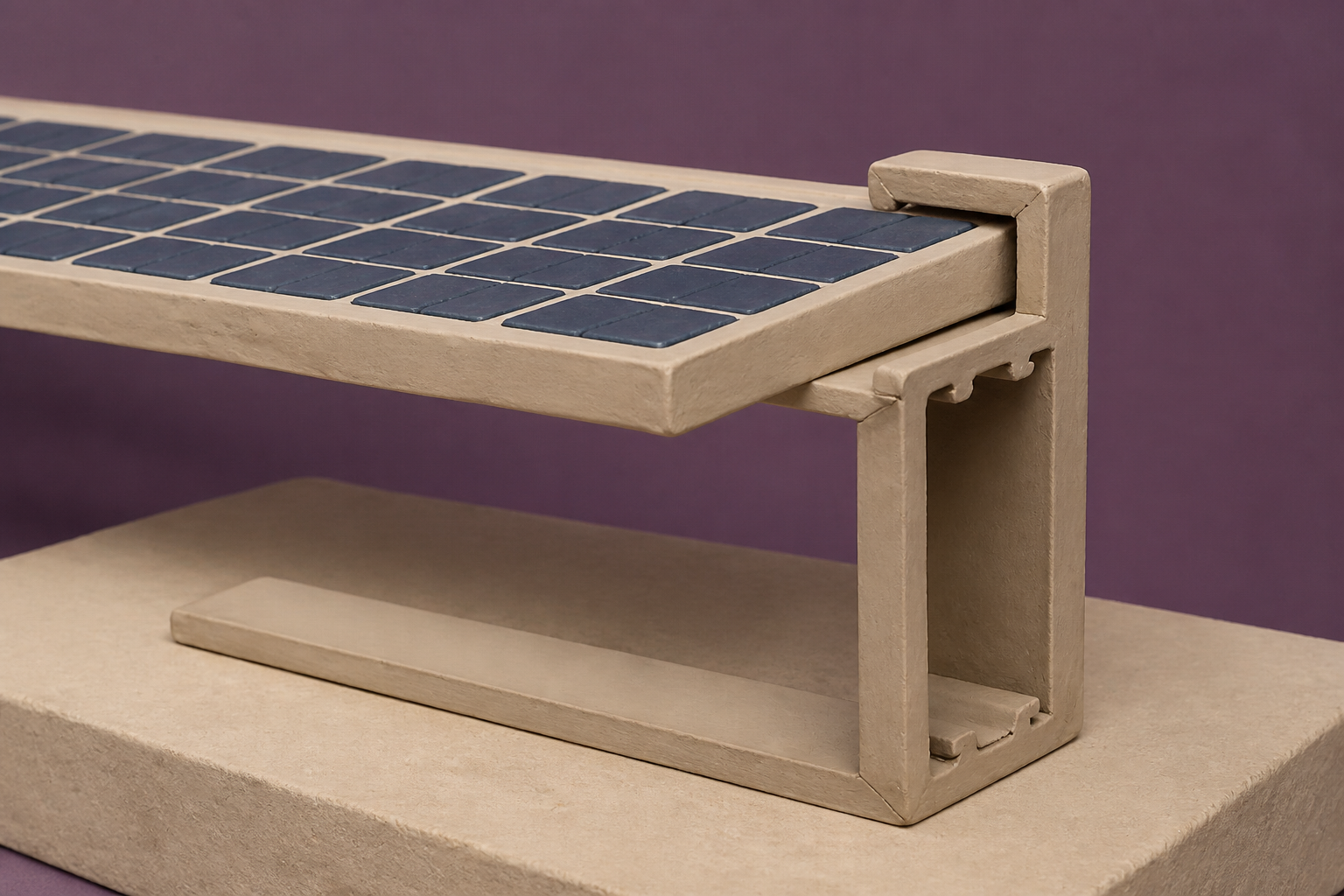
Start with Module and Assembly: A solar module includes a photovoltaic panel and a retaining frame with elongated bodies.

First, the setting
Homes, schools, and workplaces often use rooftop solar equipment to turn sunlight into electricity. The panels sit outdoors through dust, pollen, rain, leaves, and changing weather. People pay attention to how panels are mounted and cared for because they are exposed, hard to reach, and part of the building around them.
A maintenance worker on a roof sees dark glass solar panels held inside metal edges. The panels face the sky while water, dust, and leaves pass over them. Below, people enter a school, park beneath a canopy, or work near a building whose roof quietly carries the equipment.
What changes in this design
Without the frame details, a reader might picture a solar panel as one flat piece. The information provided does not say how frames for such panels are usually made.
This record uses a retaining frame made of elongated bodies. Their cross-sectional segments engage both the photovoltaic panel’s back surface and its side surfaces.
The focus on the panel’s edges helps show what is being presented: a way the frame meets the panel. No cleaning action, measurement, or result is explained.
An Edge Worth Naming
Solar panels are supposed to look simple: broad, flat surfaces that sit there while the rest of us get on with the routine. Not quite. The published record for US20260261235A1, dated September 3, 2026, complicates that ordinary picture with an object many eyes would dismiss as merely an edge. It describes a solar module including a photovoltaic panel and a retaining frame. The minor condition worth naming is the condition of being held at the edge: the panel is not simply near a frame, but met by it at particular surfaces. The edge has the air of a very quiet stage manager: rarely central, yet determined to keep everyone in position. You may never have needed a name for that condition. This filing makes the lack of one noticeable.
That condition becomes clearer once the nouns lose their ceremony. A photovoltaic panel is, in everyday language, a panel associated with turning light into electricity; a retaining frame is the frame that retains its relationship to the panel; and its elongated bodies are simply long pieces of that frame. The filing then gets more exact: each such body has cross-sectional segments. A cross-section is the shape revealed by looking across a piece rather than along its length; here, segments of that shape engage both the panel’s back and side surfaces. Engage is doing modest work: it means the parts are described as meeting those surfaces. The cross-section has the air of a librarian’s small note: it tells the frame that back and side are different places to meet. That distinction is small. It is also the whole invitation to look twice.
Once the back and side arrive separately, the ordinary comparison needs a modest revision. An everyday picture of a frame treats it as a perimeter line: one border, one general task, little need to ask which face is involved. The published record narrows that picture. Its retaining frame has elongated bodies whose cross-sectional segments engage the photovoltaic panel’s back and side surfaces, so the account asks you to attend to two named directions rather than one vague outside. In this description, the frame is less like a border drawn around the panel and more like a polite committee attending to its back and sides. What made me look twice was not the title’s large phrase, Self-Cleaning Solar Panel Assembly, but the modest geometry described with it. I think the detail earns attention because it converts an ordinary outline into a relationship with locations.
Back, Side, and Frame
That revised picture leads directly to the mechanism the filing states. A solar module includes a photovoltaic panel and a retaining frame; the frame has elongated bodies; each elongated body has cross-sectional segments; those segments engage the panel’s back and side surfaces. That is a chain of relations, not an invitation to supply invisible parts. The stated relation is specific: the cross-sectional segments engage a panel’s back and side surfaces. The retaining frame has the air of a courteous usher, making sure the panel’s back and side are both acknowledged before anyone takes a seat. You can borrow one concrete observation from this arrangement: when a main surface meets a boundary piece, ask which surfaces the boundary is meant to meet. A second follows: draw or describe the relationship in directions—back and side—before treating it as a single rim.
Those two questions matter because they prevent a label from swallowing the arrangement beneath it. The title identifies the published record as Self-Cleaning Solar Panel Assembly, while the filing describes a panel, a retaining frame, elongated bodies, and cross-sectional segments that engage the panel’s back and side surfaces. The modest editorial purpose is not to manufacture a cleaning story from the title. It is to notice what the described structure asks you to hold in mind: a broad panel and a frame whose relevant attention reaches to more than one surface. In systems far beyond this page, a boundary deserves more than a single line in a sketch when it must relate to distinct faces. The bounded habit is simple: let named contact surfaces govern the explanation, and let the grander label wait its turn.
Beyond the Generic Edge
That habit brings the named condition back to its proper size. The patent, on these stated facts, gives you a photovoltaic panel, a retaining frame, elongated bodies, and cross-sectional segments engaging back and side surfaces. It gives you a more careful picture of how the frame meets the panel. The transferable lesson is compact: whenever an ordinary object looks like one flat thing plus a border, check whether the border has distinct relations to different faces. A second lesson sits beside it: give the minor condition a name before it disappears into a general word such as edge. You do not need a brass band for a back surface, although this one has earned a small clipboard. Leave the old default—that an edge is only an outline—behind.
The record, briefly. US20260261235A1, “Self-Cleaning Solar Panel Assembly” A solar module includes a photovoltaic panel and a retaining frame with elongated bodies, each having cross-sectional segments for engaging the panel’s back and side surfaces.
More angles on this
- CPC H02S: Generation of electric power by conversion of infrared radiationThe official classification family this record was filed into, published in the USPTO Cooperative Patent Classification scheme.
- Under 55 mm, a Handoff Gets Its PlaceAnother reading from the neighbouring H02K classification family, dynamo-electric machines.
- When an Energy Bin Stops Short and Alignment Starts SpeakingAnother reading from the wider H01M classification family, processes or means, e.g. batteries, for the direct conversion of chemical energy into electrical energy.
- A Port, Two Gloves, and the Quiet Work of AlignmentAnother reading in the same Objects category on this site.
Read around this one:Public patent recordUSPTO published figure