Field Notes
The Small Moment Between Power States
A new medical-equipment switch joins a decades-long effort to make machine status legible when color, sound, and attention all fail.

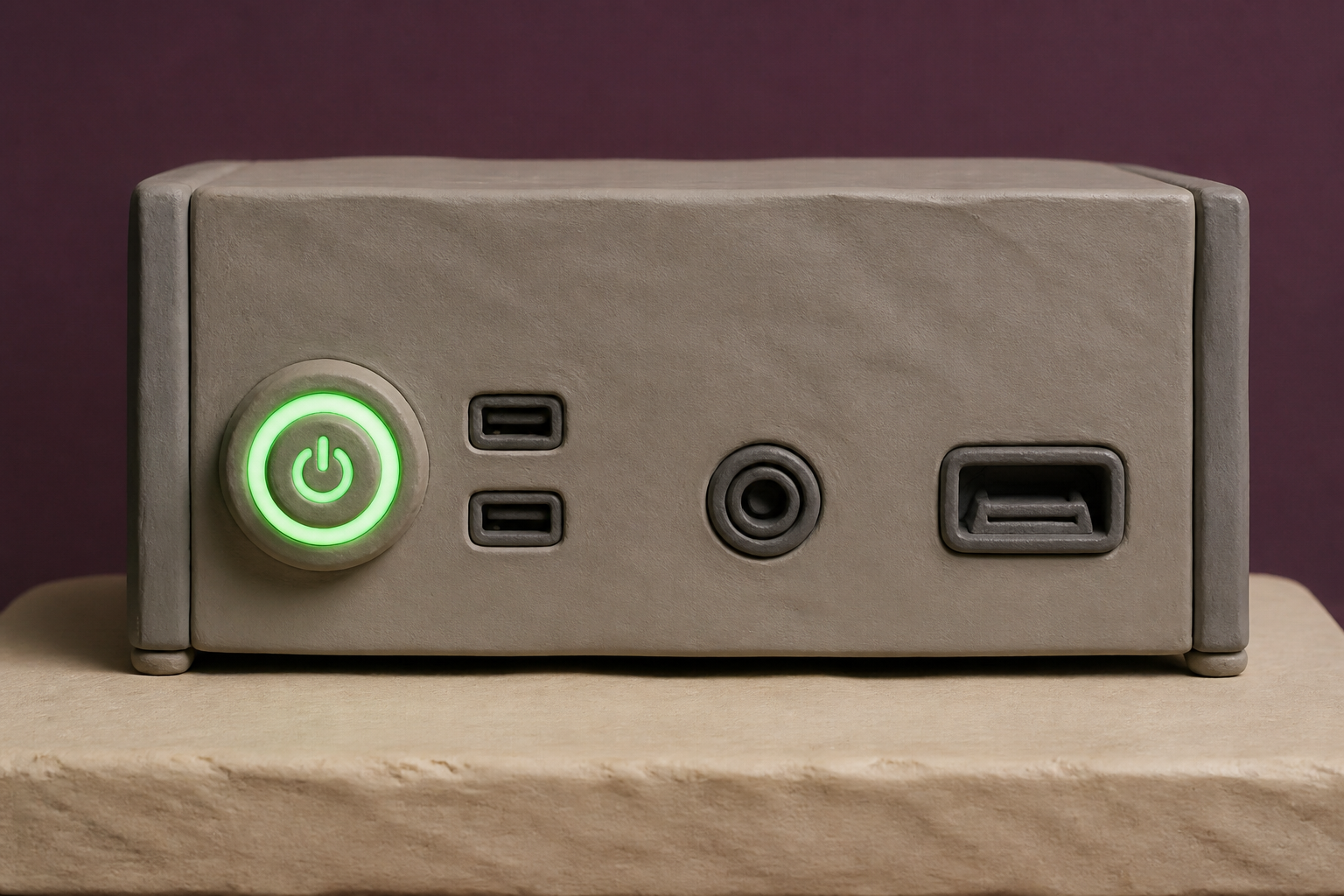
What changes in this design
Someone looking at a regular on-off control might assume it only tells them which choice has been made. That assumption leaves open whether the equipment is operating, waiting in standby, or moving between power states.
This switch is illuminated and can combine text, icons, and color to give context about the equipment's condition. White or green may indicate operation; orange or yellow may mark the time between power-on and power-off; white may also indicate powered-down or standby.
The switch is meant to communicate more than a bare on-off choice. Its light and visual information are intended to provide context about the associated equipment's condition, helping explain the purpose of those visible cues.
A Silent Number on an Anesthesia Unit
In 2025, ECRI ranked dangerously low default alarm limits on anesthesia units sixth on its health technology hazards list. Its investigators had seen numerous cases in which inappropriate defaults let dangerous conditions go unnoticed, sometimes ending in brain damage or death. That is a grim place to begin a story about a lit switch, but it is the right one: medical equipment can work while people misunderstand what it is telling them.
The safety problem is not always a missed alarm. It can be the question asked during a handoff or in a crowded room: is this machine operating, transitioning, powered down, or in standby? I kept returning to the fact that an interface can be visible and still fail to communicate. In medical settings, the difference is not academic.
The Light Beside the Power Button
That question is where US20260256339A1, "Status Indicating Switch For Electrical Equipment, Especially Medical Equipment," enters. The filing describes an illuminated, state-changing switch meant to provide context about the operating state of its associated equipment. It can combine text, icons, and color: white or green for operation, orange or yellow in the interval between power-on and power-off, and white for powered-down or standby.
At first glance, that sounds modest because it is modest: the proposal is not a new anesthesia system or diagnostic algorithm. It is an attempt to put more meaning directly at the point where somebody reaches to control a machine. My hesitation begins with the overlap in the palette. White can be used for operation and for powered-down or standby, so the accompanying text, icon, and surrounding context have to do real work. The filing presents those elements together; I would not assume color alone carries the intended message.
Three Older Answers
This is not the first attempt to turn a control into an explanation. A 2010 circuit-breaker patent added a third indicator because open/closed and charged/discharged signals did not reveal whether a breaker was ready to close. A 2013 snap-switch patent built state indication into the switch, answering a need for separate instruments, remote panels, and AC-only monitoring just to tell whether it was energized.
A 2016 device used one rotating component to distinguish connected, no-fault broken, and short-circuit-fault states. The objects differ from medical equipment, but the recurring design problem is close: many machine states must fit into something people can read quickly. What I found is a crowded history of that basic ambition, not an empty space newly discovered by this application.
That history does not decide whether this filing's specific claims are patentable. I cannot determine that from these documents alone. But it changes the scale of the story: this is a continuing effort to make equipment announce its condition.
The Colors Already Have a Grammar
The filing's colors arrive in a field with a vocabulary. IEC 60073 assigns meanings to indicator-light and actuator colors across electrical equipment, using white as a neutral or fallback choice when another color does not fit. Its editions run from 1955 through 2002. Green, yellow, and white are not blank visual territory.
NKK's illuminated rocker-switch line offers red, amber, and green LED and neon variants for medical equipment among other uses, with UL, CSA, cULus, and VDE certifications listed on its page. That does not make the new filing redundant. It establishes a baseline: colored illumination in a medical-equipment switch is already a certified product category, and compact multi-state indication already has patents.
The relevant question is less "can a light change color?" than "will this exact cue be understood under pressure?" The FDA treats indicator lights, displays, and auditory and visual alarms as interface elements subject to human-factors review. Its guidance names poor lighting, noise, and clutter among the conditions that can create use errors when an interface's demands do not match the user or environment. A switch can be elegant on a bench and still need evidence from the room where it is used.
The harder half of the problem
Medical signaling has a demonstrated problem before a hand reaches the switch. A 2025 study of IEC 60601-1-8 auditory alarms found older sounds correctly identified only 15.3% to 18.6% of the time when two played together. Newer alarms did better, about 46% to 51%, but that is still not reassuring when attention is divided. The old signals' cosine similarity exceeded 0.99, meaning they were nearly indistinguishable.
Those are measurements of tones, not proof that this switch's lights will be misunderstood. Still, they make standardized signaling hard to treat as self-explanatory. ECRI has put alarm fatigue on its annual hazard list essentially throughout the list's history and warned that too many notifications can overwhelm clinicians. More signals are not automatically clearer signals.
The filing's strongest idea may be that status should live with the control. That is sensible, but not a finished safety argument. The harder half is testing whether people can distinguish the states in real lighting and noise, quickly enough to act correctly. Until that is shown, the story is not a switch that changes color. It is a long effort to make machines speak plainly when mistakes are most expensive.
Sources
Reporting for this piece drew on the published filing and the references below.
- US20260256339A1 - Status Indicating Switch For Electrical Equipment, Especially Medical Equipment
- ECRI Update: Top 10 Health Technology Hazards for 2025
- How To Choose The Right Push Button And Pilot Light Colours
- Illuminated Rocker Switches
- Human Factors Considerations
- Evaluation of the Characteristics and Machine Learning-Based Identification Accuracy of the IEC 60601-1-8 Medical Equipment Auditory Alarms
- Alarm Fatigue Fifth on List of Top 10 Medical Device Hazards
The record, briefly. US20260256339A1, “Status Indicating Switch For Electrical Equipment, Especially Medical Equipment” An exemplary aspect concerns an illuminated, state-changing status switch that provides context about an associated equipment item's operational state. The switch may use text, icons, and colors: white or green for operation, orange or yellow between power-on and power-off, and white for powered-down or standby.
More angles on this
- Tracking Wireless Monitoring With Reduced Data Loss Questions the Default ArrangementAnother reading from the same A61B classification family, diagnosis; surgery; identification.
- System And Method For Emergency Dispatch Questions the Default ArrangementAnother reading from the same A61B classification family, diagnosis; surgery; identification.
- CPC A61B: Diagnosis; surgery; identificationThe official classification family this record was filed into, published in the USPTO Cooperative Patent Classification scheme.
- The Light Loop Inside an Oral-Care RoutineAnother reading from the neighbouring A61C classification family, dentistry; apparatus or methods for oral or dental hygiene.
- A Mixer Gets a Standing AssignmentAnother reading from the wider A47J classification family, kitchen equipment; coffee mills; spice mills; apparatus for making beverages.
Read around this one:Public patent recordUSPTO published figure