Objects
When a Core's Corner Changes Direction
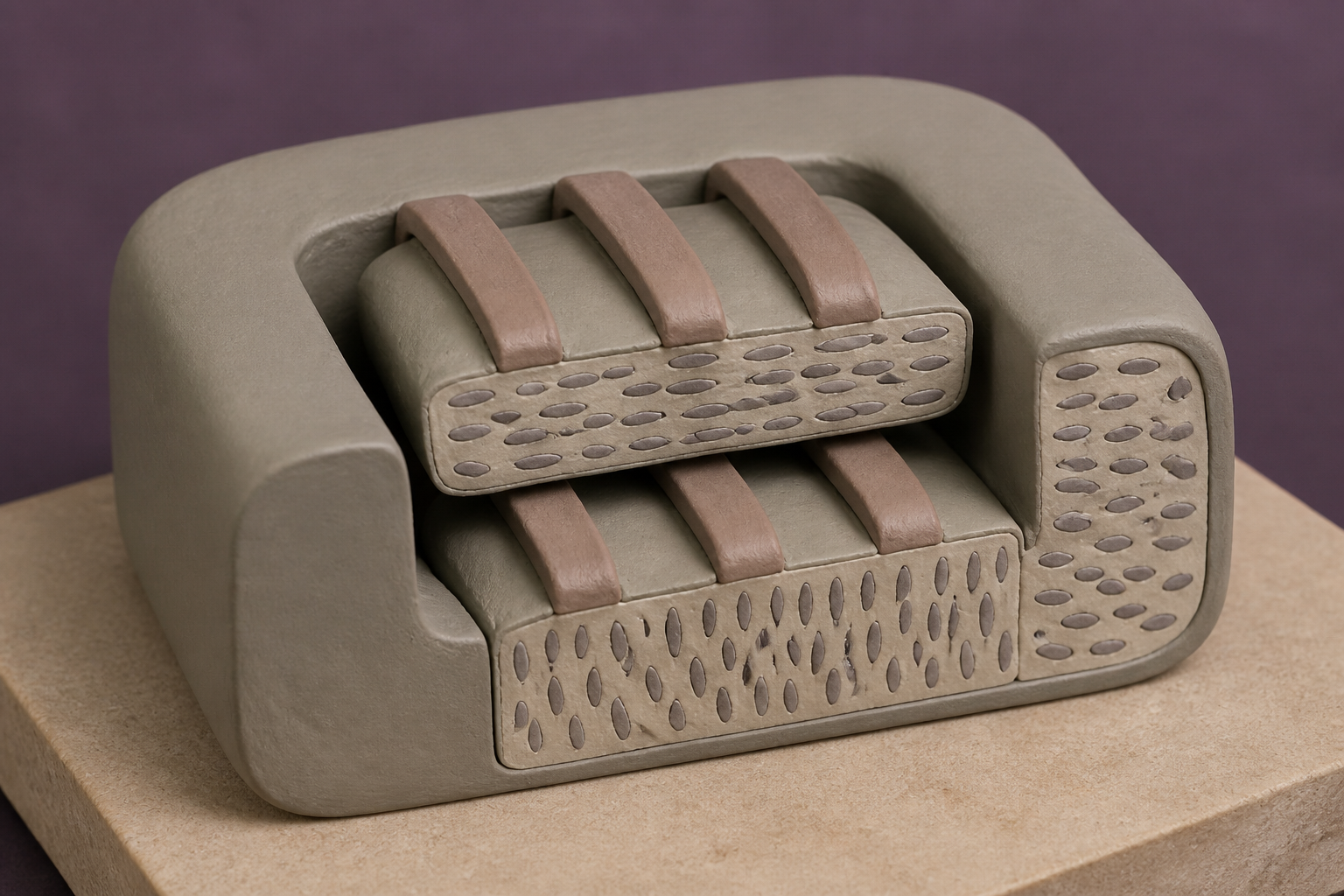
Follow Device alongside Key detail: A magnetic-core component molded from soft magnetic powder dispersed in resin has first and second core parts extending orthogonally.

First, the setting
Electric vehicles depend on electricity being managed carefully as a driver starts, accelerates, slows, and charges. People expect the vehicle to respond smoothly while its electrical equipment operates out of sight. That work involves guiding electric energy between the battery, motor, and other onboard systems.
A driver presses the accelerator and the vehicle moves quietly through traffic. Inside a protected compartment, power electronics handle changing electrical energy, with magnetic components - compact materials that guide magnetic fields - helping direct those changes. Passengers may only notice the motion, sound, cabin comfort, and charging routine.
What changes in this design
A reader might expect a molded magnetic core to have material arranged the same way throughout, even where its shape turns a corner.
This record specifies two core sections that extend at right angles. In at least one section, the orientation, or facing direction, of the soft magnetic powder differs.
The point to notice is not just the corner in the core. It is also the change in the direction of powder particles within its sections.
Right Angles Inside the Core
When the first and second parts of a magnetic core extend at right angles, the ordinary assumption is that the material within them should face the same way. The published record for US20260260795A1 complicates that default. The September 3, 2026 publication is titled Core Piece, Reactor, Converter And Power Conversion Device, but the detail that made me pause stays close to the core: a component molded from soft magnetic powder dispersed in resin. A magnetic core is the shaped magnetic component under discussion, while resin is the binding material around the powder. The core has first and second parts extending orthogonally, meaning at right angles rather than along a shared direction. The filing then states that powder orientation differs in at least one part. The arrangement is less like one material receiving a universal memo and more like two neighbors agreeing on where the corner is.
That final condition is what made me look twice, because orientation here means the direction in which the powder is arranged inside a core part. Direction is not merely scenery. First and second core parts are still part of one molded component, yet the stated orientation differs in at least one part instead of being presented as the same throughout. The material choice arrives as if a restrained committee had asked each direction to keep its own name tag. You do not need a story about the surrounding reactor, converter, or power conversion device to notice the shift in emphasis. The published record supplies a core arrangement, and that arrangement places the difference inside the two-part geometry. That is a small correction to the ordinary picture, but it is a real correction.
From that geometry, the question becomes narrower and more useful: what follows when an ordinary choice - keeping a material arrangement uniform - is not carried unchanged across a corner? The stated facts contain no performance score, and none needs to be invented. They give a structural sequence: soft magnetic powder dispersed in resin; a molded magnetic core; first and second core parts extending orthogonally; and powder orientation differing in at least one part. The sequence is the mechanism available for attention here, because it tells you where the condition sits without asking you to pretend that more is known. First comes the shared material mixture, then the shaped core, then the right-angle relation, then the orientation difference. That order keeps a reader from turning a material detail into an unsupported promise.
Orientation Changes at the Corner
That sequence leads to the mechanism without making it mystical. Molded means formed into a shape, and dispersed means distributed through the resin; those plain terms establish the setting before the different orientations enter it. The filing describes first and second parts extending orthogonally while their powder orientation differs in at least one part. A right angle is therefore more than a drawing convenience in this description. It is the place where the stated arrangement stops treating direction as automatically identical. That modest difference has the air of a careful librarian placing two related volumes on different shelves. The comparison stays deliberately small: no result beyond the described arrangement is required for the corner to become worth your attention.
Once that distinction is visible, the contrast with the broad default becomes a modest, specific revision rather than an anthem about superiority. The broad default is only a mental shortcut: one body, one material direction, one instruction carried through it. This filing keeps the one molded component, but it sets a boundary inside it at the right-angled parts and states a powder-orientation difference in at least one part. The point is not that every core must behave this way; the point is that the ordinary assumption has been made conditional by the geometry described here. This is why I think the after-effect deserves attention: a choice that looks ordinary at the level of material can become conditional at the level of form. When you examine any designed system, first ask whether a change in the relationship between parts also changes the arrangement assumed inside them. Then ask a second, more concrete question: are you treating the shared substance and its local orientation as the same decision when they are actually two decisions? The patent supplies no general answer beyond its core, yet it offers a disciplined way to notice the question.
One Molded Core, Two Directions
Those two questions bring the thread back to you and to the small choice that started it. The patent's described chain remains bounded: soft magnetic powder dispersed in resin, one molded magnetic core, first and second core parts at right angles, and powder orientation differing in at least one part. Nothing further needs to be promised for the chain to matter as an editorial prompt. The ordinary default says sameness should travel smoothly through a shared component. The published record puts a corner in that sentence. Let the old default explain why every direction must match.
The record, briefly. US20260260795A1, “Core Piece, Reactor, Converter And Power Conversion Device” A magnetic-core component molded from soft magnetic powder dispersed in resin has first and second core parts extending orthogonally, with powder orientation differing in at least one part.
More angles on this
- Inside electric vehicle adapter inspection deviceAnother reading from the same B60L classification family, propulsion of electrically-propelled vehicles.
- CPC H01F: Magnets; inductances; transformers; selection of materials for their magnetic propertiesThe official classification family this record was filed into, published in the USPTO Cooperative Patent Classification scheme.
- CPC B60L: Propulsion of electrically-propelled vehiclesThe official classification family this record was filed into, published in the USPTO Cooperative Patent Classification scheme.
- Holding the Mechanical Line on a Hair-Thin WireAnother reading from the neighbouring H01B classification family, cables; conductors; insulators; selection of materials for their conductive, insulating or dielectric properties.
- Selective Variable Relocation In Constrained Calculation SystemsAnother reading from the wider B25J classification family, manipulators; chambers provided with manipulation devices.
Read around this one:Public patent recordUSPTO published figure