Machines
When a Fluid Volume Becomes the Signal
A once-lost liquid-crystal effect is attracting money and patents again, but its history suggests that a dramatic property is not yet a market.

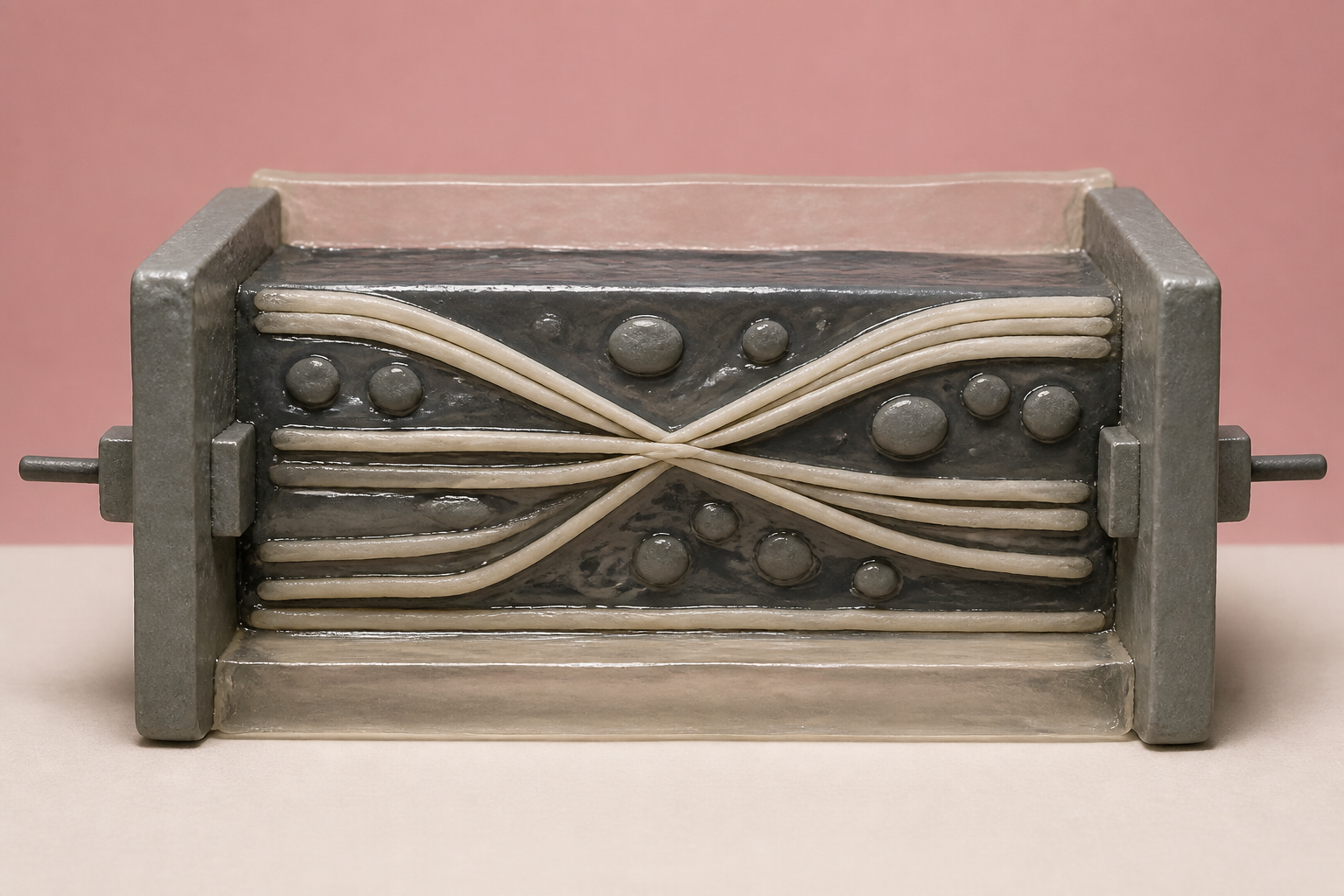
What changes in this design
No ordinary approach is set out. The record does not identify a prior device, a usual material, or the job such a device normally performs.
This record focuses on a device containing a volume of ferroelectric smectic A liquid-crystal-forming fluid. Example devices include surfaces and electrodes for applying an electric field to that volume.
It is worth knowing that the focus includes more than the fluid itself: it also includes devices and ways of forming and using them. The intended practical result of applying the field is not stated.
A 15-inch warning
In 1993, Canon sold the first commercial ferroelectric liquid-crystal display: a 15-inch monochrome screen priced at about £2,000. The underlying switching effect had been identified in 1975 and proposed for displays in 1980. A color panel had already been shown in 1985. Yet the technology never became the large, direct-view display successor its speed seemed to promise. The timeline matters because technical maturity arrived in stages, while commercial dominance never followed from the headline performance alone.
Instead, ferroelectric liquid crystals settled into smaller roles, notably liquid-crystal-on-silicon microdisplays with pixel pitches as fine as 6 micrometers. That history is the right starting point for a new patent around a related phase. A striking physical response can be real, useful, and still fail to dictate the device that eventually wins. The difference between a large panel and a microdisplay is also a reminder that the same material can find value after the market it was first expected to transform has moved on.
An effect takes a century
The new family of liquid crystals begins with an old idea. Peter Debye and Max Born proposed polar order in liquids in the 1910s, but the relevant ferroelectric nematic phase was not reported until 2020, when a Boulder team found it in a compound called RM734. Its response to electric fields was reported as 100 to 1,000 times stronger than ordinary nematics. That long interval makes the 2020 report more than a routine materials result: it turned a theoretical possibility into a phase that could be measured and investigated for devices.
Two years later, researchers from that group, Merck KGaA, and a German university reported the ferroelectric smectic A phase, usually written SmA_F. Their paper measured a longitudinal molecular dipole of about 10 Debye and a coercive field near 2 × 10^5 V/m for reversing the polarization. For me, the important detail is not that the phase has a formidable name. It is that a century-old proposition had finally become something engineers could put between electrodes. The measurements give that idea a practical frame: polarization can be addressed, reversed, and considered as part of a working structure rather than only as a property on paper.
Thirty thousand, then doubt
Young materials fields often acquire a signature number before anyone agrees what it means. In ferroelectric liquid crystals, widely repeated reports put dielectric constants as high as roughly 30,000. A separate dielectric-spectroscopy paper argued that those giant values largely come from nanoscale insulating layers at the interfaces of test cells, rather than from the liquid crystal's intrinsic bulk behavior. If that account is right, the eye-catching value says as much about the test cell as it does about the fluid placed inside it.
I don't think that critique makes these phases a dead end. It does make the usual shorthand less trustworthy. The authors say the concern applies broadly across ferroelectric liquid-crystal systems, including chiral smectic C. That uncertainty is where I start judging applications: not by the biggest reported electrical number, but by whether a device keeps an advantage once its electrodes, interfaces, switching, and manufacturing are all part of the experiment. In other words, the interface is not a detail to subtract away if it is part of the device a company would actually have to build.
One fluid, several bets
The range of proposed uses is unusually wide. In 2022, Merck KGaA offered prizes for application ideas spanning energy harvesting, actuators, sensors, capacitors, haptics, and memory. It has also made room-temperature-stable reference ferroelectric-nematic materials. That is evidence of a phase family still looking for its defining product, rather than one marching toward a settled destination. The breadth is exciting, but it also means that success in one category would not automatically answer the engineering questions in the others.
One Boulder-linked spinout, Polaris Electro-Optics, is pursuing photonic modulators. It reported a 102 Gbps PAM-4 silicon photonic modulator in 2024, and its disclosed funding milestones were a $3 million seed round, a $10 million Series A, and a $50 million Series B announcement. Elsewhere, a research group in Tokyo used ferroelectric liquid-crystal fluid to raise a liquid column more than 80 mm at 28 V/mm, reporting stress above 1,000 N/m². I find that spread more revealing than any single result. Displays, optics, and motion may share a material response while demanding entirely different ways to package and control it. A photonic modulator and a raised liquid column point toward different products even when both begin with field-responsive fluid.
Where this leaves things
US20260259458A1 enters this unsettled contest with devices containing a volume of ferroelectric smectic A liquid-crystal-forming fluid. The published application describes surfaces and electrodes for applying an electric field to that volume, alongside methods for forming and using such devices. Its title, “Ferroelectric Smectic A Phase Materials, Devices Including The Materials, And Methods Of Forming And Using Same,” is broad enough to matter if one of those routes becomes commercially important. The application is therefore directed not just to the material phase, but to arrangements for making its response available in a device.
The filing does not settle which route that will be. I cannot tell from the published record whether its disclosed device arrangements will prove better suited to optics, displays, actuation, or another use entirely. What it does show is that the effort has moved beyond discovery into claims over how the effect might be made useful. After the earlier ferroelectric-display boom, I would treat that as a stake in a race, not proof that the race has been won. The patent's breadth may give it relevance across several possible destinations, but the commercial destination remains the part the record cannot yet identify.
Sources
Reporting for this piece drew on the published filing and the references below.
- Ferroelectric liquid crystal display
- After a century of searching, scientists find new liquid phase
- Observation of a uniaxial ferroelectric smectic A phase
- Polaris Electro-Optics Inc. - Venture Partners at CU Boulder
- Dielectric spectroscopy of ferroelectric nematic liquid crystals
- Turning polarization into motion: Ferroelectric fluids redefine electrostatic actuators
- Liquid crystal phases
- Ferroelectric Nematics Challenge
- US20260259458A1: Ferroelectric Smectic A Phase Materials, Devices Including The Materials, And Methods Of Forming And Using Same
The record, briefly. US20260259458A1, “Ferroelectric Smectic A Phase Materials, Devices Including The Materials, And Methods Of Forming And Using Same” Devices having a volume of ferroelectric smectic A liquid crystal-forming fluid are disclosed, along with methods of forming and using them; exemplary devices include surfaces and electrodes for applying an electric field to the volume.
More angles on this
- Manufacturing Method Of Electronic Device Treats the Relationship as the PointAnother reading from the same G02F classification family, optical devices or arrangements for the control of light by modification of the optical properties of the media of the.
- When Angled Light Takes the HandoffAnother reading from the same G02F classification family, optical devices or arrangements for the control of light by modification of the optical properties of the media of the.
- CPC G02F: Optical devices or arrangements for the control of light by modification of the optical properties of the media of the elementsThe official classification family this record was filed into, published in the USPTO Cooperative Patent Classification scheme.
- When Vision Correction Stops Being a Separate ErrandAnother reading from the neighbouring G02B classification family, optical elements, systems or apparatus.
- Inside road safety system including multiple roadAnother reading from the wider G01W classification family, meteorology.
Read around this one:Public patent recordUSPTO published figure