Objects
When a Game View Carries Its Own Sense of Motion
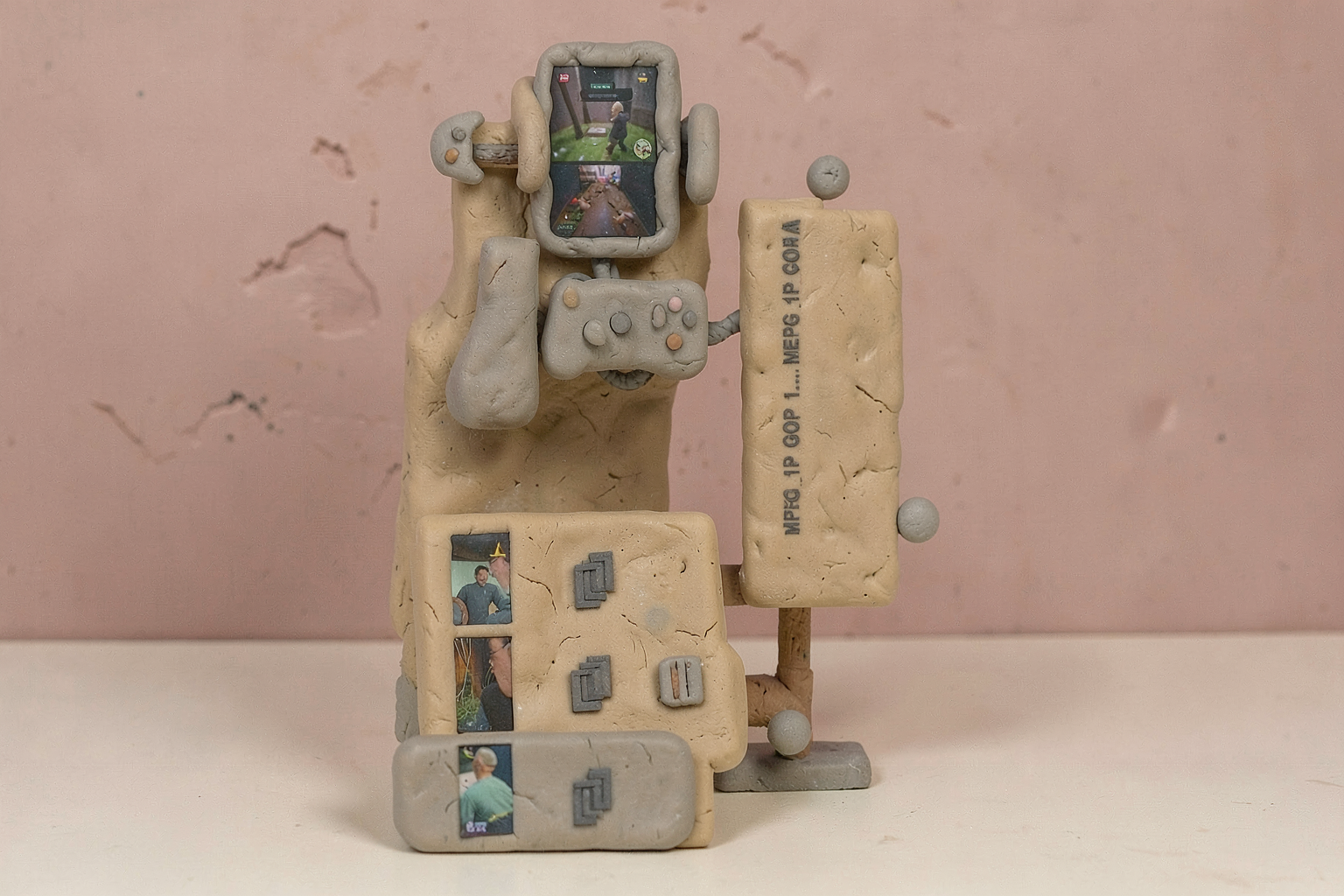
Device plus Gaming User Device carry the practical point: A game server initiates a gameplay session with video feeds from multiple virtual cameras.

First, the setting
Many people play video games after work, at home, or with friends online. In games that show movement through a character's eyes, the screen can sweep, turn, and accelerate while the player's own body stays still. That mismatch can leave some people feeling uneasy, so designers pay attention to how motion is presented.
A player wears a headset or watches a display while holding a controller. As the scene shifts between viewpoints or follows action, the image moves across the screen and the controller responds to the player's hands. A nearby friend might see the player turn their head, pause, or adjust how they are playing.
What changes in this design
A player would ordinarily receive a game video stream showing an in-game camera view, while their own controls direct play.
Here, the server also calculates virtual inertial measurement unit data, meaning calculated information about motion, and combines it with one camera's video stream before sending it to the player.
The record connects camera video, player controls, and calculated motion information to one stated goal: addressing motion sickness during a gameplay session.
Camera Views and Controls
Why would a gameplay session treat a camera view and a player's controls as part of the same conversation? First notice the contrast. The broad version of the task is familiar: a game presents a view while a player supplies inputs. By contrast, US20260263922A1, published September 10, 2026 as Mitigating Motion Sickness For Players In Gameplay Sessions, describes a server working with video feeds from multiple virtual cameras, software viewpoints within the game setting, while dynamically altering game-controlling user-device inputs. Then give the terms ordinary handles. Virtual inertial measurement unit parameters are values that represent motion-related information in the virtual setting, while a bitstream is an encoded flow of video data. That contrast made me look twice because it opens a question about how a shifting view and a shifting control signal might be kept legible together. That arrangement is less like a camera merely watching and more like a stage manager keeping the next cue within reach.
The Stream's Joined Pieces
With those terms in place, the picture becomes more concrete without getting larger than the filing permits. A game server initiates a gameplay session. Multiple virtual cameras provide video feeds. A gaming user device receives a transmitted stream. Those are small practical steps, but they prevent the view from being treated as the whole event. The order helps you notice a session, a source, a route, and a recipient. You can picture several camera perspectives being available at the server before anything is sent, rather than treating the eventual view as a lone, self-explanatory image. That is an observable distinction, not a claim about what any player experiences. The design question sits in the company the view keeps: what nearby information is considered important enough to remain attached as the session progresses? The resulting picture has the air of a careful librarian: every item is kept beside the thing that makes it meaningful.
That picture points directly to the mechanism. The server dynamically alters the game-controlling user-device inputs, calculates the virtual inertial measurement unit parameters, multiplexes a first camera bitstream with those parameters, and transmits the resulting stream to the gaming user device. Multiplexing means combining separate kinds of data into one stream for transmission; it is the joining operation at the center of the described sequence. That choice gives the outgoing item two inspectable aspects: the camera video and the accompanying calculated parameters. It does not ask you to treat the latter as a separate afterthought. Before that joining point, video and virtual motion-related information can be thought of as distinct materials. After it, the first camera bitstream and the calculated parameters travel in the same outgoing stream. That is less like handing over a finished view and more like sending a view with its small clipboard attached.
Judgment at the Handoff
Once the joining sequence is clear, the purpose can be held at the right size. The title frames the arrangement around mitigating motion sickness for players in gameplay sessions. The supplied arrangement gives a way to inspect what is being connected, but it does not itself establish a particular result, condition, or experience. That is a different question from whether the arrangement guarantees anything. The filing describes an arrangement, and that is the scale at which it can be considered here. That restraint matters because a design can reveal priorities through its handoffs as surely as through its visible surface. Here, the described handoff keeps a first camera bitstream beside calculated virtual inertial measurement unit parameters. It puts a plain systems question in front of you: when a changing view is delivered, which related context must accompany it for the situation to remain intelligible? The question is bounded, but it is not small.
That bounded question travels beyond this gameplay session. One transferable observation is to separate a visible output from the context that helps a person interpret change: an image may be present, yet the relevant companion information may be elsewhere. Another is to inspect the instant before transmission or handoff, because that is where a system decides whether related material stays linked or becomes scattered. Those observations are deliberately practical. They apply whenever a system presents a result while sending context through a different path, whether context is joined or apart. In this filing, the link is the multiplexed stream carrying a first camera bitstream and calculated virtual inertial measurement unit parameters. The choice is concrete enough to inspect without turning it into a grand promise. I think the useful discipline is modest: notice the pairing, give each part a plain name, and resist treating a polished output as the whole system.
With those observations in hand, try a small experiment the next time you encounter a changing view in any system. Before asking whether the view looks convincing, ask what information moved with it and what information was left behind. Then make the contrast observable: first imagine the view arriving alone, and then imagine it arriving with the motion-related context the system has chosen to place alongside it. Write down only what is visibly present in each version and only what travels beside it. The exercise is deliberately smaller than deciding whether the system is good. You do not need to infer a result to notice that the second picture gives you more to inspect. My takeaway is to watch the handoff, identify the companions, and ask whether their pairing changes the judgment you can make. That is the space this patent leaves open: a specific arrangement you can examine, followed by a question you can carry into the next design you encounter. For a final pass, sketch the two versions side by side and note what becomes inspectable only when the companions travel together.
The record, briefly. US20260263922A1, “Mitigating Motion Sickness For Players In Gameplay Sessions” A game server initiates a gameplay session with video feeds from multiple virtual cameras, dynamically alters game-controlling user-device inputs, calculates virtual inertial measurement unit parameters, multiplexes a first camera bitstream with those parameters, and transmits the stream to the gaming user device.
More angles on this
- When a Rounded Base Takes the HandoffAnother reading from the same A63F classification family, card, board, or roulette games.
- When the Board Carries the MoveAnother reading from the same A63F classification family, card, board, or roulette games.
- CPC A63F: Card, board, or roulette games; indoor games using small moving playing bodies; video games; games not otherwise provided forThe official classification family this record was filed into, published in the USPTO Cooperative Patent Classification scheme.
- When Green Measurements Leave Room for JudgmentAnother reading from the neighbouring A63B classification family, apparatus for physical training, gymnastics, swimming, climbing, or fencing; ball games; training equipment.
- When a Tableware Cabinet Takes On More of the ChoreAnother reading from the wider A47L classification family, domestic washing or cleaning ; suction cleaners in general.
Read around this one:Public patent recordUSPTO published figure