Machines
When a Treadmill Hands Control to the Rail
The central pairing is System with Module: A treadmill includes a running platform. It keeps the central design choice visible.

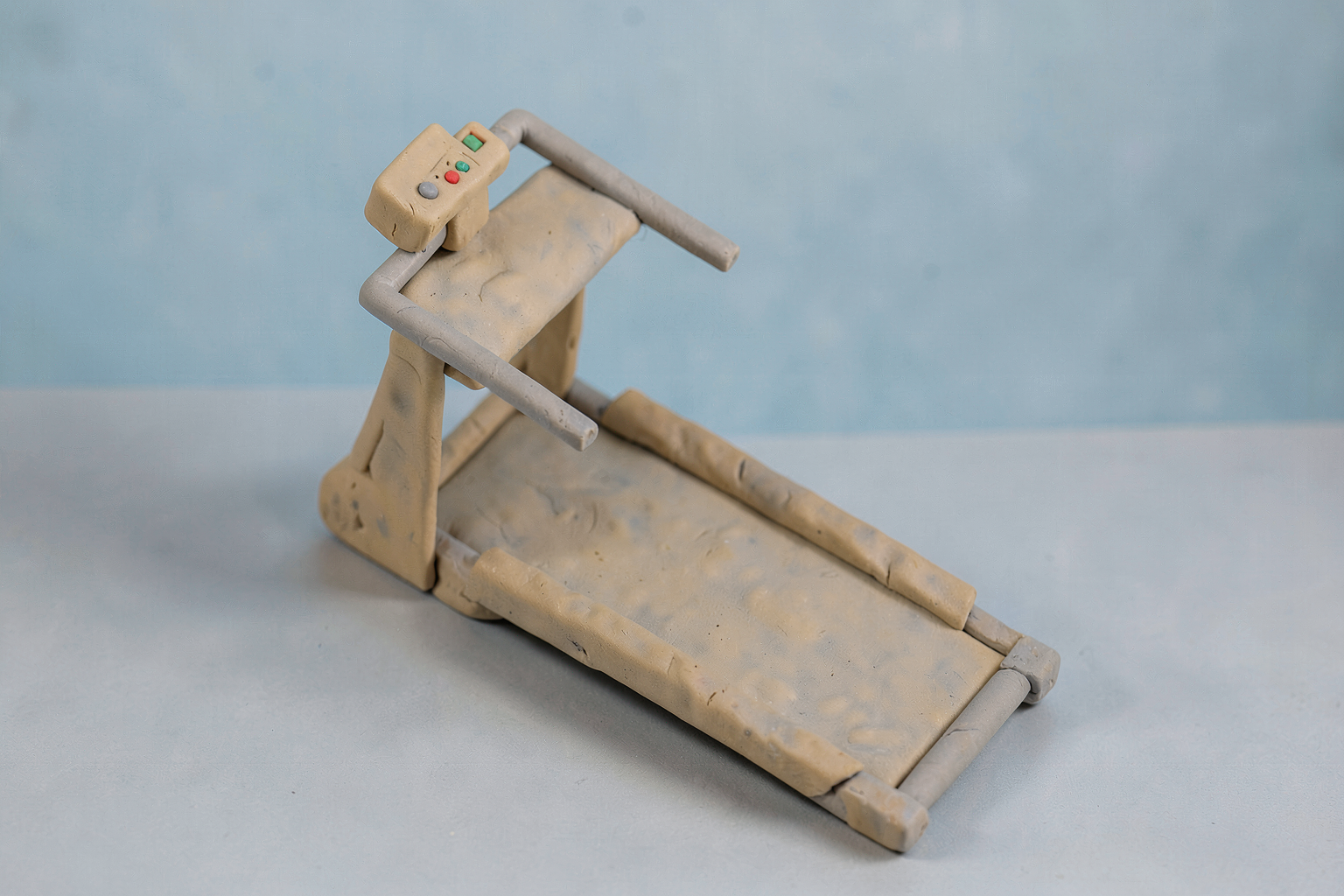
First, the setting
Many people use indoor exercise equipment when they want to walk or run without going outdoors. In homes, shared fitness rooms, and rehabilitation settings, a moving belt gives a person a steady place to exercise while walls, weather, and nearby activity stay the same.
In a fitness room or at home, a person steps onto a belt and grips the handrail while the surface moves beneath their shoes. Nearby, someone may see a display or controls at the rail, hear the drive system, and watch the walker adjust their pace.
What changes in this design
A reader might expect a treadmill's rail-mounted controls to use a cable running through the handrail or its upright supports to reach the machinery below.
This treadmill mounts a control component on the handrail and has it wirelessly control the drive system. Its handrail can therefore use column bodies without cables.
That difference is worth knowing because the controls remain on the handrail without requiring their connection to run through the column bodies. Details such as wireless range and battery life are not stated.
Handrail Control Comes Into View
Ordinary objects earn their place in human routines by meeting the hand at the right moment. That is the arrangement I notice in US20260263873A1, published September 10, 2026, under the title Treadmill With Wireless Control Component: a treadmill whose running platform and handrail set the familiar outline while a control component sits on the rail. The image arrives before the terminology does - a belt below, a rail above, and one small decision about where an instruction begins. What made me look twice was not a promised result, but the timing implied by that location. A routine can feel seamless simply because the next responsibility is waiting near the gesture that calls for it.
That first image needs firmer names if the handoff is going to mean anything. The filing calls the surface a running platform and separately names the running belt; it calls the rail a handrail, which is where the control component is mounted. A control component is the named part that wirelessly controls the drive system, the system identified as receiving that control within the arrangement. The filing also names a case and a battery module, without asking this reader to assign them extra jobs. It says the handrail can use cable-free column bodies - the upright rail support pieces described as cable-free - so two routes stay visible: the route by which control travels and the physical structure that holds the rail.
Wireless Handoff and Its Burden
Once those roles are separated, the described mechanism is modest enough to state without dressing it up. The control component is mounted on the handrail and wirelessly controls the drive system; the running platform, running belt, case, and battery module belong to the same treadmill arrangement. The physical details are few, which makes their order more legible rather than less. Control appears at the rail, then reaches the named drive system by wireless control, while the handrail can use cable-free column bodies. That placement feels less like a console arriving to supervise a walk and more like a small stage manager waiting at the rail. The image is restrained, but it keeps the sequence in view: handrail, control component, wireless handoff, drive system.
Because that sequence is the thread, purpose enters as a design question, not a scoreboard. I keep returning to a simple systems question: at what moment should an instruction leave the person-facing part of an object and enter the part named to receive it? The patent supplies an arrangement, while the answer here is an editorial one about attention. The distinction is quiet but useful: wireless control is less like a cord changing jobs and more like a message taking a different route. One transferable observation is to place the point of command where the handoff can be understood. Another is to keep the physical support and the communication path conceptually separate when a design explicitly names both. Those observations do not claim an outcome; they make the arrangement easier to see.
Those observations prepare the comparison that earns its place. In a broad mental picture of a treadmill, responsibility can collect in an unspecified control area, as if the machine keeps a clipboard somewhere offstage and asks the runner to report there. This filing offers a narrower picture without setting up a contest: a control component is mounted on the handrail, controls the drive system wirelessly, and belongs with a handrail that can use cable-free column bodies. The burden shifts: less like the platform reporting upward to a fixed panel, more like the rail accepting the question when the hand is already there. The contrast is about who carries the burden of the handoff in the picture, not evidence that one arrangement is better than another.
A Treadmill's Small Routing Decision
That bounded contrast is why I think the published record deserves a moment of your attention. It does not require a grand theory of treadmill design. Instead, it lets a familiar outline become a small trace of responsibility: platform and belt below, handrail and control component above, then wireless control moving toward the drive system. If you keep two observations from it, let them be practical ones: identify the handoff before judging the whole assembly, and do not confuse the pathway of a command with the structure beside it. The case and battery module remain named parts of the arrangement, yet the editorial focus stays on timing rather than assigning those parts a story the filing does not give. US20260263873A1 leaves a memorable but limited image - a treadmill whose rail is described not only as part of the frame, but as the place where the control component waits.
The record, briefly. US20260263873A1, “Treadmill With Wireless Control Component” A treadmill includes a running platform, handrail, control component, running belt, drive system, case, and battery module. The control component is mounted on the handrail and wirelessly controls the drive system, while the handrail can utilize cable-free column bodies.
More angles on this
- The Restless Padding Problem and the Ring of TensionAnother reading from the same A63B classification family, apparatus for physical training, gymnastics, swimming, climbing, or fencing; ball games; training equipment.
- Where Upward Assistance Enters an Exercise-Machine LiftAnother reading from the same A63B classification family, apparatus for physical training, gymnastics, swimming, climbing, or fencing; ball games; training equipment.
- CPC A63B: Apparatus for physical training, gymnastics, swimming, climbing, or fencing; ball games; training equipmentThe official classification family this record was filed into, published in the USPTO Cooperative Patent Classification scheme.
- Inside toolAnother reading from the neighbouring A63H classification family, toys, e.g. tops, dolls, hoops or building blocks.
- The Fuse That Gets Told When to Blow: A Fire Prevention Filing for Electronic Control UnitsAnother reading from the wider A62C classification family, fire-fighting.
Read around this one:Public patent recordUSPTO published figure