Machines
Why the Nozzle Stops Short of the Intake Plane
Assembly and System: An atmospheric effects assembly can include an air amplifier with an intake plane and a fluid injection assembly with a nozzle and mounting bracket.

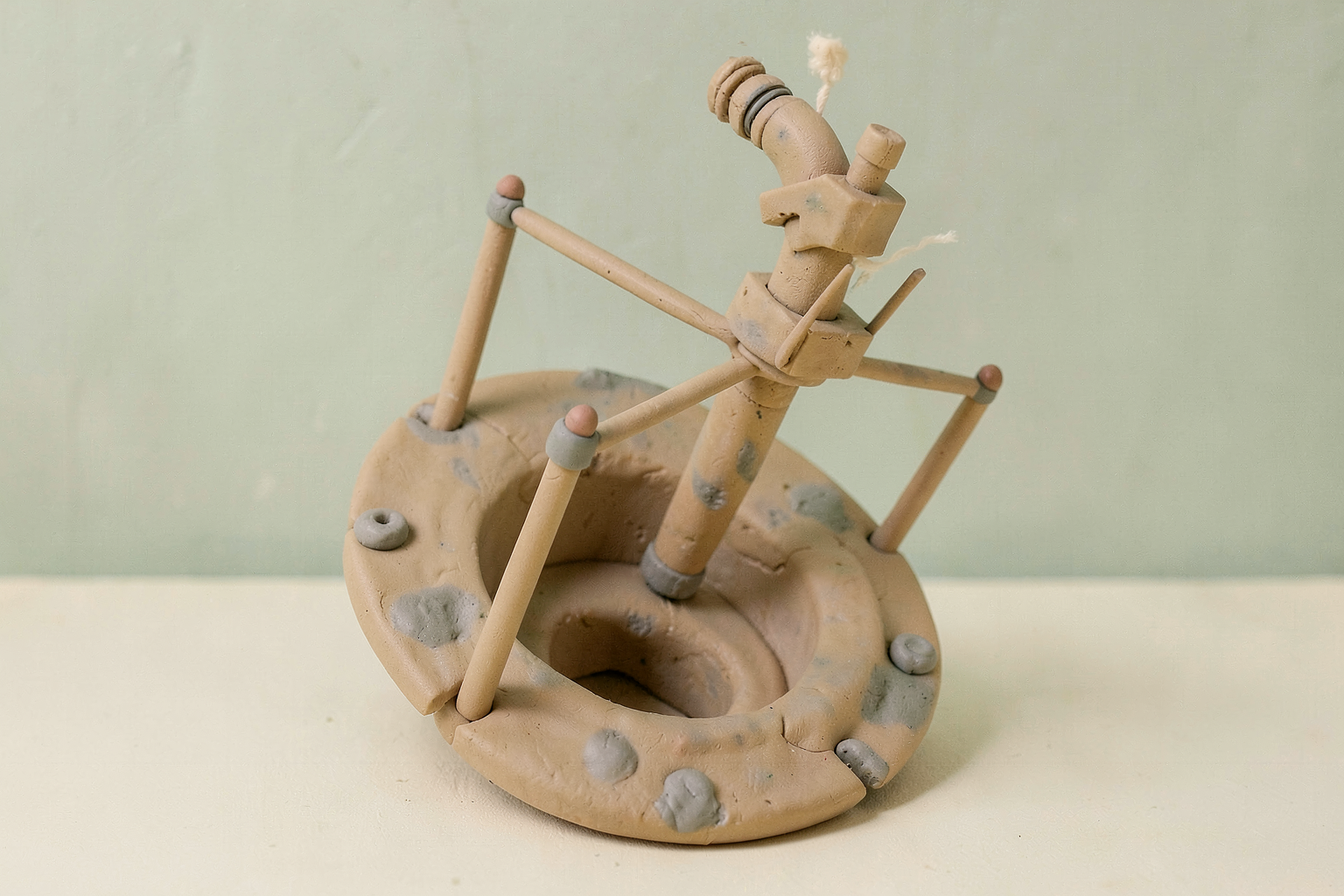
First, the setting
Live events, film sets, exhibits, and themed spaces often shape the feel of a room with moving air, mist, or fog. People work on these effects because light, sound, and air can make a place feel dramatic, calm, mysterious, or immersive to someone walking through it.
A technician may position a compact unit behind a stage curtain or inside a themed display. Air moves through a housing while a small nozzle releases fluid into the airflow. Nearby visitors may see a drifting haze catch the lights, or feel a cool moving current.
What changes in this design
When adding fluid to an air-moving device, a reader might expect the nozzle to sit at the opening where air enters.
Here, a fluid injection assembly includes a nozzle and mounting bracket, and the nozzle stays spaced apart from the air amplifier's intake plane while injecting fluid into it.
The key detail is not just that fluid is added, but that a gap remains between the nozzle and intake plane. That identifies what this setup is concerned with.
The Gap Before the Intake
Why, in a routine that asks a nozzle to add fluid to an air amplifier, would you leave space before the intake? The ordinary assumption is to treat the handoff as a touch point: bring the nozzle right up to the intake and regard the shortest route as the whole idea. Yet the published record for US20260263960A1, dated September 10, 2026 and titled Fluid Injection Assembly And Systems Including The Same, makes a smaller arrangement worth pausing over. It describes an atmospheric effects assembly in which the nozzle is spaced apart from the air amplifier's intake plane. That small interval is less like a missing connection and more like a stage manager holding a cue. The contrast made me look twice because it shifts attention from the broad task, injecting a fluid, to the exact relationship between the parts that carry it out. You can picture the scene without adding unseen machinery: an air amplifier, an intake plane at its intake, and a fluid injection assembly containing a nozzle and mounting bracket. The filing gives a placement, not a drama, and that restraint is why the placement deserves your attention.
The Nozzle and Its Bracket
That picture needs a few terms before the design can be read usefully. An atmospheric effects assembly is the larger assembly named in the patent. An air amplifier is the component the filing identifies, while its intake plane is the plane identified at that component's intake. The fluid injection assembly is the other named assembly, and it includes both a nozzle and a mounting bracket. The nozzle is the part through which the filing describes fluid being injected; the mounting bracket is the part named with it in that assembly. The mounting bracket has the air of a restrained committee member, attending to its place in the arrangement. These labels matter because they prevent a familiar word such as intake from becoming an invitation to invent a larger story than the published description supplies.
With those names fixed, the correction can be stated without mystery. The filing describes the nozzle as spaced apart from the intake plane in order to inject a fluid into the air amplifier. Nothing in the stated fact supplies a distance, a material, a flow pattern, or a result beyond that arrangement and injection. That narrowness is not a deficiency for an editorial reader. It is a useful boundary: the notable fact is not an asserted outcome, but the decision to preserve separation where an ordinary sketch might erase it. The arrangement is less like a single gesture and more like a small handoff between two parts. Once you notice that handoff, the bracket, nozzle, and plane stop reading as a pile of labels and begin reading as a deliberately placed relationship.
What a Small Offset Reveals
Because the stated mechanism is limited, its purpose should remain limited too. The design directs attention to a nozzle positioned apart from a defined intake plane while fluid is injected into the air amplifier. The before-and-after can be observed on a simple diagram: before, the nozzle and intake are treated as though they must meet; after, the nozzle and intake plane remain distinct, with separation made visible. That is a modest correction, but it changes the question you ask of the drawing. Instead of asking only what enters what, you ask where each named part is located in relation to the next. The patent does not supply every answer that question might invite, and it is better not to manufacture them.
From that before-and-after, two transferable observations follow. First, when one component supplies something to another, naming a reference boundary can matter as much as naming the two components. Here, the intake plane gives the arrangement a specific point of comparison rather than leaving the word intake as a vague destination. Second, when a routine includes a mounting relationship, look for the relation it makes visible before assuming the relation is merely incidental. I think that is the worthwhile editorial pressure in this filing: location and separation can be the subject of attention even when the visible task sounds ordinary. The small gap is not decoration. It is the bounded detail that keeps a routine from collapsing into a shorthand sketch.
That takeaway returns you to the opening question with a more practical answer. You do not need to suppose an unstated benefit to see why the gap matters on the page; you only need to notice that the filing distinguishes injection into the air amplifier from touching its intake plane. The distinction invites care in any systems diagram where a broad action hides a positional instruction. Next time you encounter a routine that appears to be one step, draw the supplying part, draw the receiving boundary, and leave a visible interval between them. Then label only what you actually know, and see whether the routine still looks as simple as it first did.
The record, briefly. US20260263960A1, “Fluid Injection Assembly And Systems Including The Same” An atmospheric effects assembly can include an air amplifier with an intake plane and a fluid injection assembly with a nozzle and mounting bracket, the nozzle spaced apart from the intake plane to inject a fluid into the air amplifier.
More angles on this
- CPC A63J: Devices for theatres, circuses, or the like; conjuring appliances or the likeThe official classification family this record was filed into, published in the USPTO Cooperative Patent Classification scheme.
- When Support Height Becomes the QuestionAnother reading from the neighbouring A63B classification family, apparatus for physical training, gymnastics, swimming, climbing, or fencing; ball games; training equipment.
- A Different Route for the Same DoseAnother reading from the wider A61K classification family, preparations for medical, dental or toiletry purposes.
- The Hinge Between a Winning Card and the Next ChoiceAnother reading in the same Machines category on this site.
Read around this one:Public patent recordUSPTO published figure