Objects
Word Line Charge Integration and the Discipline of Selective Attention
Micron's latest ferroelectric-memory filing shows why a 23-year-old promise still depends on painstaking work at the edge of a memory array.

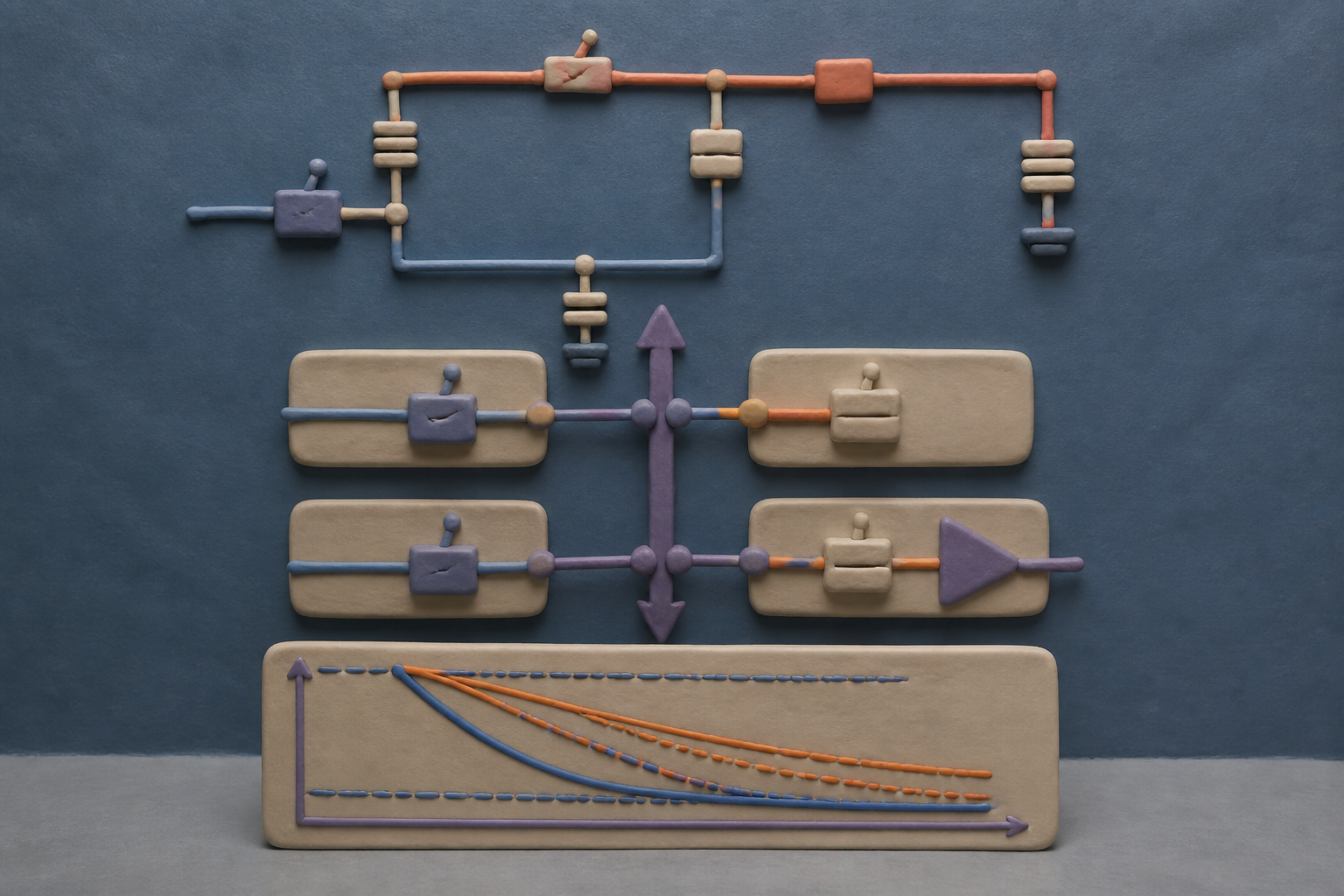
What changes in this design
Without this abstract, a reader might simply picture charge being read from memory cells, without thinking about selected electrical routes being activated beforehand.
Instead, a word line and selected groups of digit lines are activated to bring together charge from coupled memory cells before sensing parts detect the related charge.
It helps a reader see the central idea: some routes are selected, charge is brought together from linked cells, and sensing comes afterward.
The 2003 samples
In March 2003, I can imagine the appeal of a 4Mb or 8Mb ferroelectric memory sample: 70ns reads and writes, 3.0V operation, and a claim of more than 100 billion write cycles. Hynix presented those chips as a way to combine density, speed, and non-volatility in one place. That formula has barely aged. Memory that wakes instantly, retains data without power, and does not force us to choose between fast working memory and durable storage is still what we want.
That old announcement makes today's patents easier to read, which is why I started with it. The important question is not whether ferroelectric memory can store a bit. It plainly can. The question is whether enough tiny cells can be made, read, and kept reliable at a price and yield that turn a demonstration into ordinary hardware.
The 32Gb paper
Twenty years later, Micron showed a much larger result at IEDM 2023: a 32Gb, dual-layer, 3D-stacked ferroelectric macro built with 48nm-pitch 1T1C cells and 5.7nm HZO capacitors. Reported testing ran above 10^12 cycles at 1.5V, across -40 to 95 C, with more than ten years of retention. Those are serious laboratory numbers, and I don't dismiss them.
But I also don't treat a conference result as a product launch. The industry review calls Micron's emerging-memory work research and exploratory, and identifies ferroelectric RAM as less commercially advanced than rival forms. Samsung's 28nm STT-MRAM, by contrast, has been in mass production since 2019. That difference matters to me: a strong device result and a scalable business are not the same accomplishment.
The unequal cells
For me, that is where US20260253628A1 enters the story. Published on August 27, 2026, it is a continuation of a Micron application with priority back to December 22, 2022. Its concern is not a new memory category. It is the awkward last mile of reading one: cells connected along a word line can sit at different distances from the circuitry that drives them, so their charge has different amounts of time to build before sensing begins.
The proposed timing is simple in outline. Select the word line and subsets of digit lines, let coupled cells integrate charge, then turn the word line off before the sense components act. That extra sequencing is intended to give cells near and far from the driver equal integration time. The proposed timing reads to me as calibration work, not a promise that the long-awaited memory has crossed the finish line.
Two older solutions
The parent publication, released in June 2024, carried the same basic mechanism, so I found that this 2026 filing extends a line of work rather than announcing a sudden turn. Its cited history reaches further. A 2007 publication described a self-timer that stopped ferroelectric sensing when a reference signal reached a threshold. That is another way of controlling integration duration, and it traces back to a 2002 application.
Another cited publication used shared-line charge coupling for the opposite job: destroying data quickly. It activated many word lines so cells on a shared bitline would merge charges and scramble their contents. That contrast is clarifying to me. The physical behavior here is not mysterious or newly discovered. What remains hard is turning known behavior into a precise, repeatable read operation across a large array.
The part worth watching
The evidence I'll watch for is work that has escaped the conference and patent trail: a shipping part, a qualified process, or clear yield and read-margin data. A 2025 industry report points to the gaps still facing ferroelectric memory, including fatigue, imprint, breakdown, thermal budgets, and array-level sensing problems. A continuation can be a useful signal of engineering persistence. It is not, by itself, evidence that the manufacturing problems are solved.
Until that evidence appears, I think this filing deserves a modest reading. It shows engineers shaving error out of a real problem, cell by cell and line by line. That work may be necessary for ferroelectric memory to arrive. But 23 years after the first megabit-scale commercial promise, necessary is not the same as imminent.
Sources
Reporting for this piece drew on the published filing and the references below.
- US20260253628A1 - official USPTO publication record
- Word Line Charge Integration - US Patent Application 20260253628
- Word Line Charge Integration - US Patent Application 20240212736
- Memory Device, Circuits and Methods for Reading a Memory Device - US Patent Application 20070091664
- Progress of emerging non-volatile memory technologies in industry
- Hynix commercializes megabit-class FeRAM
- Ferroelectric memory industry insight
The record, briefly. US20260253628A1, “Word Line Charge Integration” Methods, systems, and devices describe a memory device whose word line and subsets of digit lines are selectively activated to integrate charges of coupled memory cells, after which sense components sense the associated charges.
More angles on this
- A Sideways Reading of Split StaircasesAnother reading from the same G11C classification family, static stores.
- CPC G11C: Static storesThe official classification family this record was filed into, published in the USPTO Cooperative Patent Classification scheme.
- Liquid Cooling Heat Dissipation Device For Multi-Disk Drive System Marks a Pause Worth NoticingAnother reading from the neighbouring G11B classification family, information storage based on relative movement between record carrier and transducer.
- When a Vehicle Notices Something, Who Decides What the Moment Means?Another reading from the wider G06V classification family, image or video recognition or understanding.
- When a Container Knows the Difference Between Open and FinishedAnother reading in the same Objects category on this site.
Read around this one:Public patent recordUSPTO published figure